Jiayingguan
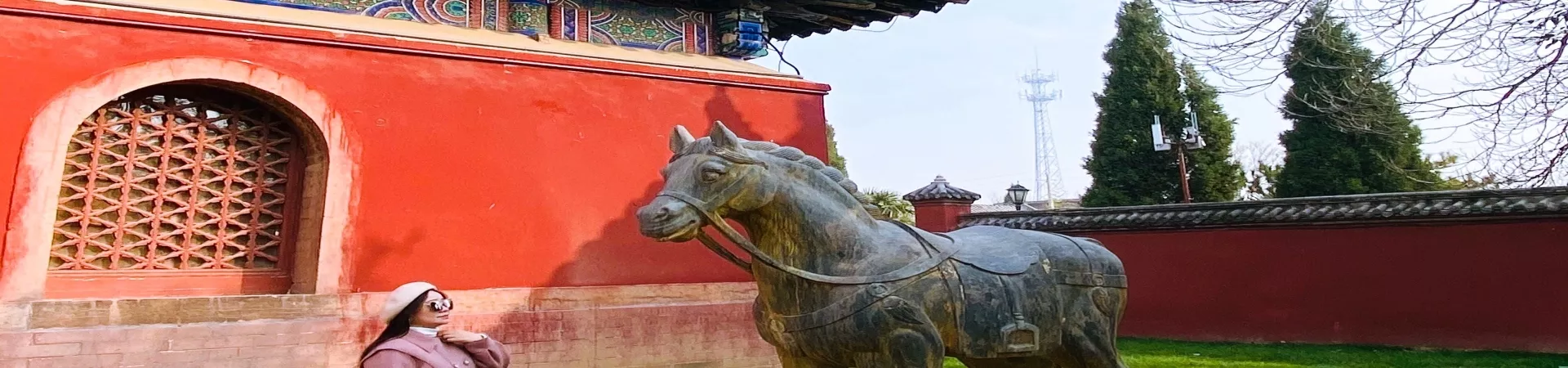
Jia Ying Guan: The "Little Forbidden City" of the Yellow River
Nestled in the ancient heart of China's Central Plains, approximately 12 kilometers southeast of Wuzhi County in Jiaozuo City, Henan Province, lies the magnificent Jia Ying Guan (嘉应观). This sprawling complex, covering an area of 9.3 square kilometers, stands as a monumental testament to imperial reverence for the mighty Yellow River and the tireless efforts to tame its waters. Constructed in 1723 under the decree of the Yongzheng Emperor of the Qing Dynasty, its primary purpose was dual in nature: to serve as a grand temple for worshipping the River God (Longwang, or the Dragon King) and to honor the historical figures who made significant contributions to flood control and river management throughout Chinese history. More than just a temple, Jia Ying Guan uniquely integrates the functions of a palace (gong), a temple (miao), and an administrative yamen (ya) into one cohesive architectural masterpiece. Its layout and majestic style so closely resemble those of Beijing's Forbidden City that it has earned the enduring and evocative nickname, the "Little Forbidden City."
An Architectural Homage to Imperial Power and Hydraulic Mastery
The architecture of Jia Ying Guan is its most immediate and striking feature, deliberately echoing the grandeur of the imperial seat in Beijing to underscore the state's supreme authority over the nation's waterways.
- The Mountain Gate (Shan Men): The journey begins at the imposing Mountain Gate, the main entrance that immediately sets the tone with its robust structure and intricate detailing, signaling the importance of the complex within.
- The Imperial Stele Pavilion (Yu Bei Ting): A centerpiece of the complex, this pavilion houses a massive, awe-inspiring stone stele erected by the Yongzheng Emperor himself. The inscriptions detail the purpose of the temple's construction, imperial edicts concerning river management, and serve as a permanent record of the emperor's personal commitment to controlling the Yellow River—a task crucial for national stability and agricultural prosperity.
- The Hall of River Control Heroes (Zhi He Gong Chen Dian): This hall is the very soul of Jia Ying Guan's commemorative purpose. Inside, statues and tablets pay homage to legendary figures from Chinese history renowned for their hydraulic engineering feats, most notably the Great Yu, who, according to myth, tamed the primordial floods. It is a hall of fame for water conservancy, uniquely blending history, legend, and statecraft.
- The Central Grand Hall (Zhong Da Dian): As the main ceremonial hall, this structure is the architectural and spiritual core of the complex. Its soaring roofs, brightly colored glazed tiles, and detailed dougong (wooden bracket) systems exemplify high Qing-era palatial architecture. It was here that major state-sponsored rituals to the River God were conducted.
- The Yu Wang Ge (禹王阁): Dedicated to Yu the Great, this multi-storied pavilion further emphasizes the cult of this paramount cultural hero. Its presence reinforces the narrative that effective river governance is a virtuous, sage-like pursuit, directly linking the Qing emperors to a mythical, benevolent past.
Practical Information for Your Visit
To fully appreciate the historical and architectural significance of Jia Ying Guan, planning your visit with the following details in mind is essential.
Location and Transportation: Jia Ying Guan is situated in Wuzhi County, under the administration of Jiaozuo City, Henan Province. It is about 35 kilometers from downtown Jiaozuo and approximately 12 kilometers from the center of Wuzhi County. Visitors can reach Jiaozuo by high-speed train or intercity bus from major cities like Zhengzhou. From Jiaozuo, taxis or local buses provide access to the site. While public transport is available, hiring a taxi or booking a ride-sharing service for the final leg from Jiaozuo or Wuzhi offers greater convenience and flexibility.
Admission and Opening Hours: The standard admission fee for the complex is 55 Chinese Yuan (RMB). The site is open to visitors daily from 8:30 in the morning until 17:00 in the afternoon. This schedule generally remains consistent throughout the year, from January 1st to December 31st. It is always advisable to confirm the latest timings before your visit, as special circumstances or maintenance could occasionally lead to adjustments.
Suggested Duration and Contact: To thoroughly explore the main halls, courtyards, and exhibits at a comfortable pace, a visit of 3 hours or more is recommended. This allows time to absorb the intricate details of the architecture, contemplate the historical narratives, and appreciate the serene atmosphere of the complex. For any specific inquiries regarding group visits, special events, or current conditions, you can contact the site administration at 0391-7681095.
The Enduring Legacy: More Than Just a Temple
Jia Ying Guan transcends its physical form as a collection of beautiful buildings. It is a profound cultural symbol. It represents the centuries-long, often desperate struggle between human civilization and the unpredictable power of the Yellow River, a river that has been both the cradle and the scourge of Chinese culture. The construction of such a grandiose complex by an emperor highlights the paramount political and economic importance of water conservancy in pre-modern China. The integration of the administrative yamen within the temple grounds physically demonstrates how spiritual supplication and practical bureaucratic management were intertwined in the governance of natural forces. Therefore, a visit to Jia Ying Guan is not merely an architectural tour; it is an immersion into a central theme of Chinese history—the attempt to achieve harmony between humankind and the natural world through a combination of ritual, commemoration, engineering, and imperial will. Walking through its quiet courtyards and grand halls, one walks through the narrative of China's relationship with its most vital and temperamental river.