Hailongtun
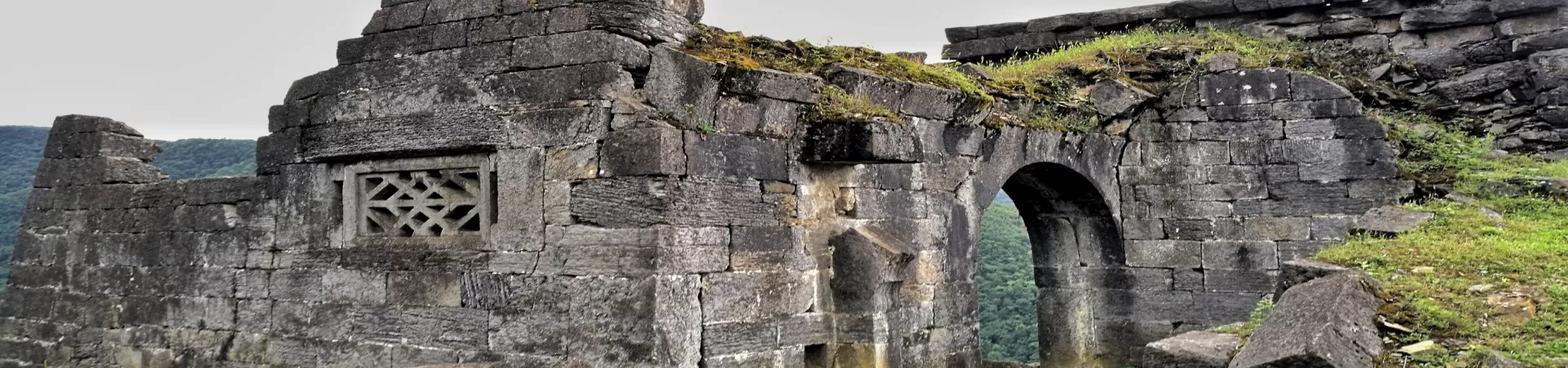
Subtitle: A Journey Through Time: Unveiling the Medieval Majesty of Hailongtun Fortress
Introduction: A Sentinel in the Mist Nestled amidst the rugged landscape approximately 30 kilometers northwest of Zunyi City in Guizhou Province, China, lies the formidable Hailongtun Fortress. This site stands as a monumental testament to medieval military architecture and regional power, uniquely blending extensive defensive structures with palatial complexes. Recognized as one of the best-preserved medieval castle sites in China and indeed across Asia, Hailongtun offers visitors a profound journey into a pivotal chapter of Chinese history, where every stone whispers tales of ambition, strategy, and resilience.
I. The Unconquerable Fortress: Strategic Design and Natural Defense A. A Landscape Forged for War The genius of Hailongtun begins with its extraordinary natural setting. The fortress is perched upon a solitary peak, surrounded by a ring of mountains. Its distinctive shape, often compared to a slender-necked gourd, provided a formidable natural advantage. This topography was masterfully integrated into the fortress's design, creating a nearly impregnable stronghold.
B. The Moat of Cliffs and Rivers Adding to its defensive prowess, the northern, eastern, and southern flanks of the fortress are bounded by the "Baisha River," a primary tributary of the Xiangjiang River. These sides feature sheer cliffs that drop dramatically to the water below, forming a natural moat of staggering scale. This formidable barrier made direct assault from these directions virtually impossible, forcing any potential attacker to confront the meticulously engineered man-made defenses.
II. Architectural Marvel: Walls Within Walls A. The Imposing Ramparts The most striking feature of Hailongtun is its complex, multi-layered defensive system. The fortress is encircled by not one, but three massive walls that snake and wind along the mountain's contours. Their majestic, undulating silhouette against the skyline evokes comparisons to a miniature Great Wall, a testament to the immense labor and strategic planning invested in its construction. These walls, built from local stone, were designed to thwart every advance, with each successive level presenting a new challenge to besieging forces.
B. Layered Defense: From Moon City to the Inner Sanctum Within this grand scheme, the defense was further segmented into specialized zones. The outermost protections included structures like the "Moon City" (Yuecheng) and an earthen rampart, which served as advanced buffer zones to absorb and disrupt the first waves of an attack. Progressing inward, the defenses grew more concentrated and formidable. This layered approach—from the broad outer works to the tightly guarded inner citadel—showcases a sophisticated understanding of medieval siege warfare and perimeter defense.
III. A Dual Identity: Military Stronghold and Administrative Center A. Beyond the Battlements What truly sets Hailongtun apart from purely military castles is its dual function. It was not merely a garrison but also a combined political and administrative nerve center for the local Bozhou Tusi (chieftain). Within the securest parts of the fortress, the remains of palatial buildings have been discovered. This indicates that Hailongtun served as a secure seat of power, where the chieftain could govern, hold court, and reside in safety during times of unrest. This fusion of martial might and civil authority within a single, fortified complex is rare and highlights the unique socio-political structure of the Tusi system in southwestern China.
B. The Legacy of the Tusi System The fortress is intrinsically linked to the history of the Yang clan, the Tusi rulers of Bozhou. Its most famous and final chapter was written during the massive Ming dynasty campaign against the Bozhou rebellion in 1600. Hailongtun became the last stand for the Yang forces. After a protracted and brutal siege, the fortress fell, marking the end of the rebellion and the beginning of the direct administration of the region by the central Ming government. Thus, the stones of Hailongtun bear witness to the climax of a conflict that reshaped the region's integration into imperial China.
IV. Planning Your Visit: Practical Information A. Ticket Information and Opening Hours To fully appreciate the scale and history of Hailongtun, planning is essential. The site is open year-round, but operating hours vary seasonally. * Winter Hours (November 1 - March 31): 09:00 - 17:00, with last entry at 16:00. * Summer Hours (April 1 - October 31): 08:30 - 18:00, with last entry at 16:30. Admission is required, with standard adult tickets priced around 65 RMB. Concession tickets (e.g., for students) are approximately 32.5 RMB. It is always advisable to verify the latest pricing and hours directly with the site before your visit, as details are subject to change.
B. Making the Most of Your Tour The general visit duration is estimated between 1 to 3 hours, depending on your pace and interest. The terrain involves significant climbing and walking on ancient stone paths and steps, so wearing sturdy, comfortable footwear is highly recommended. Be prepared for changing weather conditions in the mountainous area. As you explore the sprawling walls, gateways, and foundations, consider engaging a local guide or utilizing audio guides to fully comprehend the strategic purpose of each structure and the dramatic history that unfolded there. The onsite museum can provide valuable context through artifacts and exhibits before you embark on your walk through the ruins.
Contact and Further Details For the most current information, you may contact the site at 0851-23270077. A visit to Hailongtun is more than a scenic hike; it is an immersive exploration into medieval military engineering, a pivotal moment in China's expansion, and the enduring legacy of the Tusi culture. It stands as a powerful and evocative monument where history is etched into the very landscape.