And your building
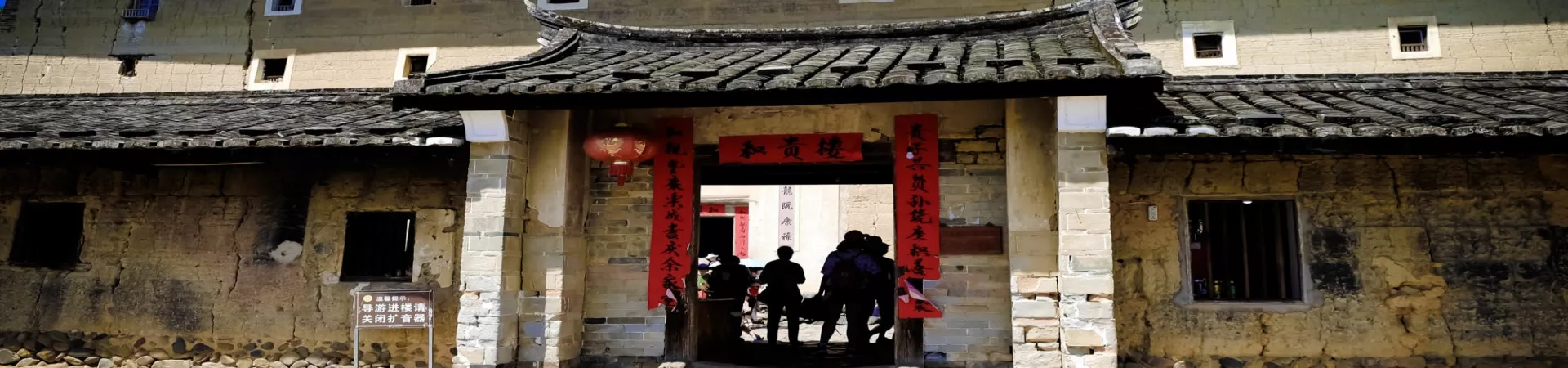
Subtitle: A Marvel of Engineering and Resilience in the Heart of Fujian's Tulou Region
1. Introduction to Hegui Building Nestled within the scenic Yunshuiyao Ancient Town in Zhangzhou, Fujian Province, Hegui Building stands as a remarkable testament to the ingenuity and perseverance of the Hakka people. Among the numerous earthen buildings (Tulou) that dot the mountainous landscape of Fujian, Hegui Building distinguishes itself not only through its imposing stature but, more fascinatingly, through the incredible foundation upon which it was constructed. This architectural wonder invites visitors to step back in time and witness a harmonious blend of human innovation and natural adaptation, offering a unique narrative that goes beyond mere visual appeal.
2. Architectural Uniqueness and Historical Significance 2.1. The Tallest Square Tulou Hegui Building holds the distinguished title of being the tallest square-shaped Tulou in all of Fujian. Its formidable, multi-storied structure, built from compacted earth, wood, and stone, rises majestically, showcasing the defensive and communal living design characteristic of these UNESCO World Heritage sites. The building’s sheer scale and well-preserved condition provide an authentic glimpse into the communal lifestyle of large Hakka families who sought safety and solidarity within its walls.
2.2. Built on a Swamp: The Engineering Marvel The most astonishing aspect of Hegui Building is not visible at first glance. Incredibly, this massive structure was built directly upon a 3,000-square-meter swamp. To achieve this, the builders employed a ingenious foundation system, driving over 200 pinewood piles deep into the soft, boggy ground to create a stable, raft-like base. For more than two centuries, Hegui Building has defied logic by standing firm on this "giant floating bed," earning it the local nickname "Noah's Ark on the Marshland." This feat of pre-modern engineering highlights the advanced understanding of soil mechanics and sustainable building practices possessed by the Hakka builders.
2.3. An Interactive Experience: Feeling the Movement While the building appears solid and unmoving, a simple experiment reveals its extraordinary foundation. Visitors are often encouraged to gently stomp on the compacted earth courtyard (the "tianjing") at the building's center. The resulting, subtle yet perceptible undulation—a gentle rocking sensation felt throughout the structure—serves as a direct and tangible proof that one is indeed standing atop a swamp. This interactive element transforms the visit from a passive observation into a memorable, physical connection with the building's history and ingenuity.
3. Practical Visitor Information 3.1. Location and Access Hegui Building is located within the Yunshuiyao Scenic Area in Nanjing County. The primary access points are: * Via Train to Nanjing: Arrive at Nanjing Railway Station. From outside the station, you can take a tourist bus directly to Yunshuiyao (departures approximately every hour, fare around 20 RMB, travel time 1.5 hours). Alternatively, take a local vehicle to Nanjing Bus Station and transfer to a special Tulou line bus (also around 20 RMB). Private taxis or hired cars are available for roughly 40 RMB per person. * Direct from Xiamen: Buses depart from Xiamen's Hubin South Long-Distance Bus Station to Yunshuiyao (e.g., an 8:00 AM departure). The fare is approximately 55 RMB, with a journey time of about 3.5 hours. Upon reaching the Yunshuiyao scenic area, Hegui Building, along with the nearby Huaiyuan Lou, is accessible on foot via pleasant walking paths that connect the key sites.
3.2. Ticketing and Opening Hours * Ticket: Entrance operates on a combined ticket system covering three main attractions: Yunshuiyao Ancient Town, Huaiyuan Lou, and Hegui Building. The standard ticket price is 90 RMB per person. Full-time students with valid ID are eligible for a 50% discount. * Opening Hours: The site is open daily from 8:00 AM to 6:00 PM, with the last admission at 6:00 PM. These hours are consistent throughout the year.
3.3. Suggested Duration A comprehensive visit to explore Hegui Building, appreciate its architectural details, and experience its unique "floating" courtyard typically requires between 1 to 3 hours. This allows ample time to absorb the atmosphere and engage with local guides or residents who often share fascinating stories.
4. Nearby Exploration: Cuimei Lou A short distance from Hegui Building lies Cuimei Lou, an optional add-on to your Tulou visit. Not officially part of the main scenic area ticket, this smaller building offers a different charm. For a small fee of about 5 RMB paid directly to the residing household, visitors can enter. It is colloquially known as the "Little Leaning Tower" due to its visibly tilted structure, adding another layer of quirky architectural interest to the region's landscape. This visit supports local residents directly and provides a more intimate, off-the-beaten-path experience.