Xiong'er Mountain National Geopark
Subtitle: A Journey Through Millennia of Geological Marvels
1. Introduction to Xiong'er Mountain National Geopark Nestled within Beizhuang Town in the northeastern part of Zaozhuang City, Shandong Province, Xiong'er Mountain National Geopark derives its evocative name from the silhouette of its main peak, which strikingly resembles the ear of a giant bear when viewed from afar. This park is a magnificent testament to the unique geological heritage of the Taiyi Mountain range, showcasing a spectacular karst landform characterized by its distinctive "table mountain" or "Gu" structure. It masterfully integrates a constellation of natural wonders—clustered table mountains, the profound Double Dragon Grand Canyon, the enigmatic crouching Tiger Cave, the dramatic Dragon's Claw Cliff, and preserved遗迹 of collapse-related geological hazards. The landscape is so awe-inspiring that it is often described as a masterpiece "crafted by nature and chiseled by divine skill." Its significance is recognized through multiple honors: it is a National AAAA-level Tourist Attraction, a National Seismic Disaster Prevention and Mitigation Science Education Base, a National Model Site for Agricultural Tourism, one of Shandong Province's Top Ten Excellent New Attractions, and a designated Self-Driving Tour Base in Shandong.
2. Geological and Scenic Highlights 2.1. The Unique "Gu" Landform and Karst System The park's core geological identity is defined by the "Gu" landform—isolated, flat-topped hills with steep, cliff-like sides. This structure, resulting from millions of years of erosional processes on the limestone bedrock, creates a dramatic and picturesque topography. The karst system beneath and within these hills has given rise to an intricate network of fissures, caves, and underground features, making the area a living textbook of geomorphology.
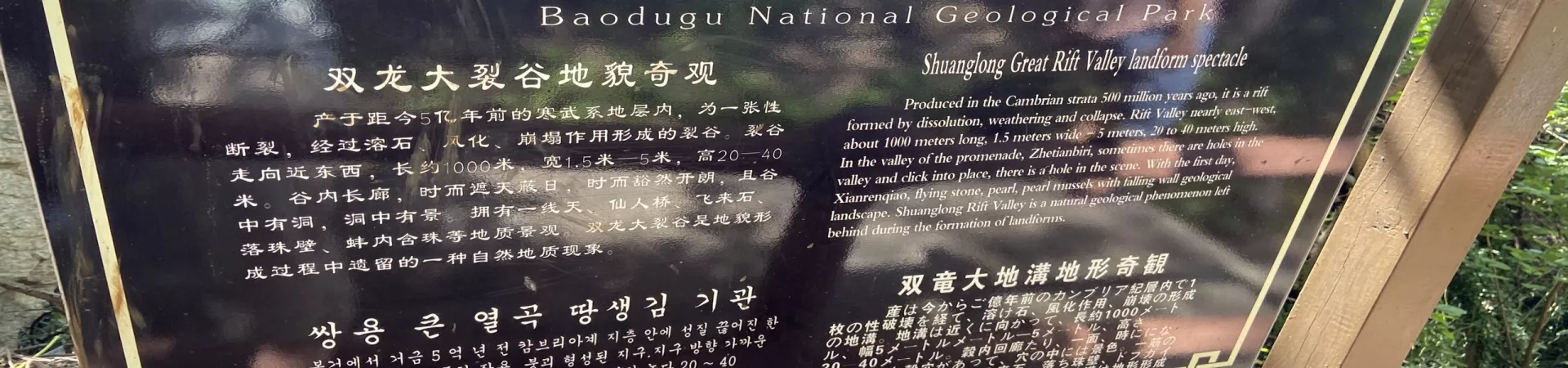
2.2. Key Natural Attractions 2.2.1. The Double Dragon Grand Canyon This is the geological and scenic centerpiece of the park. The canyon is a deep, winding fissure, believed to be formed by tectonic forces and water erosion. Walking through its shaded, narrow paths between towering rock walls offers a humbling and cool respite, with glimpses of unique rock formations and subtle ecosystems thriving in the microclimate.
2.2.2. Clustered Table Mountains (Qun Gu) The panoramic view of multiple "Gu" summits clustered together is a signature vista of the park. Each table mountain stands as a solitary sentinel, their flat tops often covered in greenery, contrasting sharply with their stark, vertical cliffs. This formation provides not only stunning photographic opportunities but also crucial insights into the region's erosional history.
2.2.3. Crouching Tiger Cave (Wohu Dong) and Dragon's Claw Cliff (Longzhua Ya) These features add layers of mythical charm to the geological facts. The Crouching Tiger Cave invites exploration into its cavernous spaces, revealing stalactites and stalagmites. The Dragon's Claw Cliff presents a formidable rock face with textures and fractures that vividly resemble the deep scratches of a giant dragon's talon, sparking the imagination.
2.2.4. Collapse Geological Hazard Relics Preserved within the park are clear evidences of past geological activity, such as rockfall accumulations and landslide scars. These sites serve as powerful, open-air classrooms for understanding earth's dynamic processes, aligning with the park's role as an educational base for disaster prevention.
3. Practical Visitor Information 3.1. Transportation Guide Reaching the geopark via public transport requires a connection through Zaozhuang's city center. * From Zaozhuang West Railway Station (Conventional Rail): Take bus B1 or T2 to the "Liantong Transfer Center." Switch to bus number 15 or 35 and disembark at "Sanjiao Huayuan" (Triangle Garden). The dedicated tourist shuttle bus to Xiong'er Mountain departs from the east side of the road at this location. * From Zaozhuang High-Speed Railway Station: Take the T1 bus to the "Liantong Transfer Center." Then, follow the same steps as above, transferring to bus 15 or 35 to Sanjiao Huayuan to catch the tourist shuttle.
3.2. Admission and Operating Hours * Ticket Fee: The standard admission ticket is priced at 50 RMB. * Opening Hours: The park is open daily from 08:30 to 16:30. The last admission is at 16:00. These hours are generally consistent throughout the year (January 1st to December 31st).
4. Educational and Touristic Value Beyond its visual splendor, Xiong'er Mountain National Geopark serves a vital educational purpose. As a National Seismic Disaster Prevention and Mitigation Science Education Base, it utilizes its authentic geological hazard relics to teach visitors about earth science and preparedness in an engaging, real-world context. Furthermore, its designation as a National Agricultural Tourism Demonstration Point highlights the harmonious blend of natural geology with the surrounding rural landscape and agricultural practices, offering a holistic cultural and ecological experience. For self-driving tourists, the well-equipped base provides a perfect starting point to explore this remarkable region at one's own pace, combining geological wonder with the freedom of the road.
Information last updated: February 4, 2023. Credit to contributor zhm_jinan.