Hook loophole scenic area
Subtitle: A Journey Through Time and Stone: Exploring the Karst Wonders and Taoist Heritage of Goulou Cave Scenic Area
1. Introduction to a Sacred Karst Landscape
Nestled at the base of the main peak of Goulou Mountain, approximately three kilometers southeast of Beiliu City in China's Guangxi Zhuang Autonomous Region, lies the Goulou Cave Scenic Area. Encompassing 204 hectares, this provincial-level scenic spot is a magnificent showcase of classic karst (limestone) topography. Its name, "Goulou," is derived from the distinctive characteristics of its caverns:勾 (gou, winding), 曲 (qu, twisting), 穿 (chuan, penetrating), and 漏 (lou, leaky/perforated). This geological poetry in stone has captivated visitors for over a millennium and a half, not only for its natural splendor but also for its profound spiritual significance as the legendary "22nd Grotto-Heaven" in Taoist cosmology—one of thirty-six sacred cave paradises believed to be conduits to the celestial realms.
2. The Geological Marvel: A Subterranean Palace of Stone
2.1. The Four Interconnected Caverns The heart of the scenic area is the Goulou Cave system itself, a 300-meter-long subterranean labyrinth composed of four interconnected sections: Baogui, Yuque, Baisha, and Taoyuan. Each chamber offers a unique perspective on the slow, artistic work of water and mineral deposition over eons.
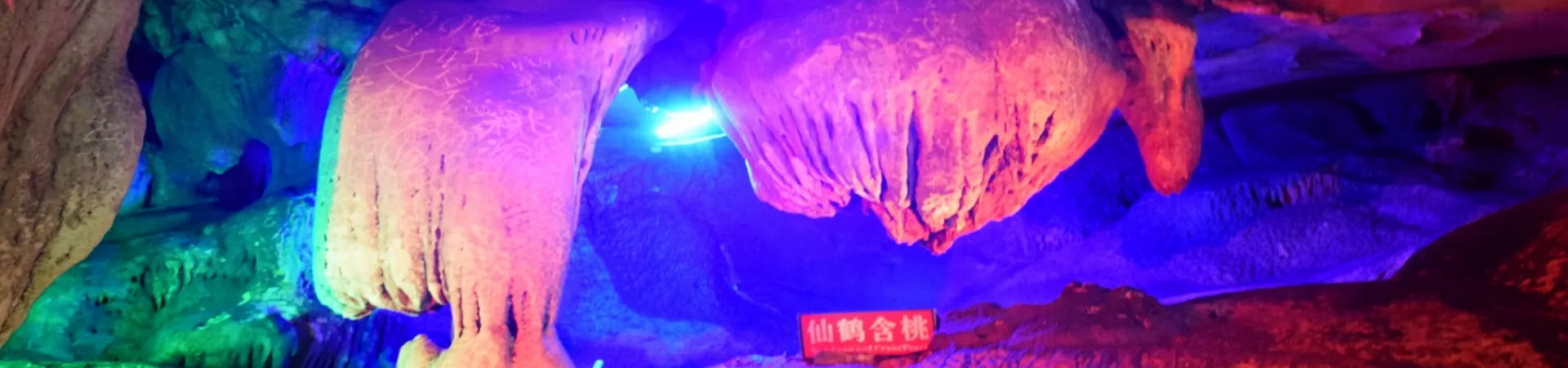
2.2. A Spectacle of Speleothems Within these caverns, visitors are greeted by a breathtaking forest of speleothems. Stalactites hang like frozen waterfalls from the ceilings, while stalagmites rise majestically from the floors. Stone pillars, curtains, and shields—all formed drop by drop of mineral-rich water—create a surreal landscape of natural sculpture. The play of light on their textured surfaces reveals forms that spark the imagination, from mythical beasts to delicate floral patterns.
2.3. Varied Chambers and Hidden Waters The cave's topography is wonderfully diverse. It opens up into vast, cathedral-like halls that inspire awe, then narrows to intimate corridors that require a single file passage, enhancing the sense of adventure. A defining feature is the presence of a crystal-clear underground river, whose still waters perfectly mirror the stone formations above, creating a mesmerizing, dreamlike symmetry and a profound sense of tranquility.
3. A Tapestry of History and Humanistic Spirit
3.1. The Taoist Heritage and Ge Hong's Legacy The cave's history is deeply intertwined with Taoism. The most famous chapter was written during the Eastern Jin Dynasty (317-420 AD) by the renowned scholar, alchemist, and Taoist master Ge Hong. Legend holds that he retreated into these very caves to "refine elixirs and cultivate the Tao." This association sanctified the site. At the cave entrance, the Ge Xian Ancestral Temple stands in his honor, while a statue of Ge Hong resides within the cavern's depths, serving as a silent testament to his enduring spiritual presence.
3.2. A Gallery of Ancient Inscriptions The area surrounding the cave entrance functions as an open-air museum of calligraphic art. Over 120 cliff-face inscriptions and stone tablets (moya碑碣), dating from the Tang and Song Dynasties onward, are etched into the rock. These are not mere graffiti; they are the travelogues, poems, and reflections of centuries of luminaries.
3.3. Visitors Through the Ages Following Ge Hong, a procession of China's great intellectuals and officials felt drawn to Goulou. Figures like the philosopher Wang Fu, the stalwart Southern Song minister Li Gang, and the legendary travel writer Xu Xiake of the Ming Dynasty all journeyed here. They came to admire its beauty, contemplate its serenity, and inscribe their experiences onto its stone canvas. This tradition continued into the modern era, with calligraphic works and poetic inscriptions left by contemporary cultural figures such as Guo Moruo, Ma Datie, and Yu Liqun, weaving a continuous thread of cultural appreciation from ancient to modern times.
4. Practical Information for Visitors
4.1. The Verdant Surface Landscape Above ground, the scenic area offers a complementary beauty. The paths are shaded by lush, emerald-green forests, prominently featuring the graceful Acacia confusa (相思树) trees. Their delicate foliage and seasonal blooms provide a serene and picturesque setting, framing the dramatic cave entrance and offering pleasant walks between the historical and natural points of interest.
4.2. Admission and Operating Hours Admission to the Goulou Cave Scenic Area is priced at 50 RMB per person. The site is open daily from 8:30 AM to 5:00 PM. It is important to note that the last entry is at 5:00 PM, so visitors are advised to arrive with sufficient time to fully explore the caves and the surrounding parkland. These hours are consistent throughout the year, from January 1st to December 31st.
4.3. Contact Information For any inquiries prior to a visit, the scenic area management can be reached via telephone at 0775-6355219 or 0775-6355015.
In essence, a visit to the Goulou Cave Scenic Area is a multidimensional experience. It is a journey into the awe-inspiring heart of the earth through its karst caverns, a walk through a living manuscript of Chinese literary and spiritual history inscribed on stone, and a peaceful retreat into a verdant, tranquil landscape. It stands as a powerful testament to how natural wonder and human culture can intertwine across centuries, creating a destination that engages the senses, the intellect, and the spirit.