Ho Family Garden
Subtitle: A Journey Through Time: Unveiling the Architectural Poetry and Cultural Tapestry of Heyuan Garden
Introduction: The Last Masterpiece of Imperial China
Nestled in the historic city of Yangzhou, Jiangsu Province, the Heyuan Garden, also poetically known as Jixiao Mountain Villa, stands as a crowning achievement of late Qing dynasty garden artistry. Constructed between 1883 and 1885 by He Zhidao, a former high-ranking official who retreated from public life, this private residential garden is widely celebrated as the "Number One Garden of the Late Qing Dynasty." It represents a perfect fusion of traditional Chinese horticultural philosophy, innovative architectural design, and the personal aspirations of its creator, offering visitors a profound glimpse into the refined aesthetics and complex social narratives of China's final imperial era.
1. Architectural Layout and Design Philosophy
1.1. A Symphony of Spaces: Three Distinct Sections Heyuan is ingeniously divided into three primary sections that harmonize to form a cohesive whole. The layout masterfully blends the practical needs of domestic life with the spiritual pursuit of natural beauty.
- The Residential Courtyards: This area comprises the family's living quarters, including the elegant and spacious Two-Story Building with Winding Corridors. The architecture here reflects the luxurious yet scholarly lifestyle of the He family, featuring intricately carved woodwork, traditional furniture, and scholarly inscriptions.
- The Rear Garden: Serving as the heart of the garden's scenic beauty, the Rear Garden is a classic example of "borrowed scenery" techniques. It centers around a large pond, around which pavilions, rockeries, and lush vegetation are arranged to create ever-changing vistas and a sense of serene expansiveness within a limited urban space.
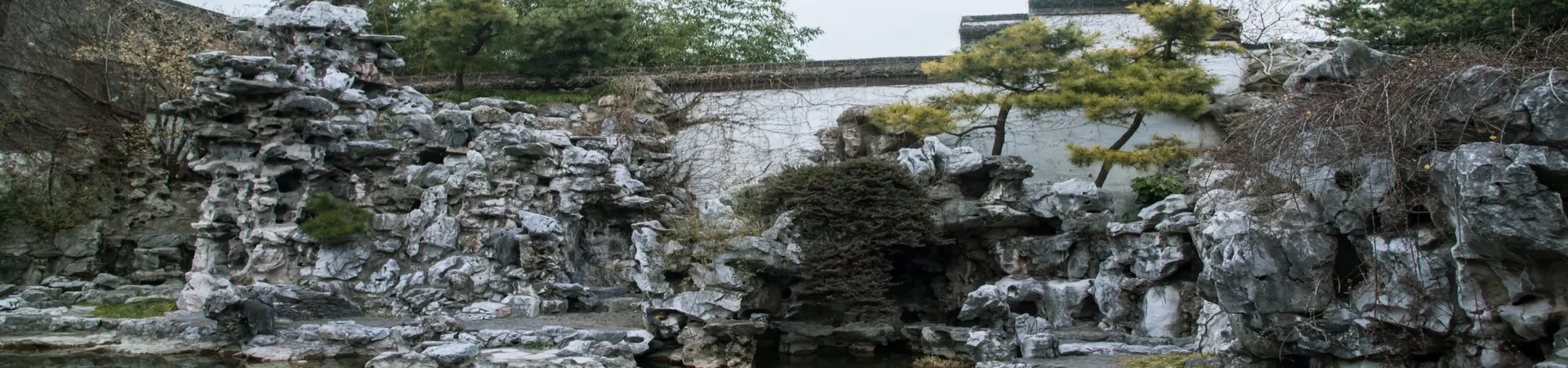
- Pianshi Shanfang (The Rockery House): Located in the southeastern part of the complex, this section is particularly renowned. It features an exquisite artificial mountain crafted from layered yellow stones, embodying the essence of Yangzhou's unique rockery art. A two-story building integrated into the rockery offers a secluded space for contemplation, blurring the lines between interior and exterior, architecture and nature.
1.2. The Unifying Artery: The Double-Level Corridor System The most distinctive and celebrated architectural feature of Heyuan is its extensive network of Double-Level Corridors and Winding Walkways, often hailed as the "First Corridor under Heaven." Stretching for over 1,500 meters, these covered passageways seamlessly connect every building and scenic spot across the garden's upper and lower levels. This innovative design ensures a continuous touring experience regardless of weather, while also creating dynamic, multi-layered perspectives of the garden's landscapes. Walking these corridors, one experiences a cinematic unfolding of framed views—a living scroll painting in motion.
2. The "Four Firsts Under Heaven" and Artistic Highlights
Heyuan's reputation is cemented by its acclaimed "Four Firsts Under Heaven," each highlighting a pinnacle of garden craft.
- 2.1. The First Corridor under Heaven: As described, this is the structural backbone of the garden, an unparalleled feat of planning that guides movement and perception.
- 2.2. The First Mountain under Heaven: This title refers to the majestic Rockery in the Rear Garden. Constructed from thousands of tons of stones from Lake Tai, it mimics the grandeur of natural mountains, complete with caves, peaks, and winding paths. It symbolizes a microcosm of the world and serves as a centerpiece for meditation and admiration.
- 2.3. The First Window under Heaven: The garden boasts an exceptional collection of Latticed Windows. Each window is a work of art, with frames carved into myriad shapes—flowers, vases, butterflies, and geometric patterns. These windows are not merely openings but active framing devices, transforming the external scenery into a series of carefully composed, picture-like views from within the buildings.
- 2.4. The First Pavilion under Heaven: This honor is bestowed upon the "Water-Moon Pavilion" situated in the Rear Garden. Built partially over the central pond, the pavilion creates a magical interplay of reality and reflection. On a moonlit night, the moon in the sky, its reflection in the water, and the pavilion itself merge into a poetic tableau, perfectly illustrating the classical Chinese garden ideal of harmony between man-made structure and natural element.
3. Heyuan as a Cultural and Cinematic Icon
Beyond its architectural merits, Heyuan serves as a vibrant cultural repository and a favored canvas for the visual arts.
- 3.1. A Living Film Set: The garden's impeccably preserved late-Qing atmosphere and photogenic scenery have made it a natural base for film and television production. Over a hundred period dramas and films have been shot within its walls, including notable productions like the 2010 remake of "Dream of the Red Chamber" and the sequel to "My Fair Princess." Walking through Heyuan, visitors often feel a sense of stepping directly into a historical drama, with every corner offering a potential cinematic backdrop.
- 3.2. Inscriptions and Cultural Legacy: The garden is adorned with couplets, plaques, and calligraphic works by noted scholars and the family itself. These inscriptions, often poetic reflections on nature, tranquility, and virtue, add a deep literary layer to the physical beauty, inviting contemplation on the intellectual life of China's literati class.
4. Practical Visitor Information
4.1. Location and Transportation Heyuan is located at 66 Xuningmen Street, Guangling District, Yangzhou City. * By Bus: The most convenient public transport option. Take bus routes 19, 66, 66 (Night Service), 6, or Tourist Line 1 and alight at the "Qiersansuo" (723 Institute) bus stop. The garden entrance is within a short walking distance from the stop.
4.2. Opening Hours and Admission * Opening Hours: The garden is open daily from 07:30 to 18:00, with last admission at 17:30. It is advisable to allocate 1 to 3 hours for a comprehensive visit. * Admission Fees: * Peak Season (Mar 1-May 31 & Sep 1-Nov 30): Adult ticket 45 RMB. * Low Season (Dec 1-Feb 28 & Jun 1-Aug 31): Adult ticket 30 RMB. * Free Admission Policy: Free entry is granted to: * Children aged 6 and below or with a height of 1.4 meters and below. * Seniors aged 70 and above (with valid ID). * Active-duty PLA soldiers, armed police officers, retired veterans, disabled military personnel (with valid certificate). * Visitors with disabilities (with valid certificate). * Journalists (with valid press card). * Important Note: The above ticket information and policies are for reference. Please verify the latest details, including any seasonal adjustments, with the garden's official announcements on the day of your visit.
4.3. Contact Information * Telephone: For inquiries, you may contact the garden at 0514-87239626.