Longchuan Scenic Area
Longchuan Scenic Area: A Living Museum of Huizhou Culture
Nestled amidst the rolling hills of southern Anhui, approximately 10 kilometers from Jixi County, lies the ancient village of Longchuan, also known as Kengkou. More than just a picturesque settlement, Longchuan is a profound cultural capsule, a designated Historical and Cultural Preservation Area of Anhui Province, where breathtaking natural scenery intertwines seamlessly with a rich, centuries-old legacy. Its unique charm stems from a remarkable fusion of geography and history, offering visitors a journey through the heart of traditional Huizhou civilization.
A Landscape Shaped by Philosophy and Time
The village's layout is a testament to the ancient Chinese art of feng shui. Cradled by mountains and embraced by rivers, Longchuan is poetically described as a "boat moored to the shore." To the east stands the majestic Longxu Mountain (Dragon Whisker Mountain), while the Dengyuan River flows gently beside it. The south gathers the waters of the Longchuan streams, with the elegant Fengguan (Phoenix Crown) Peak gracing the west and formidable mountain ranges guarding the north. This harmonious balance between human habitation and the natural world is no accident. It was this very perfection of geomantic omen that captivated General Hu Yan, a Chamberlain for the Imperial Stud of the Eastern Jin Dynasty. In the year 337 AD, enchanted by the land's outstanding "wind and water" properties, he relocated his entire family here, founding the village and initiating the illustrious Hu lineage that would shape its destiny for generations.
A Cradle of Scholars and Statesmen: The Legacy of the Hu Clan
Longchuan's beauty is not merely physical; it is an intellectual and scholarly haven. Renowned throughout Huizhou as the "Village of Imperial Scholars," Longchuan, particularly through the Hu family, produced an extraordinary number of high-achieving scholars and officials, especially during the Ming Dynasty—its golden age. The village reached its zenith when over ten individuals passed the formidable imperial examinations to attain the prestigious jinshi degree.
Among these luminaries, two figures stand out for their national prominence: * Hu Fu: In 1478, Hu Fu achieved the jinshi degree and rose through the ranks to become the Minister of Revenue in Nanjing and Tutor to the Heir Apparent (Taizi Shaobao). * Hu Zongxian: Sixty years later, in 1538, Hu Zongxian followed in these esteemed footsteps, also earning the jinshi degree. His career was even more illustrious, culminating in the powerful positions of Minister of War and Grand Tutor to the Heir Apparent (Taizi Taibao), playing a crucial role in defending the Ming coast against pirates.
This remarkable concentration of talent cemented Longchuan's reputation as a powerhouse of Confucian learning and bureaucratic excellence, a legacy physically etched into the village's architecture.
Architectural Treasures and Cultural Monuments
The historical and cultural significance of Longchuan is preserved in its exceptional collection of ancient buildings, which serve as the core of any visit.
The Ancestral Temple of the Hu Clan (Longchuan Hu Shi Zongci): As a National-Level Cultural Relics Protection Unit, this temple is the undisputed architectural and spiritual centerpiece of Longchuan. It is a masterpiece of Ming dynasty Huizhou ancestral hall architecture, renowned for its exquisite wood carvings that adorn beams, brackets, and panels. These carvings, depicting mythical creatures, floral patterns, and scenes from daily life and legend, are considered among the finest in all of China, showcasing the pinnacle of artisan skill during the clan's prosperity.
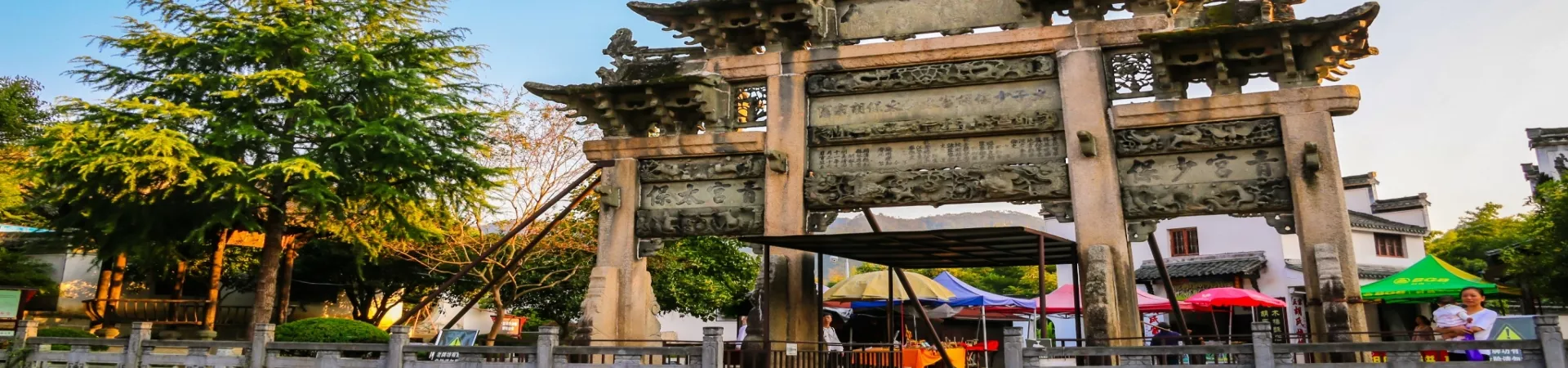
The Yishi Shangshu Memorial Archway (Yishi Shangshu Fang): This beautifully preserved stone archway, a Provincial-Level Cultural Relics Protection Unit, stands as a permanent tribute to the village's most famous sons, Hu Fu and Hu Zongxian. Erected to honor their high ministerial ranks ("Shangshu"), the archway's intricate stonework symbolizes the enduring honor their achievements brought to the Hu family and the entire village.
Historic Residences: Scattered throughout the village are other significant dwellings that offer a glimpse into different facets of local history. The Former Residence of Hu Zongxian (a County-Level Protection Unit) provides context to the life of the great military commander. Meanwhile, the Hu Bingheng Residence represents the legacy of the Hui merchants, the formidable business class of Anhui whose wealth often funded the construction of such elegant homes and community structures.
The Natural Sanctuary: Longxu Mountain
Beyond the village lanes lies another realm of wonder—Longxu Mountain. Named after the dragon's whisker grass, a raw material once used for papermaking, the mountain is a paradise for nature enthusiasts and trekkers. Its slopes are adorned with ancient, twisted pine trees, peculiar rock formations, and are home to diverse bird and animal life. A network of ancient, rugged paths leads explorers past cascading waterfalls, clear mountain springs, and fascinating sites such as the Xuanyan Cliff, the Stone Gate Cave, and the Immortal's Stone House. For those interested in religious heritage, the mountain's western slopes host sites like the Longfeng Chan Temple and the ancient Qiao Convent, as well as the tombs of Hu Zongxian and Hu Fu. This area perfectly complements the cultural visit, offering opportunities for ecological exploration, hiking, and contemplation amidst serene landscapes.
Practical Visitor Information
- Location: Longchuan (Kengkou) Village, near Jixi County, Xuancheng City, Anhui Province.
- Contact: 0563-8315763; 0563-8315555
- Suggested Visit Duration: A minimum of 3 hours is recommended to fully appreciate the village and its surroundings.
- Admission Fees:
- Standard Ticket: 75 RMB per adult.
- Concession Ticket: 40 RMB. Applies to: minors between 1.2m and 1.5m tall; seniors aged 60-64 (with valid ID); full-time undergraduate students and below (with valid student ID).
- Free Admission: Children under 1.2m; seniors aged 65 and over (with valid ID); active-duty military personnel, retired army personnel, and persons with disabilities (with valid credentials).
- Note: Fees are for reference; please confirm with the scenic area on the day of your visit.
- Opening Hours:
- March 1 - October 31: 8:00 - 17:00 (Monday-Thursday, last entry at 17:00); 8:00 - 17:50 (Friday-Sunday, last entry at 17:20).
- November 1 - February 28/29: 8:00 - 17:30 daily (last entry at 16:40).