Longchuan Hu's Family Ancestral Hall
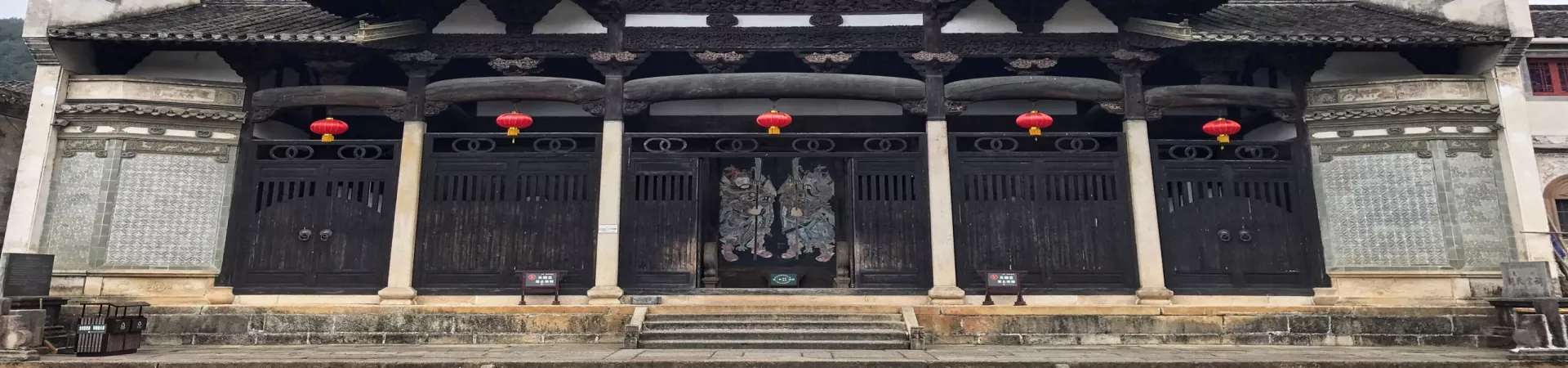
Subtitle: A Journey into the Heart of Huizhou Culture: The Ancestral Hall of the Hu Clan in Longchuan
1. Introduction: A Pillar of Heritage in Jixi
Nestled within the scenic village of Longchuan (also known as Kengkou) in Yingzhou Township, Jixi County, stands a monumental testament to Chinese clan culture and architectural artistry—the Ancestral Hall of the Hu Clan. Jixi, historically a core part of the Huizhou Prefecture, was renowned for its profound scholarly traditions and a landscape dotted with elaborate ancestral halls. Among these, the Longchuan Hu Clan Ancestral Hall is preeminent, not merely as a family shrine but as a nationally recognized treasure. It encapsulates centuries of history, artistic achievement, and the illustrious legacy of one of the region's most prominent families, offering visitors a profound glimpse into the soul of traditional Huizhou.
2. Historical Significance and Legacy
2.1. Foundations and Renovations The hall's origins date back to the Ming Dynasty, specifically the 25th year of the Jiajing reign (1547 AD). It underwent a significant restoration during the Qing Dynasty in the 4th year of the Guangxu reign (1898), ensuring its preservation for future generations. This timeline marks it as a witness to nearly five centuries of Chinese history.
2.2. A Cradle of Eminence The hall's significance is magnified by the formidable individuals associated with the Longchuan Hu lineage. It served as the clan temple for figures such as Hu Fu, a Minister of Revenue, and Hu Zongxian, a Minister of War during the Ming Dynasty. In the Qing era, the lineage produced the legendary "Red-Topped Merchant" Hu Xueyan (Hu Guangyong), a titan of business and philanthropy. Furthermore, the surrounding area of Jixi is the ancestral hometown of Hu Jintao, former President of the People's Republic of China. This continuous thread of high achievement in bureaucracy, commerce, and national leadership underscores the clan's enduring influence and the hall's symbolic importance as a source of ancestral pride and inspiration.
3. Architectural Layout and Artistic Grandeur
3.1. Spatial Composition and Setting The ancestral hall is meticulously oriented, sitting north-facing south—an auspicious alignment in traditional Chinese geomancy. Its layout follows a classic three-courtyard progression, covering a total area of 1,271 square meters. The structure harmoniously integrates with its natural surroundings, designed "with the mountain as its backdrop and water flowing before it," creating an impression of both grounded stability and dynamic grace.
3.2. The Treasure Trove of Huizhou Woodcarving While architecturally imposing, the hall's true glory lies within. Its interior is adorned with exquisitely detailed decorations, among which the woodcarvings are unparalleled. So vast, intricate, and well-preserved is this collection that the hall has earned the epithet "The Treasure House of Huizhou Woodcarving Art."
3.3. Details of the Carvings Every beam, bracket, lintel, and panel serves as a canvas for master craftsmen. The carvings depict a rich tapestry of motifs: mythical beasts like dragons and phoenixes symbolizing power and prosperity; scenes from folklore and operas conveying moral tales; delicate renderings of flowers, birds, and landscapes celebrating the natural world; and intricate geometric patterns. These carvings are not merely decorative; they embody Confucian values of filial piety, loyalty, and scholarly pursuit, reflecting the clan's aspirations and cultural refinement. The level of detail, from the expressive faces of figures to the textured feathers of birds, demonstrates an artistic virtuosity that leaves visitors in awe.
4. Practical Visitor Information
4.1. Location and Access The hall is located in Longchuan Village, approximately 11 kilometers from Jixi County's urban center. A convenient public transportation option is to take Bus No. 6 from the front of the local high-speed rail station, which provides direct access to the scenic area.
4.2. Admission and Operating Hours Entrance to the site requires a ticket, priced at 75 RMB (or 77 RMB for a postage-inclusive souvenir ticket). The ancestral hall is open to the public daily from 8:00 AM to 5:30 PM, throughout the year.
4.3. Suggested Duration and Contact A comprehensive visit to appreciate the architecture, history, and artistry typically takes between 1 to 3 hours. For any specific inquiries prior to a visit, the site management can be contacted via phone at 0563-8315763 or 0563-8315555.
5. Recognition and Enduring Value
The immense historical and artistic value of the Longchuan Hu Clan Ancestral Hall was formally recognized in 1988 when it was designated as a National Key Cultural Relics Protection Unit. This status affirms its importance as part of China's shared cultural heritage. Experts in architecture and history consistently praise its completeness and artistic merit, often hailing it as "a peerless masterpiece among China's ancient ancestral temples." It stands not just as a memorial to a single family, but as a pristine museum of Huizhou culture during the Ming and Qing dynasties, preserving within its walls the aesthetic ideals, social structures, and spiritual world of a bygone era.