Jiangnan First Pass
Subtitle: A Journey Through History and Nature on the Huizhou-Hangzhou Ancient Road
I. Introduction: The Gateway to the Clouds
Nestled in the eastern reaches of Fuling Township within Xuancheng City, at an elevation of 424 meters, stands a formidable natural and historical sentinel known as Jiangnan First Pass. Also called Yaoyaoyan, this awe-inspiring gorge is the most critical and dramatic section of the ancient Huizhou-Hangzhou Road, serving as the primary passage towards the majestic Qingliang Peak. More than just a scenic wonder, the pass is a stone-carved chronicle of commerce, community, and human perseverance, earning its formidable reputation over centuries.
II. The Ascent: A Test of Nerve Amidst Geological Splendor
The journey to the pass begins humbly at the foot of the gorge, marked by the Yan Kou Pavilion and its bold, Wei-style inscription proclaiming "Path to Jiangsu and Zhejiang." Crossing the simple Jiangnan First Bridge, the true challenge and beauty unfold as a steep, 1,400-stone-step pathway snakes its way upward between colossal cliffs.
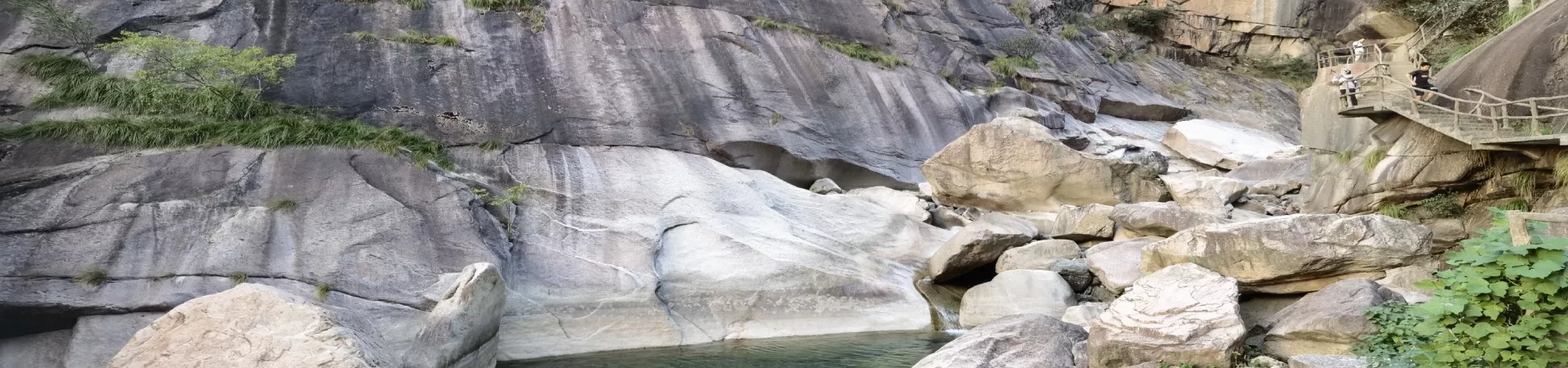
A. A Landscape Sculpted by Time The ascent is a dialogue with ancient geology. The trail is flanked by soaring peaks and bizarre rock formations that stir the imagination—the Millstone Rock, the Celestial Crown Rock, the General Rock, and the Rice-Husking Mortar Rock are among the most striking. The path itself is an engineering marvel. In its most daring section along the northern cliff, a walkway is formed by granite slabs, some over two meters long, embedded directly into the vertical rock face, with parts hanging precariously over the deep chasm below. The roar of the Xiao Yao River echoes from the depths, tumbling through a chaotic riverbed of boulders shaped like beasts and melons, its waters alternating between gentle murmurs and turbulent pools.
B. The Thrill of the Climb For first-time visitors, the climb is an exhilarating, heart-pounding experience. The sheer drop beside the narrow, steep steps induces dizziness, compelling one to press close to the rock wall, hesitant to look down. The sense of exposure is profound until finally, after navigating this stone ladder to the sky, one arrives at the pass itself—a narrow slit of daylight between the towering rocks.
III. The Pass Itself: A Monument in Stone
The gateway that crowns this arduous climb is deceptively simple yet powerfully symbolic. Constructed from four massive stone beams laid across natural rock pillars, it is a testament to pragmatic ancient craftsmanship. The stone lintel bears silent witness to history: on the western side, the bold characters "江南第一关" (Jiangnan First Pass) are carved, while the eastern side reads "徽杭锁钥" (Key Locking Huizhou and Hangzhou), followed by "Built by Local People in the 3rd Year of the Tongzhi Reign [1864], Inscribed by Shao Daotang," in precise regular script.
Standing at this gate, one is met by rushing mountain winds that seem to amplify the feeling of standing at the edge of the world, "as if riding the void," suspended between history and the vast landscape. Beyond the gate, the path, though still winding along steep slopes, becomes somewhat less severe.
IV. Layers of History: Inscriptions and Legacy
The history of this vital artery is literally etched in stone. On a cliff face near the Guan Dong Tea Shelter east of the pass, a significant inscription details the古道小史 (Brief History of the Ancient Road):
- Southern Song Dynasty (1253-1257): Hu Dan from Dashimen Village first hewed the stone steps along the mountain's contour, creating over five li of path for travelers.
- Yuan Dynasty (1297-1307): The Cheng family from Beixiang (today's Bei Village), recognizing the route's perilous depth, quarried stones to build protective railings, greatly enhancing safety.
- Ming Dynasty (1465-1487): The path was renovated again by Wang Yimao and others.
- Maintenance Through Ages: Subsequent dynasties continued repairs. In the modern era, nearby villagers have organized through agreements to maintain the trail right up to the present day.
A. The Origin of the Name The pass's celebrated name, "Jiangnan First Pass," is commonly attributed to Taiping Rebellion leader Li Shixian, the "Service King," who led his troops through here in 1861 and, marveling at its strategic impregnability, declared it a "natural barrier," thus bestowing its title. An alternative tradition suggests the name may originate from the Ming Dynasty official Hu Zongxian.
B. A Memorial in the Gorge: The "Two Cheng" Temple Within the pass sits a somber reminder of the gorge's ever-present dangers: the "Two Cheng" Temple. Built by Hu Guisen from Hu Village, it commemorates Cheng Zaoqi and Cheng Ruihu from Bei Village. In the spring of 1932, while traveling to Zhejiang for trade, they took shelter under an overhanging rock. A sudden rockfall killed them both, and the temple was erected as a memorial and a caution. Later, Shao Zaibing funded the construction of a stone pavilion beside it.
V. From Ancient Trade Route to Cultural Heritage
The channel of Jiangnan First Pass is the product of continual evolution. After its initial creation, it was funded and improved multiple times by wealthy Huizhou merchants from Jixi who ventured out to trade, understanding this route's vital importance to their livelihood. Their investments transformed it from a rugged trail into a stable commercial corridor. Today, this collective effort across dynasties is recognized, as the Huizhou-Hangzhou Ancient Road, with Jiangnan First Pass as its crown jewel, is celebrated as a nationally protected cultural heritage site. It stands not only as a breathtaking destination for hikers and tourists but as an enduring monument to the spirit of the Huizhou people and their profound connection to the landscape they mastered.
(Note: Practical information such as contact number, ticket details, and opening hours, while provided in the source material, has been integrated contextually or omitted here to maintain the narrative flow focused on history, geography, and experience, as per the request for a descriptive rewrite.)