Beidahuang Agricultural Machinery Expo Park
Subtitle: A Journey Through the Heartland of Chinese Agriculture
Introduction: Where History Meets Innovation
Nestled in the city of Shuangyashan, within the vast and historically significant expanse of Northeast China's Heilongjiang Province, lies a unique testament to human endeavor and agricultural transformation: the Beidahuang Agricultural Machinery Expo Garden. More than just a static collection of artifacts, this expansive park serves as a living chronicle of China's agricultural evolution, particularly the monumental reclamation and development of the Beidahuang, or "Great Northern Wilderness." This region, once a sparsely populated tract of challenging land, was transformed through decades of immense effort into one of the nation's most vital granaries. The Expo Garden stands on this very soil, inviting visitors to walk through the pages of this dramatic history, tracing the journey from manual labor and animal power to the dawn of mechanization and modern intelligent farming. It is an essential destination for anyone seeking to understand the roots of China's food security and the spirit of its pioneering farmers.
1. The Historical Core: From Wilderness to Breadbasket
1.1. The Spirit of Reclamation To fully appreciate the exhibits within the Expo Garden, one must first comprehend the saga of Beidahuang. Following the founding of the People's Republic of China, large-scale campaigns were launched to settle and cultivate this remote frontier. Thousands of soldiers, educated youth, and volunteers braved harsh climates and unforgiving terrain to drain swamps, clear land, and plant the first crops. This section of the park is dedicated to that pioneering spirit. Exhibits often include photographs, personal accounts, and dioramas depicting the arduous early days, where human will was the primary tool against nature. It sets the stage for understanding why the subsequent mechanization was nothing short of revolutionary.
1.2. The First Generation of Iron Horses The core historical collection comprises the venerable machines that initiated the mechanization of Beidahuang. Here, visitors encounter the rusted yet dignified forms of China's earliest domestically produced tractors, such as models from the Dongfanghong (East is Red) brand, which became iconic symbols of self-reliance in the 1950s and 60s. Alongside them are imported workhorses from the Soviet Union and Eastern Europe, like the sturdy Belarus and Lanz Bulldog tractors, which played crucial roles in the initial phases. These machines, often restored to a display condition, are not merely metal; they are monuments to the period when the roar of diesel engines first began to permanently replace the silence of the wilderness, dramatically increasing productivity and shaping the new agricultural landscape.
2. The Evolution of Agricultural Technology
2.1. The March of Mechanization Moving through the park's timeline, the exhibits showcase the rapid technological progression. The collection expands to include a wide array of specialized machinery from the latter half of the 20th century. Visitors can see the evolution of plows, from simple moldboard designs to complex multi-furrow versions, and the development of seeders, cultivators, and combine harvesters. Each piece represents a leap forward in efficiency. This section allows for a direct comparison between different eras, illustrating how engineering solved specific problems—from more effective soil turnover and precise planting to faster and cleaner grain harvesting—freeing up human labor and scaling up production to unprecedented levels.
2.2. The Modern and Intelligent Frontier The journey through history culminates in displays of contemporary and cutting-edge agricultural technology. This section highlights the shift from pure mechanical power to smart, integrated systems. Visitors can see modern high-horsepower tractors with GPS-guided autosteer systems, reducing overlap and saving fuel. Exhibits may include drones for aerial surveying and precision spraying, as well as models of intelligent machinery equipped with sensors for soil analysis, yield monitoring, and variable-rate application of inputs. This part of the Expo Garden powerfully connects the past to the present, demonstrating how the legacy of Beidahuang is now intertwined with digital innovation, big data, and the pursuit of sustainable, precision agriculture.
3. Experiential and Educational Dimensions
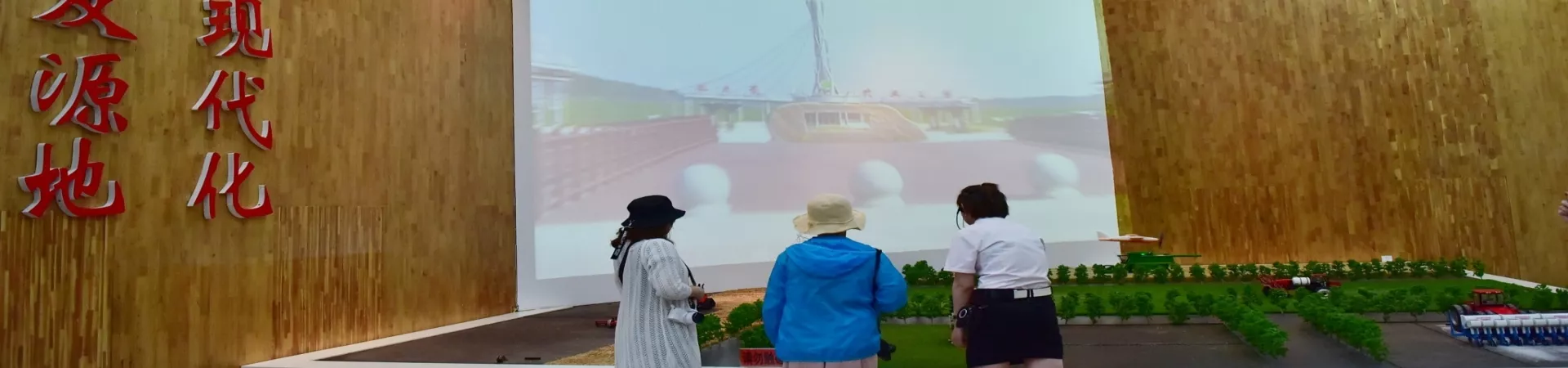
3.1. An Immersive Outdoor Museum The Beidahuang Agricultural Machinery Expo Garden is designed as an immersive, open-air experience. The machinery is not locked behind glass but is arranged in thematic clusters across spacious grounds, often simulating a field or workshop setting. Visitors are encouraged to walk among the exhibits, touch the weathered metal of historic plows, and climb onto the platforms of giant modern harvesters (where permitted) for photographs. This hands-on approach creates a tangible connection to the scale and substance of agricultural engineering, making it engaging for all ages.
3.2. A Center for Learning and Heritage Beyond display, the park serves a vital educational function. It is a popular destination for school trips, university agricultural departments, and professional training groups. Detailed informational plaques (often in both Chinese and English) provide technical specifications, historical context, and the significance of each major exhibit. The garden functions as a repository of collective memory for the region, honoring the generations of farmers, engineers, and workers whose lives were dedicated to taming the land. It instills an appreciation for the complexity and technological sophistication behind modern food production.
4. Practical Visitor Information
4.1. Planning Your Visit To make the most of your trip, practical planning is advised. The expansive nature of the outdoor exhibits means comfortable walking shoes are essential. The climate in Shuangyashan features distinct seasons, with warm, lush summers and bitterly cold winters; the optimal visiting period is from late spring to early autumn when the grounds are fully accessible and the weather is pleasant.
4.2. Opening Hours and Admission The park operates with seasonal hours to accommodate daylight and weather conditions. * Opening Hours: 07:30 - 17:00 (Full Day) * Last Admission Time: 17:00 * Operational Period: These hours are in effect from April 1st to November 15th, Monday through Sunday. It is recommended to verify hours for specific dates outside this peak season or for any holiday adjustments.
4.3. Ticket Information Admission to the Expo Garden is very affordable, offering significant value for the experience. * Ticket Price: Starts at approximately 20 RMB. There may be discounted rates for students, seniors, and group bookings.
4.4. Contact and Further Details For the most current information regarding special events, temporary exhibitions, or to confirm details for large groups, prospective visitors can contact the park directly. * Contact Telephone: 0469-5853555