Twenty Eight Ancient Towns
Subtitle: A Journey Through Time in Zhejiang's "Cultural Enclave"
Introduction: The Guardian of the Mountain Pass
Nestled in the mountainous borderlands of western Zhejiang province, where the contours of Fujian, Jiangxi, and Zhejiang meet, lies the ancient town of Nianbadu. Far more than a mere scenic stop, this is a living, breathing chronicle of history, culture, and human migration. Recognized as a National-Level Historical and Cultural Town and a "Hometown of Chinese Folk Art," Nianbadu's story begins over a millennium ago. Its founding was dictated by geography and strategy; as the first major settlement for travelers entering Zhejiang from the south via the ancient, rugged paths from Fujian, it earned the formidable title "The Lock and Key of Fengxi." This strategic importance was underscored during the Ming and Qing dynasties by the establishment of a high-ranking military outpost, a "third-grade游击衙门" (Youji Yamen), a testament to its role in guarding a crucial frontier. It is even said that the young Zheng Chenggong (Koxinga), the legendary Ming loyalist, spent part of his childhood here while his father was stationed at this garrison. Today, the town stands not as a fortress, but as a remarkably preserved museum of architectural and cultural fusion, often poetically described by scholars as a "cultural enclave" and "a dream lost in the mountains."
Architectural Tapestry: A Symphony in Wood and Stone
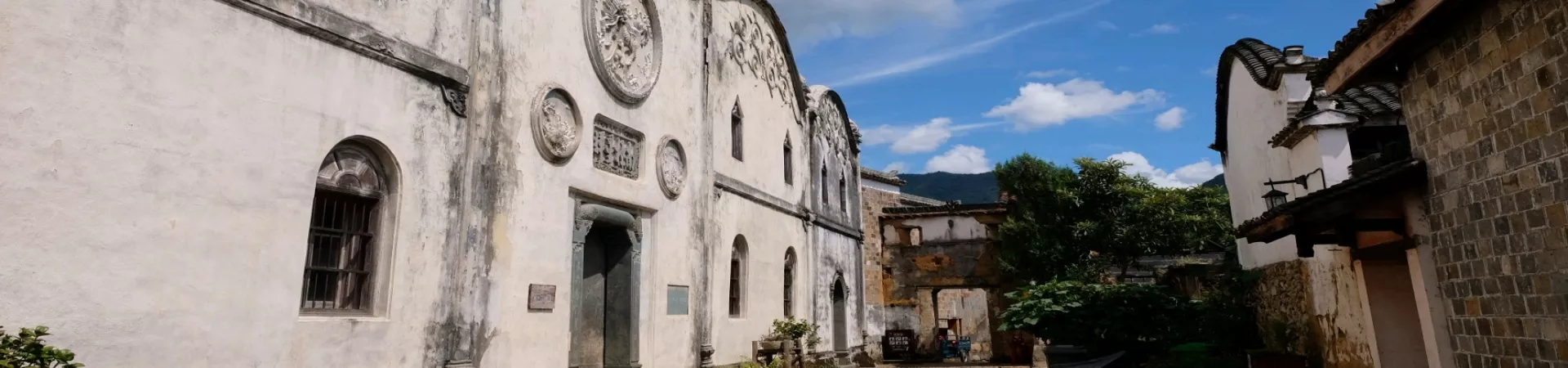
The most immediate and stunning testament to Nianbadu's unique history is its architectural landscape. Walking its ancient streets is akin to flipping through a textbook of regional building styles, all harmoniously interwoven. The town boasts an impressive collection of 36 well-preserved, large-scale traditional residential compounds and halls, complemented by 11 public buildings.
2.1 A Convergence of Styles The genius of Nianbadu lies in its synthesis. You will find the elegant, white-walled and black-tiled Zhejiang-style houses standing shoulder-to-shoulder with the ornate horse-head gables and intricate stone carvings of Hui-style (Anhui) architecture. The influence of neighboring Fujian (Minnan) style is evident in some roof structures and layouts, while the pragmatic, fortified communal buildings of the Hakka (Kejia) tradition speak to the town's defensive past. Surprisingly, traces of Western-style decorative elements also appear, a subtle reminder of distant cultural exchanges. This extraordinary blend is a direct result of the town's role as a merchant and military hub, attracting and accommodating people from vastly different origins.
2.2 Craftsmanship and Detail Everywhere you look, the buildings are adorned with exquisite craftsmanship. "Exquisitely carved, with painted beams and ridgepoles, and soaring pavilions dripping with vermilion" – this classical description comes alive in the detailed wood carvings on door frames, window lattices, and eaves. Mythical beasts, floral patterns, and scenes from folklore are meticulously rendered, telling stories of hopes for prosperity, longevity, and good fortune. Key public structures like the Confucius Temple (Kong Miao), the Great King Temple (Dawang Miao), the Longevity Palace (Wanshou Gong), and the Literature Pavilion (Wenchang Ge) not only served spiritual and communal needs but also stand as pinnacles of this collective architectural artistry.
A Living Museum of Human Diversity
If the buildings form the skeleton of Nianbadu, its people and their traditions are its vibrant soul. The demographics of this small town are nothing short of astonishing. Within a community of just over 3,600 residents, an incredible 13 distinct dialects are spoken, and an almost unimaginable 142 family surnames have been recorded and continue to flourish. This level of linguistic and genealogical diversity in such a confined area is unparalleled in China, leading experts to hail it as "extremely rare nationwide, ranking first in Zhejiang Province."
3.1 The Custodians of Intangible Heritage The descendants of soldiers, merchants, and migrants have not only preserved their unique identities but also a rich tapestry of intangible cultural heritage. The townspeople are active custodians of ancient folk arts passed down through generations. These vibrant traditions are not staged merely for tourists but are integral to local festivals and community life.
3.2 A Calendar of Folk Arts Throughout the year, the lanes of Nianbadu resonate with the sounds and colors of these traditions. You might hear the melodic call-and-response of mountain folk songs (dui shange), or witness the energetic rhythms of folk dances (tiao minwu). During celebrations, the streets come alive with the colorful spectacle of land boat dancing (pao hanchuan), the luminous artistry of lantern festivals (nao huadeng), and the skillful manipulation of puppetry (qian mu'ou). The dexterity of paper-cutting (jian huazhi) creates delicate window decorations, while the thrilling sight of stilt-walking (cai gaoqiao) and the unique local activity of stone-skipping (hua shitou) add to the town's dynamic cultural portfolio. This enduring vitality rightfully earns Nianbadu its reputation as a "natural folk museum."
Practical Information for Your Visit
To fully immerse yourself in the timeless atmosphere of Nianbadu, planning is helpful.
4.1 Admission and Hours The town operates as a managed cultural site. The standard full-price admission ticket is approximately 100 RMB, with discounted half-price tickets (often for students, seniors, etc.) available at around 50 RMB. It is always advisable to check for the latest pricing on official channels on the day of your visit, as details may be subject to change. The town is generally open to visitors daily from 08:00 to 17:00, with last entry typically at 16:00.
4.2 Suggested Duration To leisurely explore the main streets, visit several key mansions and temples, appreciate the architectural details, and perhaps encounter daily local life or seasonal folk activities, allocating a full day is highly recommended. This allows you to absorb the town's unique ambiance without rush.
4.3 Contact For specific inquiries, you can contact the town's management office at 0570-4887543.
As you wander through Nianbadu's ancient flagstone paths, past silent courtyards and bustling small squares, you are walking through layers of history. You are witnessing the physical manifestation of China's complex cultural exchanges and the enduring spirit of communities that carved out a home in a remote mountain pass. It is a place where every corner has a story, every surname a history, and every festival a connection to a past that remains vibrantly alive.