Nanyang Wuhou Temple
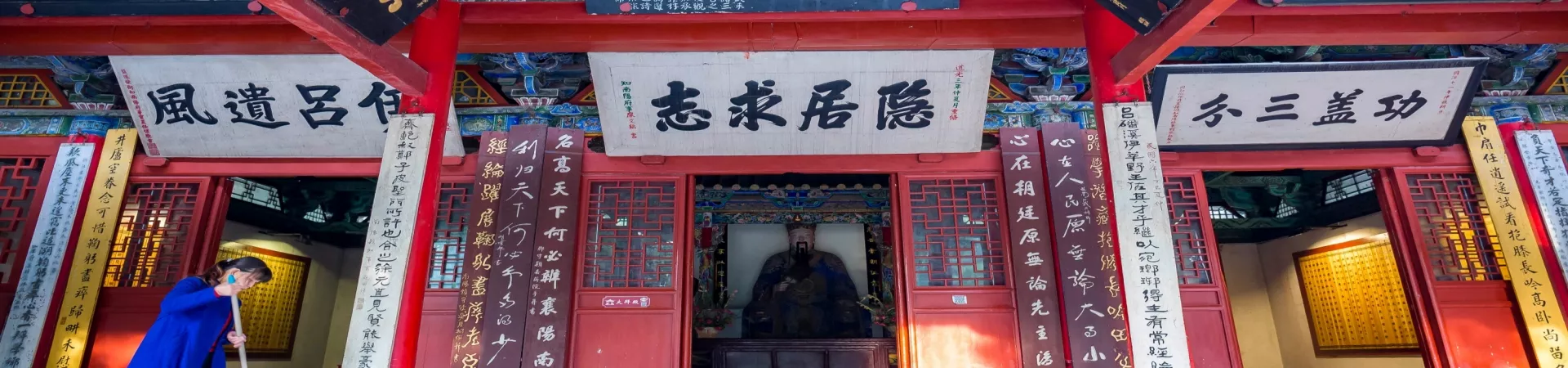
Subtitle: A Journey to the Heart of Chinese Strategy and Culture: Nanyang's Wuhou Temple
Introduction: The Cradle of a Legend
Nestled upon the serene West Wolonggang (Crouching Dragon Ridge) in Nanyang City, Henan Province, stands the Nanyang Wuhou Temple, a site of profound historical reverence and architectural grandeur. Recognized as a National Key Cultural Relic Protection Unit, this temple complex is dedicated to Zhuge Liang (181-234 AD), the legendary strategist and Prime Minister of the Shu Han state during the Three Kingdoms period. More than just a memorial hall, it is believed to be the very ground where the young Zhuge Liang lived in seclusion, tilling the land and cultivating his unparalleled wisdom before his fateful meeting with Liu Bei. The temple's origins trace back to the Wei and Jin dynasties, established as an act of remembrance. Although ravaged by war in the early Yuan Dynasty, it was magnificently rebuilt during the Dade era (1297-1307), laying the foundation for the awe-inspiring complex visitors witness today.
Architectural Layout and Historical Layers
The temple is a masterpiece of classical Chinese planning, harmoniously integrating commemorative halls with recreated landscapes that poetically reflect Zhuge Liang's life and spirit.
1. The Core Temple Complex The central axis of the site is formed by a sequence of solemn ceremonial structures. Visitors pass through the imposing Shanmen (Mountain Gate), leading to the majestic main hall. Key buildings include the San Gu Tang (Three Visits Hall), commemorating Liu Bei's three earnest invitations that brought Zhuge Liang into the world of statecraft, and the Guan Zhang Hall, dedicated to the sworn brothers and generals Guan Yu and Zhang Fei. The Qingfeng Lou (Clear Breeze Pavilion) and numerous stone Pailou (Memorial Archways) add layers of historical depth and aesthetic grace to the precinct.
2. The Wolonggang Ten Scenes: A Poetic Landscape A unique feature of the temple grounds is the embodiment of the "Wolonggang Ten Scenes." In the Qing Dynasty's Kangxi reign, prefect Luo Jing discovered stone inscriptions describing these ten poetic vistas. Inspired, he reconstructed them around the temple, creating a landscape garden of deep symbolic meaning. These scenes include: * Thatched Cottage (Caolu): The symbolic heart of the complex. * Half-Moon Platform (Banyuetai) * Old Dragon Cave (Laolong Dong) * Wild Cloud Hermitage (Yeyun An) * Small Rainbow Bridge (Xiao Hongqiao) * Hug-Knee Rock (Baoxi Shi) * Personal Tilling Pavilion (Gonggeng Ting) * Ancient Cypress Pavilion (Gubai Ting) * Liangfu Rock (Liangfu Yan) * Zhuge Well (Zhuge Jing) Together with the main temple buildings, they form a cohesive and monumental architectural ensemble that feels both grand and intimately connected to nature.
Detailed Highlights of Key Scenes
1. The Thatched Cottage (草庐) Positioned at the rear center of the compound, the Thatched Cottage is an octagonal, sharp-roofed hut built by later generations on the believed foundation of Zhuge Liang's original dwelling. It is a potent symbol of his humble, scholarly beginnings. Its significance is underscored by the calligraphic plaques adorning it: the front plaque, "Zhuge Thatched Cottage," was penned by the renowned modern scholar Guo Moruo in 1973; the inner plaque, "Zhuge's Hut," bears the handwriting of Yu Youren, President of the Control Yuan of the National Government in 1940; and the rear plaque, "Nanyang Zhuge's Hut," was inscribed by Fu Fengju, the Nanyang Prefect in the Qing Dynasty (1894).
2. The Small Rainbow Bridge (小虹桥) Located directly in front of the Thatched Cottage, this exquisite, single-arch bridge made of blue bricks is a charming and delicate structure, its form reminiscent of a rainbow—hence its name. Tradition holds that this was a path frequently traversed by Zhuge Liang during his years of residence here, connecting his humble abode with the wider world of the ridge.
3. Cultural Treasures: Stele Forest and Historic Relics The temple is renowned for its extensive collection of stone steles, a forest of inscribed history and art. The most celebrated among them is the stele engraved with the "First and Second Memorials on the Expedition" (Chu Shi Biao), authored by Zhuge Liang but transcribed in the powerful and elegant calligraphy of the national hero Yue Fei from the Southern Song Dynasty. This fusion of two legendary figures' spirits—the wise minister and the loyal general—makes it an unparalleled cultural artifact. Furthermore, at the southeastern corner of the temple grounds lies a platform said to be Zhuge Liang's personal reading spot, while the Longjiao Pagoda (Dragon Horn Pagoda) stands at the southwestern corner, adding a vertical accent to the skyline.
Visitor Information
- Address: West Wolonggang, Nanyang City, Henan Province, China.
- Ticket: General admission is 50 RMB (approximately $7 USD). This fee typically provides access to the entire temple complex and landscape gardens.
- Opening Hours: Hours vary seasonally. From October 17th to April 30th, the temple is open from 9:00 AM to 5:00 PM. During the peak season (May 1st to October 16th), hours are usually extended from 8:00 AM to 5:30 PM. It is advisable to confirm the latest schedule before your visit.
- Suggested Duration: A comprehensive visit to appreciate the architecture, landscapes, and steles requires a minimum of 1.5 to 2.5 hours. A brief tour of the main halls can be completed in about an hour.
- Contact: For inquiries, you may call +86-377-63229166.
A visit to Nanyang Wuhou Temple is more than a historical tour; it is an immersion into the enduring Chinese ideals of wisdom, loyalty, and the harmonious balance between scholarly retreat and public service. Walking through its halls and gardens, one follows in the footsteps of a sage, surrounded by the art and architecture that have kept his legacy alive for nearly two millennia.