Nanjie Village
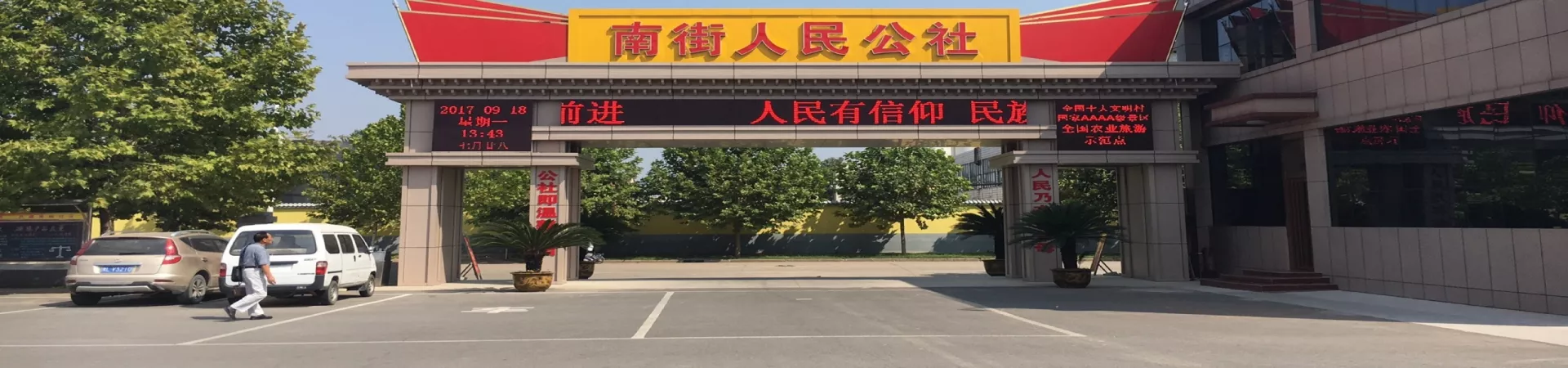
Subtitle: A Living Experiment: Nanjie Village, a "Communist Small Community" in Modern China
Introduction: The "Model Village" and Its Allure
Nestled within the city of Luohe, in China's Henan province, lies Nanjie Village, a settlement that defies easy categorization. To the outside world, and particularly to domestic tourists, it is not merely a village but a socio-economic phenomenon—a self-proclaimed "Communist small community" operating within the framework of a market-driven nation. For decades, Nanjie has captivated visitors not with ancient temples or natural landscapes, but with its unique and steadfast adherence to a collective, Maoist-era model of governance and economy in the 21st century. It presents itself as a living museum of egalitarian ideals, where the promises of collective welfare are presented not as historical artifacts, but as a functioning contemporary reality. The village's core appeal lies in its bold claim to have realized the aspirational socialist dream: "The elderly are cared for, the able-bodied are employed, the youth are educated, and the young are nurtured," creating a tightly-knit social fabric that stands in stark contrast to the inequalities prevalent in much of modern China.
The Ideological Foundation: "Red Tourism" and Collective Life
At the heart of Nanjie Village's identity and its tourism strategy is the deliberate and prominent emphasis on "red tourism." This goes beyond displaying historical relics; it involves immersing visitors in an environment that actively celebrates and perpetuates Maoist socialist values.
2.1. The "Communist Small Community" as a Lived Experience The village's most distinctive feature is its unabashed declaration as a "共产主义小社区" (Communist small community). This is not a nostalgic slogan but the central organizing principle for all aspects of life. For visitors, this translates into an immersive experience. They witness a society where the village collective, rather than private individuals or corporations, owns and controls all major enterprises, from the famous Nanjie instant noodle and seasoning factories to local hotels and shops. The pervasive iconography—large statues of Marx, Engels, Lenin, Stalin, and Mao Zedong on the main square, revolutionary songs broadcast through loudspeakers, and political slogans adorning buildings—serves to constantly reinforce this ideological framework. The tour is designed to let visitors "feel the continuous growth of communist elements," offering a tangible, if highly curated, glimpse into a communal lifestyle that has largely disappeared elsewhere.
2.2. The Mechanics of Collective Welfare and Equality The ideology is given concrete form through the village's economic and social policies. The collective operates on a system often described as a "supply and salary combination." Villagers receive extensive in-kind benefits—housing (allocated by the collective, not owned privately), utilities, education, healthcare, and even staple food items are heavily subsidized or provided free by the village administration. Monetary wages are modest but are supplemented by this comprehensive social safety net. This structure is presented as the practical pathway to "common prosperity," aiming to eliminate both extreme wealth and poverty. The narrative presented to tourists emphasizes harmony and security: there are no "tycoons" and no "impoverished households," as the collective acts as the ultimate guarantor for every member. This visible, day-to-day manifestation of collective care is a primary point of fascination and inquiry for visitors.
Tourist Infrastructure and Practical Information
To accommodate and educate the steady stream of curious tourists, scholars, and party members, Nanjie has developed a specific tourism infrastructure that aligns with its thematic focus.
3.1. Key Sites and Attractions The village layout itself is an attraction, featuring neat rows of uniform apartment blocks, well-maintained public spaces, and the aforementioned ideological monuments. Guided tours typically include visits to: * The Industrial Plants: Particularly the food processing factories, which are the economic engine of the collective and symbolize its self-reliance. * The Education System: Showcasing schools to highlight the priority given to collective upbringing and ideological education from a young age. * Cultural Exhibition Halls: Museums that detail the village's history, its principles, and the achievements of the collective system. * Residential Areas: Sometimes allowing glimpses into the standardized housing provided to villagers, emphasizing uniformity and equality.
3.2. Visitor Logistics For those planning a visit, the following practical details are essential: * Admission Fee: Entry to the Nanjie Village scenic area requires a ticket, priced at 80 Yuan. This fee typically covers access to the main public areas, exhibition halls, and often includes a guided tour that explains the village's philosophy and development. * Operating Hours: The village is open to visitors daily from 08:00 to 18:00. Last admission is at 18:00. These hours are consistent throughout the year (January 1st to December 31st, Monday through Sunday).
Interpretations and Lasting Impressions
A visit to Nanjie Village inevitably prompts deep reflection and varied interpretations. It exists as a complex symbol within modern China.
4.1. A Utopian Enclave or a Curated Display? Many visitors leave pondering the authenticity and sustainability of the model. Supporters view it as a successful, utopian enclave that preserves noble socialist values against the tide of capitalism, offering a viable alternative focused on community and equality. Critics and skeptics, however, may see it as a meticulously curated display—a subsidized theme park of ideology that relies on its profitable collective industries and its unique status to survive. They question the degree of individual freedom and the model's replicability elsewhere. The village does not shy away from this debate; instead, its existence is a permanent provocation to it.
4.2. Nanjie's Place in Contemporary Chinese Discourse Ultimately, Nanjie Village serves multiple purposes. It is a functional community for its residents, a tourist destination, and a political statement. For the Chinese state, it can be presented as an example of diverse developmental paths within socialism. For visitors, especially domestic ones, it acts as a powerful touchstone for memory, ideology, and curiosity about a different way of life. Whether seen as a bold experiment, a nostalgic relic, or a pragmatic adaptation, Nanjie Village stands as a unique and thought-provoking destination, challenging preconceptions about progress, community, and the very meaning of modernity in China today. Its streets, echoing with revolutionary songs, offer a silent yet potent commentary on the nation's tumultuous journey and its ongoing search for identity.