Cai Hesen Memorial Hall
Subtitle: A Journey Through Revolutionary History: The Cai Hesen Memorial Hall in Loudi, Hunan
I. Introduction to the Memorial Hall
Nestled at the intersection of Fuxing Road and Shuyuan Road in Shuangfeng County, Loudi City, stands the Cai Hesen Memorial Hall. This institution serves as a profound tribute to one of the early and pivotal figures of the Chinese Communist Revolution. Directly opposite the hall lies the Cai Chang Library, named after Cai Hesen's renowned sister, creating a dedicated precinct honoring this extraordinary revolutionary family. Since its inauguration on July 1, 1987, the memorial hall has established itself as a central site for historical education and remembrance in Hunan Province. The building itself, with a total floor area of 1,624 square meters, is both dignified and accessible. Above its main entrance, visitors are greeted by the inscribed name of the hall, "Comrade Cai Hesen Memorial Hall," penned by Marshal Nie Rongzhen, a testament to the high regard in which Cai Hesen is held by the revolutionary generation.
II. The Memorial Square and Exterior Commemorations
A. Cai Hesen Square Approaching the hall, one first enters the expansive Cai Hesen Square, covering approximately 11,000 square meters. This open space provides a solemn and contemplative approach to the museum, setting the tone for the historical journey within.
B. The Central Monument Dominating the square is a striking 9-meter-high monument. At its pinnacle stands a resolute statue of Cai Hesen. The stele features an inscription personally calligraphed by Comrade Chen Yun, another key leader of the revolution. This monument serves as a powerful focal point, symbolizing Cai Hesen's enduring legacy and lofty stature in Chinese revolutionary history.
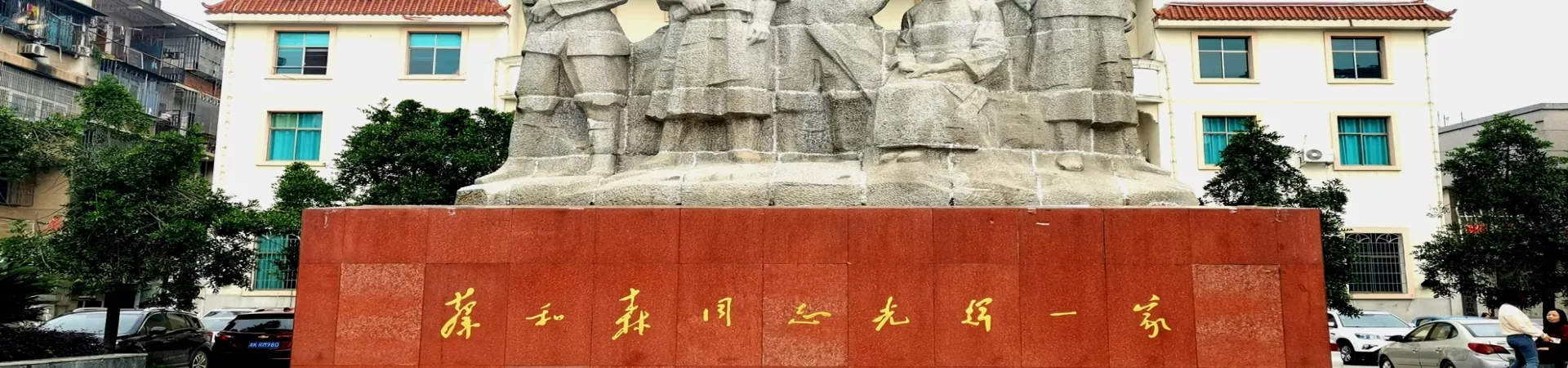
C. "The Glorious Family of Cai Hesen" Sculpture To the side of the hall resides one of its most evocative exterior features: the group sculpture titled "The Glorious Family of Cai Hesen." This white granite ensemble captures six central figures from the family: Cai Hesen himself; his wife and fellow revolutionary martyr, Xiang Jingyu; his sister, Cai Chang, a prominent women's leader; his remarkable mother, Ge Jianhao, who supported her children's revolutionary pursuits; his niece, Cai Luxian; and Li Fuchun, Cai Chang's husband and a significant economic planner for the PRC. The sculpture brilliantly captures their collective determination and intellectual spirit. Cai Hesen is depicted with a penetrating gaze, seemingly contemplating the world's affairs and a brighter future. His Western-style haircut, suit, and tie are not merely sartorial details but are rendered to reflect his embrace of advanced ideas and his determination to transform old China. The sculpture's title, in nine golden characters, is transcribed from Chairman Mao Zedong's own running-hand calligraphy. This choice is deeply symbolic, referencing both the profound personal bond between Mao and Cai—once praised by their teacher Yang Changji as "two sons for national salvation"—and Mao's famous, high praise of Cai: "What a Communist Party member should do, Comrade Hesen did."
III. Interior Exhibitions and Collections
A. The Main Hall and Bronze Bust Upon entering the memorial hall's lobby, visitors encounter a dignified bronze bust of Cai Hesen. Donated in 1988 by his granddaughter Cai Yu (daughter of Cai Bo) and her husband Xu Longsen, the bust stands 1.15 meters high (2.68 meters including the pedestal). It is set against the backdrop of a commemorative inscription written by Deng Xiaoping on September 27, 1979, further connecting Cai's legacy to the broader narrative of China's revolutionary and reform periods.
B. The Six Exhibition Halls The hall's core consists of six meticulously arranged exhibition rooms. These rooms guide visitors through a comprehensive narrative of Cai Hesen's life and contributions, displaying over 140 precious artifacts, historical photographs, documents, and personal writings. The exhibition is structured chronologically and thematically, beginning with his formative years.
1. Early Life and Intellectual Formation The initial exhibits focus on Cai Hesen's youth, highlighting his diligent studies and early exposure to progressive thought. Artifacts from this period illustrate the foundation of his intellectual rigor and his growing concern for China's fate, which would lead him to seek solutions abroad.
2. The Work-Study Movement in France A significant section is dedicated to Cai Hesen's pivotal role in the Work-Study Movement in France during the early 1920s. This period was crucial for his ideological development. The exhibits detail how, alongside Mao Zedong who remained in China, he engaged in intense discussions about Marxism-Leninism through correspondence, actively participating in the founding of the Chinese Communist Party organizations in Europe. His writings from this period showcase his early and sophisticated theoretical contributions to the Party's founding ideology.
3. Revolutionary Leadership and Theoretical Work Subsequent halls document his return to China and his subsequent work as a key Party leader, propagandist, and theoretician. He served in important roles within the Central Committee and was known for his incisive analyses and writings on the Chinese revolution. Exhibits include his published works, documents related to his Party activities, and photographs from this intense period of struggle.
4. Final Years and Martyrdom The final exhibition halls address the later, tragic chapter of his life. They cover his arrest by the Kuomintang in 1931 and his heroic martyrdom at the age of 36, refusing to yield under torture. This section solemnly commemorates his ultimate sacrifice for his beliefs, cementing his status as a revolutionary hero.
IV. Practical Information for Visitors
A. Educational Significance and Recognition The Cai Hesen Memorial Hall's importance extends beyond preservation; it is an active center for education. In 1995, it was officially designated as a "Hunan Provincial Patriotic Education Base." This status underscores its role in fostering historical understanding and patriotic spirit among students, cadres, and the general public. The hall's impact is evidenced by its impressive visitor numbers, having hosted over 800,000 people from across China since its opening.
B. Visiting Details For those planning a visit, the following practical information is essential: * Opening Hours: The hall is open daily from 08:30 to 17:00 throughout the year (January 1st to December 31st, Monday through Sunday). * Contact Information: For inquiries, visitors can contact the memorial hall at +86-738-6853308.
A visit to the Cai Hesen Memorial Hall is more than a museum tour; it is an immersion into the personal and political journey of a foundational revolutionary thinker and his family. Through its serene square, powerful sculptures, and detailed interior exhibitions, the hall offers a tangible connection to the ideals, struggles, and sacrifices that shaped modern China. It stands as a lasting monument to the power of intellectual conviction and revolutionary courage.