Gutian Congress Site
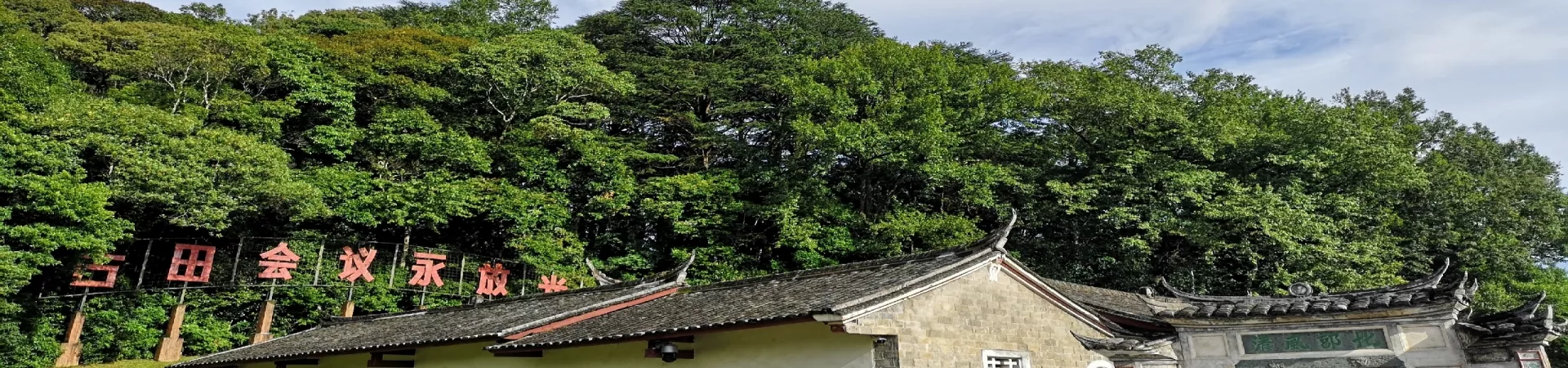
Subtitle: A Journey Through History: Exploring the Gutian Conference Site in Longyan
Introduction: The Cradle of a Revolution
Nestled at the foot of the Bijiashan Mountain in Caitouling, Gutian Town, Shanghang County, within the city of Longyan, Fujian Province, lies a site of profound historical significance for modern China. This is the Gutian Conference Site, a location that transcends its modest architectural scale to occupy a monumental place in the nation's political and military history. Originally constructed not for political assemblies but as a place of ancestral worship, the building's transformation into a crucible of revolutionary ideology marks a pivotal chapter in the story of the Chinese Communist Party and the People's Liberation Army. A visit here is not merely a tour of an old building; it is an immersion into the foundational principles that shaped a movement.
1. Architectural Heritage: From Ancestral Hall to Schoolhouse
1.1. The "Liao Clan Ancestral Hall": Original Form and Function The structure now known globally as the Gutian Conference Site began its life in 1848, during the 28th year of the Daoguang Emperor's reign in the Qing Dynasty. It was built as the "Liao Clan Ancestral Hall," also known as the "Wanyuan Ancestral Hall." This single-story brick-and-wood complex exemplifies the traditional siheyuan (courtyard) style with a hip-and-gable (xieshan) roof, a design common for significant communal buildings in southern China. Oriented east-west, the hall served as the spiritual and social center for the local Liao family, a place for rituals, gatherings, and upholding clan traditions.
1.2. Layout and Structural Composition The architectural layout is characteristic of its era and purpose. The complex is composed of a front hall, a rear hall, and left and right wing-rooms, all arranged around a central courtyard. This configuration facilitated both ceremonial processions and daily clan activities. With a total floor area of 826 square meters, the space is substantial yet intimate. The construction materials—local brick, wood, and stone—and the intricate craftsmanship evident in the roof beams and carvings speak to its importance as a community project in the mid-19th century.
1.3. Transition to "Hesheng Primary School" In the early 20th century, as China underwent immense social change, the building's function evolved. It was converted into the Hesheng Primary School. This repurposing from a site of traditional lineage worship to one of modern education reflects the broader intellectual and cultural shifts occurring in China at the time. It was this very role as a schoolhouse that made it a suitable and discreet venue for a critical political meeting later on.
2. The Pivotal Event: The Gutian Conference of 1929
2.1. Historical Context and Necessity By late 1929, the Chinese Red Army, led by the Communist Party, was at a critical juncture. Following the failure of several urban uprisings, the revolutionary focus had shifted to the countryside. However, the army was composed largely of peasants and former Kuomintang soldiers, leading to internal conflicts, non-proletarian ideologies, and debates over the army's fundamental role. There was an urgent need to unify thought, establish clear political principles, and solidify the Party's absolute leadership over the military.
2.2. The Conference Proceedings It was in this context that the 4th Army of the Chinese Red Army convened its 9th Party Congress in this unassuming former ancestral hall and school from December 28 to 29, 1929. Presided over by Mao Zedong, Zhu De, and Chen Yi, the meeting addressed the existential issues within the army. The delegates, housed in the simple wing-rooms and debating in the main halls, worked under spartan conditions to forge a new path.
2.3. The Gutian Conference Resolution: Core Tenets The outcome was the seminal "Gutian Conference Resolution," drafted primarily by Mao Zedong. Its most enduring contributions are: * The Primacy of Political Building: It established that the army was not merely a fighting force but a political force tasked with carrying out the Party's political missions. Ideological education was paramount. * The Party's Absolute Leadership: It institutionalized the system of Party branches at the company level, ensuring the Party's direct command over every unit of the army. * Elimination of Purely Military Viewpoints: It criticized the idea that the military should operate independently of mass politics and the peasant movement. * Clarifying the Army's Mission: The resolution defined the army's role in carrying out revolution, organizing masses, and establishing political power.
This resolution is widely regarded as the foundational document that shaped the nature and character of the People's Liberation Army, defining the principle of "the Party commanding the gun."
3. The Site Today: A Living Museum
3.1. Preservation and Exhibition Today, the Gutian Conference Site is meticulously preserved as a national key cultural relic protection unit and a major patriotic education base. The restoration maintains its appearance from the winter of 1929. Visitors can walk through the rear hall, which served as the main conference venue, and see the simple wooden desks and benches, the portable oil lamp used by Mao Zedong, and the charcoal braziers that provided warmth against the winter chill. The walls are adorned with period slogans and posters. The wing-rooms, where delegates slept on makeshift beds of wooden boards and straw, are also open for viewing, offering a tangible sense of the austere conditions.
3.2. The Surrounding Memorial Landscape The site is part of a larger memorial area. In front of the hall lies a spacious square, often used for commemorative ceremonies. Nearby, the Gutian Conference Memorial Hall houses extensive historical exhibits, documents, and photographs that provide deeper context to the conference and its historical aftermath. The surrounding landscape of rolling hills and quiet countryside helps visitors imagine the remote, secure environment that allowed for such a crucial meeting to take place.
4. Practical Visitor Information
4.1. Location and Transportation The site is located in Gutian Town, Shanghang County, Longyan City, Fujian Province. The most convenient way for independent travelers to reach it is by hiring a local taxi or arranging a private car from Longyan city center or Shanghang county. The site is accessible via National Highway 319; following the road towards Gutian will lead directly to the memorial area.
4.2. Opening Hours and Admission The Gutian Conference Site is open to the public year-round. * Opening Hours: 08:00 - 18:00 (Monday through Sunday). * Admission Details: It is advisable to check the latest ticket prices and any potential free entry policies directly with the scenic area administration prior to your visit, as these details can be subject to change.
4.3. Suggested Duration and Experience A comprehensive visit to the Gutian Conference Site and the adjacent memorial hall typically requires 1 to 3 hours. This allows sufficient time to explore the historic building itself, reflect on its significance, and review the detailed exhibitions in the modern memorial museum. The atmosphere is one of quiet reverence, encouraging contemplation on a defining moment in China's revolutionary history.