Walking Marriage Bridge
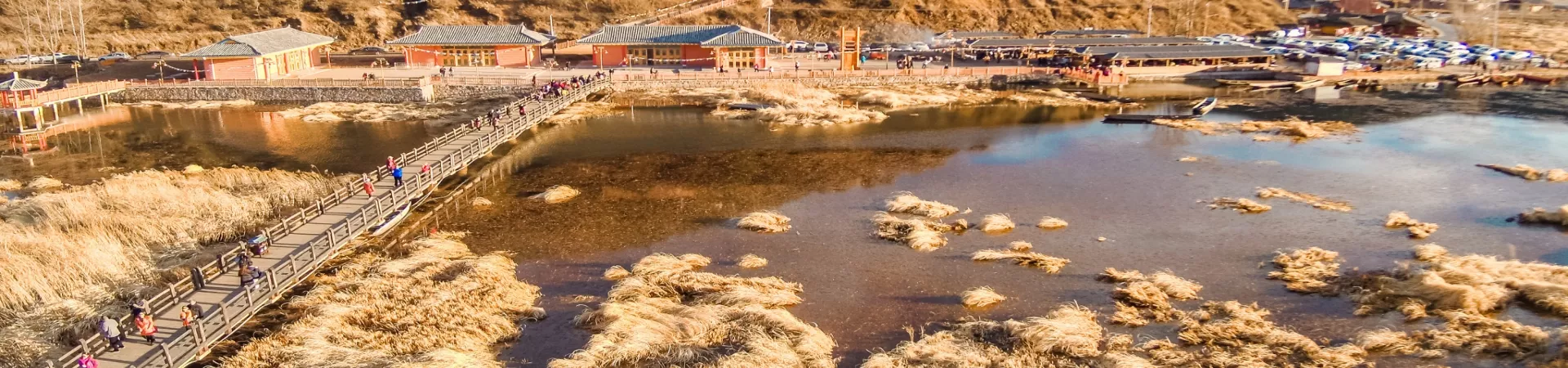
Subtitle: A Journey Across the "World's First Magpie Bridge": The Legendary Walking Marriage Bridge of Lugu Lake
1. Introduction to the Walking Marriage Bridge
Nestled within the breathtaking expanse of Caohai ("Grass Sea"), the vast natural wetland of Lugu Lake, lies a structure of profound cultural and romantic significance: the Walking Marriage Bridge. Reverently dubbed the "World's First Magpie Bridge," this 300-meter-long wooden pathway stretches gracefully through a seemingly endless sea of whispering reeds. More than just a scenic boardwalk, it serves as a vital artery connecting communities and, more poetically, as the legendary stage for the unique Mosuo practice of "walking marriage." For visitors, a stroll across this bridge is not merely a walk through a stunning landscape but a step into the heart of one of China's most fascinating and enduring matriarchal cultures.
2. History and Reconstruction of the Bridge
2.1. The Original Century-Old Structure The current Walking Marriage Bridge is, in fact, a successor to a bridge with nearly a century of history. The original structure, built from local timber, bore silent witness to generations of Mosuo life, love, and daily communion. Over decades of exposure to the elements and the humid environment of the wetland, sections of the old bridge gradually succumbed to decay and damage. Today, remnants of this historic path can still be seen, with weathered wooden pilings and fragments resting peacefully in the shallow waters amidst the reeds, serving as poignant relics of the past.
2.2. The New Bridge: Preservation and Access To ensure both safety and the preservation of this important cultural site, a new bridge was constructed directly adjacent to the original alignment. This reconstruction was undertaken with careful consideration, aiming to maintain the bridge's authentic character and function while using modern materials and techniques for longevity. The new Walking Marriage Bridge now stands as a seamless continuation of tradition, offering visitors and locals alike a stable and scenic passage while honoring the legacy of the path it replaced.
3. Cultural Significance and the "Walking Marriage" Tradition
3.1. The Bridge as a Functional and Social Lifeline The primary, practical purpose of the Walking Marriage Bridge is elegantly simple: to provide a direct, convenient passage across the Caohai wetland. It connects the villages on either side, facilitating daily travel, trade, and interaction for local residents. This function is deeply intertwined with its more famous cultural role, as it also provides the crucial, discreet pathway for "Axias" (romantic partners in the Mosuo tradition) to meet.
3.2. Understanding the Mosuo "Sese" Custom To truly appreciate the bridge, one must understand the social fabric of the Mosuo people residing around Lugu Lake. They practice a unique familial system often referred to as "walking marriage" (Mosuo: "sese"). In this matrilineal society, there is no institutional marriage in the conventional sense. Instead, the core social unit is the extended maternal family, with lineage and property passed through the female line. Adults form romantic relationships based on mutual affection, but partners do not live together in a single household.
3.3. The Bridge's Role in Romance This is where the Walking Marriage Bridge becomes legendary. Under the cover of dusk or after nightfall, men would traditionally walk from their own maternal homes to visit their beloved partners. The bridge, stretching silently through the isolating reeds, offered a private, symbolic corridor for these journeys. It was a place of anticipation, secret meetings, and whispered promises. The term "Magpie Bridge" is a direct allusion to the Chinese folktale of the Cowherd and the Weaving Maid, who are reunited across a bridge formed by magpies once a year. Similarly, the Walking Marriage Bridge facilitates the romantic unions central to Mosuo life, making it a powerful, real-world symbol of love and connection.
4. Practical Visitor Information
4.1. Location and Accessibility The Walking Marriage Bridge is located within the Caohai section of the Lugu Lake scenic area, which straddles the border between Sichuan and Yunnan provinces. It is a central and accessible highlight for any tour of the lake, easily reached by local transport, bicycle, or as part of guided tours from nearby villages like Luoshui or Lige.
4.2. Admission and Opening Hours Access to the Walking Marriage Bridge is included in the general admission ticket for the Lugu Lake scenic area. There is no separate fee for the bridge itself. Notably, the bridge is accessible to visitors 24 hours a day. While daytime offers spectacular views of the green reed beds against blue water and mountains, an evening or early morning visit can provide a more serene and atmospheric experience, closer to the traditional context of its use.
4.3. Suggested Visit Duration and Tips A visit to the bridge itself typically requires less than an hour for a leisurely walk across and back, allowing time for photography. However, visitors are encouraged to allocate more time to absorb the surrounding beauty of Caohai, perhaps by taking a paddleboat ride through the reeds for a different perspective of the bridge. When visiting, respectful observation of local customs is appreciated. The bridge remains a functional and meaningful site for the Mosuo community. It is a place for quiet reflection on a unique way of life, where love, family, and community are defined by traditions that have gracefully endured for centuries amidst the stunning natural beauty of Lugu Lake.