Qin Palace
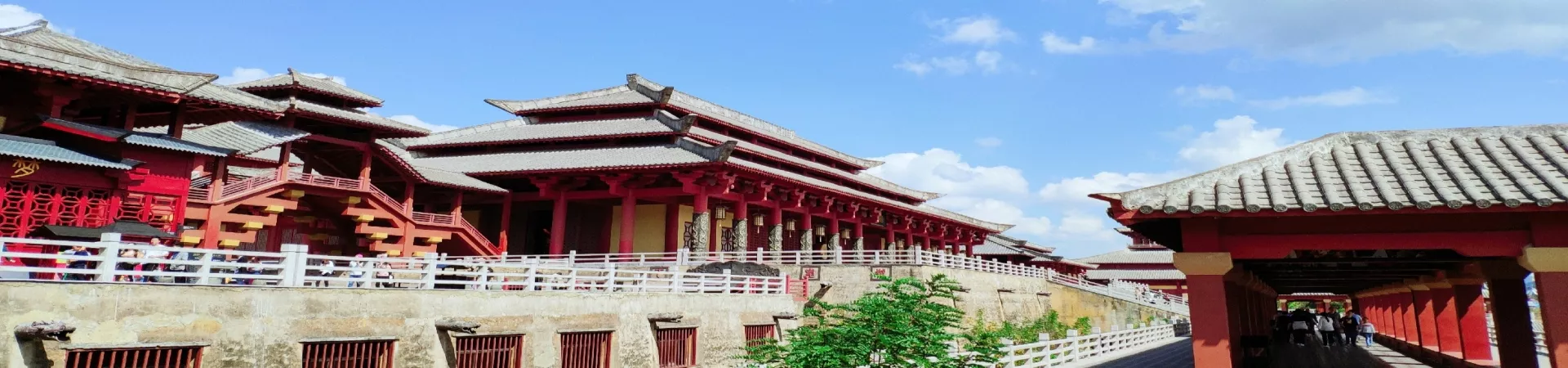
Subtitle: A Cinematic Journey into China's Ancient Qin Dynasty
Introduction: A Palace Built for the Silver Screen
Nestled within the sprawling Hengdian World Studios in Jinhua, Zhejiang Province, the Qin Dynasty Palace (Qin Wang Gong) stands as a monumental tribute to China's ancient history and its modern cinematic imagination. Unlike historical sites with centuries of patina, this palace was conceived and constructed in the late 1990s for a singular artistic purpose: to serve as the primary filming location for renowned director Chen Kaige's historical epic, The Emperor and the Assassin. Designed as a meticulous replica of the Xianyang Palace, the most crucial administrative and ceremonial heart of the Qin Dynasty (221-206 BC), the complex offers visitors a tangible, immersive step into the world of China's first emperor, Qin Shi Huang.
Architectural Grandeur: Symmetry and Symbolism
The palace's design is a profound study in traditional Chinese palatial architecture and cosmological symbolism, adhering strictly to ancient principles.
2.1 The Axial Layout and Ritual Order The entire complex is organized along a powerful central north-south axis, embodying the concept of "zhong zhou dui chen" (central axis symmetry). This layout reflects the imperial belief in cosmic order and the emperor's role as the pivotal link between heaven and earth. Flanking this axis are structures arranged according to the "zuo zu you she" principle, with ancestral temples on the left (east) and altars to the gods of earth and grain on the right (west), underscoring the dynasty's reverence for lineage and state.
2.2 From Court to Chamber: The Functional Divide The "qian chao hou qin" (front court, rear寝) design clearly demarcates the palace's public and private spheres. The expansive front sections were dedicated to awe-inspiring imperial audiences, grand ceremonies, and the serious business of governance. In contrast, the rear quarters provided living spaces for the imperial family, emphasizing a strict hierarchy and order in daily life. Throughout the halls, visitors encounter intricate details like the imposing dragon throne and remarkably lifelike bronze ritual vessels, which enhance the authentic atmosphere.
The Heart of the Empire: The Hall of Unification
Dominating the complex is its centerpiece, the "Si Hai Gui Yi Dian" (Hall Where the Four Seas Unify). This majestic structure was the symbolic and functional core where the emperor held court and administered his unified empire.
3.1 A Journey Through the Hall The hall is a vast, elongated pavilion divided into three progressive sections: the Front Hall, Central Hall, and Rear Hall, creating a dramatic纵深 (depth) of over 120 meters. This design was intentional, forcing officials and supplicants to traverse a long, awe-inspiring path to the throne, visually reinforcing the emperor's supreme authority and remoteness. The scale is deliberately overwhelming, designed to diminish the individual and exalt the power of the state.
A Living Film Set: The Cradle of Epic Stories
Beyond its historical impersonation, the Qin Dynasty Palace's primary legacy is its role as a cornerstone of Chinese film and television.
4.1 A Reel History Since its inauguration for Chen Kaige's film, the palace has become one of China's most prolific and iconic filming locations. Its authentic and grand-scale architecture has provided the perfect backdrop for nearly a hundred historical dramas and blockbusters. Notable productions filmed here include Zhang Yimou's visually stunning Hero, the popular time-travel series A Step into the Past, and the intricate court intrigue drama Beauty's Rival in Palace. Walking through its gates and courtyards, visitors are treading the same stones where countless cinematic legends have been made, blurring the lines between historical recreation and pop culture history.
4.2 An Immersive Experience The palace leverages its film set heritage to offer dynamic visitor experiences. Throughout the day, scheduled live performances and stunt shows, often featuring themes from famous movies shot on-site, bring the courtyards to life with action and drama. The opportunity to dress in period costume for photographs further allows guests to insert themselves into both history and their favorite cinematic narratives.
Practical Visitor Information
Getting There The palace is located within the Hengdian World Studios complex in Dongyang, Jinhua. Direct long-distance buses are available from major cities like Hangzhou and Shanghai to Hengdian. Upon arrival in Hengdian, local public buses such as the Hengdian Line 12, Line A, or Line B can take you to the "Qin Wang Gong" (Qin Dynasty Palace) bus stop, from which the entrance is within walking distance.
Admission Details * Standard Ticket: 180 RMB (Adult). * Half-price Ticket: Applicable to children aged 8-13 (inclusive) or with height between 1.3m-1.6m (inclusive); holders of a disability certificate. * Free Admission: Children aged 7 and below or under 1.3m in height; active-duty military personnel, armed police, national comprehensive fire rescue force members; accredited journalists. * Discounted Tickets (Please Note): * 30% discount (approx. 126 RMB): Senior males aged 60+ and females aged 55+. * 20% discount (approx. 144 RMB): Teachers holding a county-level or above education bureau-issued teacher qualification certificate; youths under 18 (without student ID) or full-time students with a valid student ID; military veterans. * Important: All discounted, half-price, or free admissions require presentation of original, valid physical identification documents (ID card, passport, disability certificate, student card, officer card, etc.) at the ticket office. Failure to present the required document will necessitate purchasing a full-price ticket at the gate. Visitors under 18 must be accompanied by an adult. * Disclaimer: Ticket information is for reference only. Please confirm the latest prices and policies on the official website or at the ticket booth on the day of your visit.
Opening Hours * May 1st - October 6th: 08:00 - 17:00 (Last entry at 16:30). * October 7th - April 30th (following year): 08:00 - 16:30 (Last entry at 16:00). * Suggested Visit Duration: 1-3 hours is typically sufficient to explore the main structures and catch a performance.
Contact For any inquiries, you may contact the venue at: 0579-86547155.