Hongjiang Ancient Mall
Subtitle: A Journey Through Time: Exploring the Architectural Marvel and Historical Tapestry of Hongjiang Ancient Commercial Town
1. Introduction: The Labyrinthine Heart of Ancient Commerce Nestled at the confluence of the Yuan and Wu Rivers in Huaihua City, Hunan Province, the Hongjiang Ancient Commercial Town stands as a remarkably preserved testament to China's mercantile history. More than just a collection of old buildings, it is a physical narrative of economic prowess, architectural ingenuity, and social life from the Ming Dynasty through the Republican era. Often described as a "living architectural encyclopedia" of southern China, its maze-like alleys and imposing structures whisper tales of merchant princes, bustling trade, and a uniquely integrated urban philosophy.
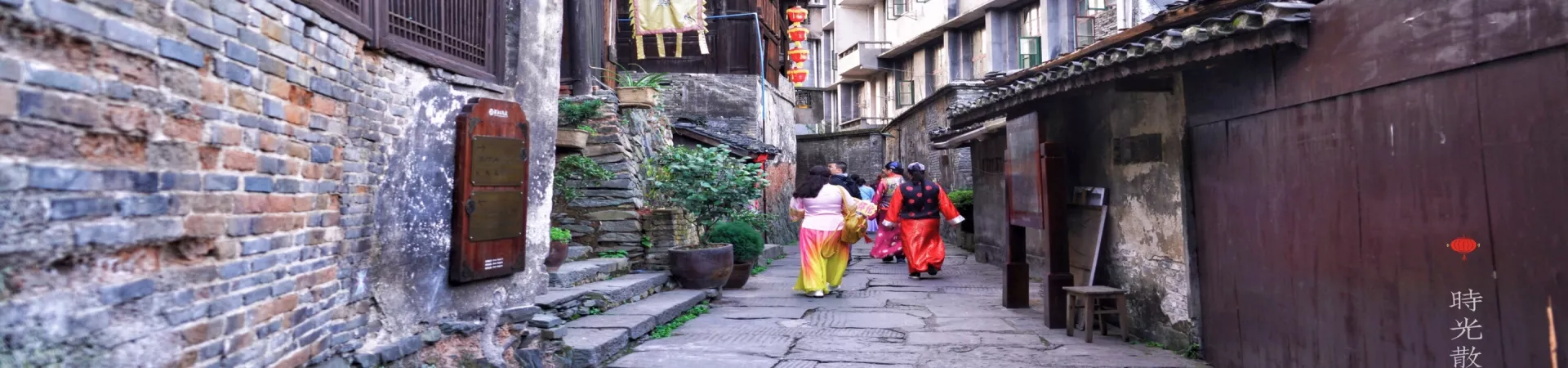
2. Architectural Philosophy and Spatial Mastery 2.1. A Maze Designed by Philosophy The town's most striking feature is its spatial distribution. From above, the town reveals itself as an intricate, multi-layered maze. A network of winding, dark-blue slate paths divides the urban fabric into a captivating labyrinth. This design is not accidental but a profound application of traditional Chinese philosophy and geomancy. As documented in the meticulously drawn "Complete Map of Hongjiang Streets" from 1889 (Guangxu 15th year of the Qing Dynasty), the entire settlement was planned according to the principles of Yin-Yang, the Eight Trigrams (Bagua), and traditional rites. Builders adapted ingeniously to the challenging terrain, carving structures into hillsides, filling valleys, and ensuring most buildings faced the Yuan River or nestled against the Wu River.
2.2. Harmony Between Architecture and Nature The overall layout, despite its density and wide distribution, is scientifically rational and aesthetically harmonious. Buildings rise layer upon layer up the mountain slopes in a fan-shaped pattern, creating a stunning visual cascade that blends seamlessly with the natural landscape. This "following the mountains and leveraging the waters" approach showcases the ancient planners' exceptional skill in creating man-made beauty that complements, rather than conquers, its environment. Each building maintains a careful balance: interconnected for community integrity yet independently beautiful, contributing to a perfectly coordinated whole.
2.3. The Iconic "Yinzi" Houses: Symbols of Power and Wealth The architectural character is epitomized by the distinctive traditional compound houses known as Yinzi Wu. These structures, with their grey-tiled roofs, grey brick walls, soaring eaves, and attic galleries, are masterpieces of practical design and opulent statement. Their construction ensures excellent natural lighting and ventilation, while their decorative elements and robust frameworks exude an aura of authority and immense wealth. They represent a classic fusion of Huizhou-style and Jiangnan residential architecture. The relationship between these architectural clusters, their morphological features, internal layouts, and the surrounding hills, waterways, and gardens forms a unique ecosystem, preserving a nearly complete socio-cultural morphology encompassing politics, military, economy, daily life, education, religion, and entertainment.
3. Historical Scale and Preserved Legacy 3.1. An Unparalleled Collection of Historical Fabric The present scale of Hongjiang Ancient Commercial Town is nothing short of extraordinary. It boasts the well-preserved remains of over 380 buildings, covering nearly 300,000 square meters. This collection, remarkable for its size, breadth, imposing presence, architectural diversity, historical depth, and state of preservation, is extremely rare in Hunan and across China. The timeline encapsulated here spans from Ming-era temples and monasteries to Qing-dynasty banks, foreign trading companies, guildhalls, workshops, shops, opium dens, inns, and brothels, all the way to Republic-era schools and newspaper offices.
3.2. A Walk Through the "Riverside Scene at Qingming Festival" Wandering its 8 kilometers of intermittently preserved bluestone roads and stepped river docks, which wind and dip through the town, is akin to stepping into a three-dimensional scroll painting. The town functions as a vivid panorama of Ming, Qing, and Republican society. Scattered throughout are authentic relics that bring history to life: door plaques, couplets, stone carvings, and inscriptions from the reigns of Kangxi, Qianlong, Daoguang, Tongzhi, Guangxu, and the Republic of China; over 40 exquisitely patterned and finely carved "Taiping" water vats, each with distinct styles; 48 scattered stone tablets and steles; and a collection of over 380 cultural artifacts.
3.3. Priceless Cultural Artifacts and Ancient Traces Among its treasures are historically significant items like the "Record of the Hongjiang Victory Pavilion" stele, documenting crucial history of the Xuefeng Campaign during the War of Resistance Against Japan. The town also safeguards precious calligraphy by renowned masters, including works by Zheng Banqiao, one of the Qing Dynasty's "Eight Eccentrics of Yangzhou," and the modern master Yu Youren. Evidence of even older habitation exists in the form of three Neolithic sites and an ancient tomb of a notable figure. The dense concentration of temples, halls, guilds, old newspapers, banks, schools, theaters, and various commercial establishments completes the immersive experience, solidifying the town's reputation as a real-life "Riverside Scene at Qingming Festival."
4. Visitor Information 4.1. Admission and Operating Hours The general admission ticket is priced at 90 RMB per person, applicable year-round from Monday to Sunday. The ancient town is open to visitors daily from 08:00 to 17:00, with the last admission at 17:00.
4.2. Suggested Duration and Contact A thorough exploration to appreciate the architectural complexity and historical depth typically requires 1 to 3 hours. For further inquiries, visitors can contact the management via telephone at 0745-7632579 or 0745-7626500.