Zhenhuai Building
Subtitle: A Journey Through Time: Exploring Huai'an's Ancient Sentinel, the Zhenhuai Tower
1. Introduction: The Heart of Huai'an
Standing proudly at the very center of Huai'an's ancient city in Jiangsu Province, the Zhenhuai Tower is far more than a mere historical structure; it is the enduring symbol of the city's resilience, architectural ingenuity, and deep connection to the mighty Huai River. Its story, woven through dynasties, begins not with its current name, but in the Southern Song Dynasty, marking it as a witness to nearly a millennium of Chinese history. Initially serving a practical purpose in the city's daily life, its evolution reflects the changing needs and challenges faced by the people of Huai'an. Today, meticulously preserved and enhanced by the dedicated efforts of the local community, it presents visitors with a captivating blend of solemn history and serene beauty, offering a tangible link to the past amidst the modern city.
2. Historical Evolution: From Watchtower to Guardian
2.1. Southern Song Origins and Ming Transformation The tower's foundations were laid during the Southern Song Dynasty (1127–1279), though its original form and function from this period are nuanced by time. Its significant transformation came during the Ming Dynasty (1368–1644), when it was integrated into the city's fortifications and repurposed as a Qiaolou – a watchtower or drum and bell tower. In this vital civic role, it governed the rhythm of daily life, its drums and bells marking the hours, signaling the opening and closing of city gates, and serving as an alarm during emergencies. This phase established the tower as a central nervous system for the ancient city.
2.2. The Qing Dynasty: Rebuilding and Renaming The tower's relationship with the Huai River, a life-giving yet often destructive force, culminated in a name change during the Tongzhi reign (1862–1874) of the Qing Dynasty. It was formally renamed "Zhenhuai Lou," which translates to "Tower for Suppressing the Huai River." This name directly embodied the populace's hopes and prayers to subdue the river's frequent and devastating floods. The physical structure visitors see today largely dates from a subsequent reconstruction in the 7th year of the Guangxu Emperor (1881). This late-Qing reconstruction carefully preserved the tower's essential character while ensuring its survival into the modern era.
3. Architectural Splendor: A Study in Form and Function
The Zhenhuai Tower's design is a classic example of traditional Chinese tower architecture, characterized by a robust, fortified base supporting an elegant wooden pavilion.
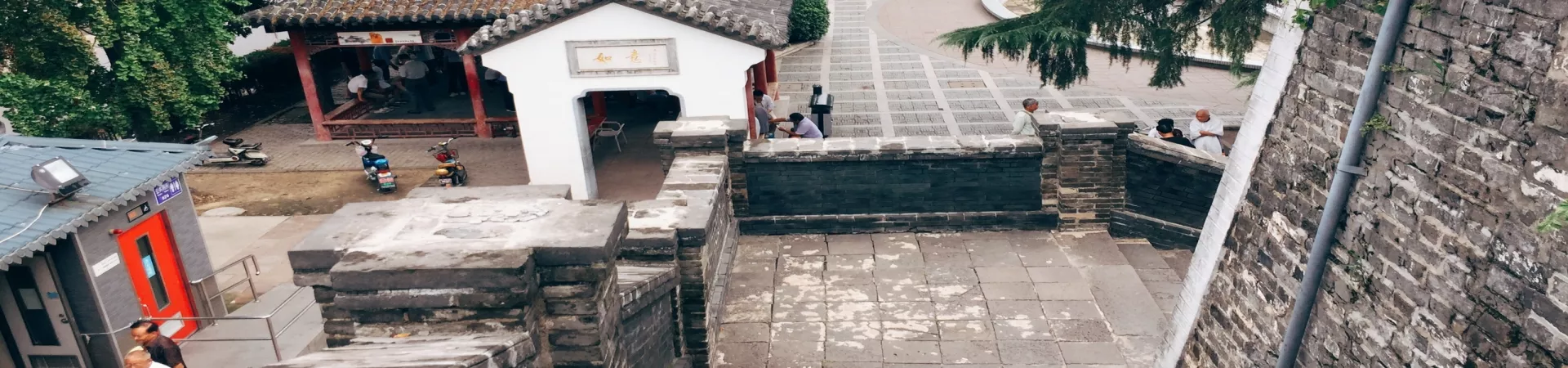
3.1. The Solid Base: The Brick-and-Stone Platform The tower rests upon an imposing brick and stone terrace. This solid base, which narrows slightly towards the top, creating a trapezoidal profile, is pierced by a grand, vaulted archway passage at its center, allowing traffic to flow through the city's heart. A brick staircase, nestled against the side of the platform, provides access to the summit. The top of this platform is encircled by protective balustrades, forming a spacious viewing deck.
3.2. The Elegant Pavilion: The Wooden Superstructure Crowning the sturdy platform is a two-story wooden pavilion, a masterpiece of carpentry. It features a Xieshan style roof with double eaves, covered in dark grey tiles, presenting a dignified and古朴 (gǔ pǔ, simple and elegant) silhouette. The pavilion is three bays wide, with intricately crafted wooden brackets (dougong) supporting the broad, overhanging roofs. This harmonious contrast between the heavy, earthbound base and the graceful, seemingly weightless wooden structure above is a key element of its aesthetic appeal.
4. Visitor Information: Planning Your Visit
4.1. Location and Transportation The Zhenhuai Tower is situated in the ancient urban core of Huai'an District, Huai'an City. It is easily accessible by public bus; routes 61, 62, and 63 all have stops in the vicinity. The tower's central location makes it an ideal starting point for exploring the surrounding historical areas.
4.2. Admission Fees and Opening Hours Access to the tower grounds is typically unrestricted, but to ascend the platform and enter the wooden pavilion for the best views, a modest admission fee is required. As of the latest information, the fee for登楼 (dēng lóu, ascending the tower) is approximately 5 to 10 RMB. Visitors should verify the exact fee on-site, as pricing can be subject to change. The tower is open to the public daily from 7:30 AM to 6:30 PM. The last admission is at 6:30 PM. It is advisable to confirm these hours before your visit, as they apply year-round but could be adjusted for maintenance or special circumstances.
4.3. The Experience: Views and Ambiance Climbing the ancient staircase to the top of the platform rewards visitors with a panoramic view of the modern city of Huai'an unfolding around this historic nucleus. The interior of the wooden pavilion often houses small historical exhibitions related to the tower and the city. Standing on the deck, one can easily imagine the watchman's view centuries ago, listening for the river's mood or watching over the bustling city below. The site is particularly atmospheric in the soft light of early morning or late afternoon.
5. Cultural Significance: More Than a Landmark
The Zhenhuai Tower transcends its physical form to embody a profound cultural narrative. It stands as a testament to human perseverance in the face of natural challenges, symbolized by its very name aimed at "calming" the Huai River. It represents the architectural intelligence of successive dynasties, combining defensive utility with aesthetic grace. For the people of Huai'an, it is a source of local pride and identity, a constant in the city's long history. Its careful preservation and presentation highlight a community's commitment to honoring its heritage. For the visitor, it offers a quiet moment of reflection, a chance to touch the layered history of central Jiangsu, and an appreciation for the enduring dialogue between a city, its people, and the environment they have shaped and been shaped by over centuries.