Ming Ancestor's Mausoleum
Subtitle: The First Imperial Mausoleum of the Ming Dynasty: A Journey into History, Water, and Revival
1. Introduction: The Ancestral Origin of an Empire
Nestled in Guanzhen Township, Xuyi County, approximately 20 kilometers from the county seat, lies the Ming Zuling Mausoleum, revered as the "First Mausoleum of the Ming Dynasty." This sacred site is not the tomb of an emperor, but rather the collective cenotaph—a tomb containing ceremonial objects instead of bodies—for the paternal great-great-grandfather, great-grandfather, and grandfather of Zhu Yuanzhang, the founding emperor of the Ming Dynasty (reigned as the Hongwu Emperor). According to historical records like the "Zhu Yuanzhang Chronology," the Zhu family's ancestral home was in Zhujia Lane, Tongde Township, Jurong County, Jiangsu. Upon ascending the throne in 1368, Emperor Hongwu, driven by a profound desire to honor his lineage and legitimize his rule, posthumously elevated his ancestors to imperial status: Xuan Emperor (great-great-grandfather), Heng Emperor (great-grandfather), Yu Emperor (grandfather), and Chun Emperor (father). The construction of the Ming Zuling was a monumental project fueled by this filial piety and political strategy, an endeavor meant to solidify the celestial mandate and eternal foundation of the Great Ming Empire by venerating its very roots.
2. Discovery and Structure: A Tomb Reclaimed from the Lake
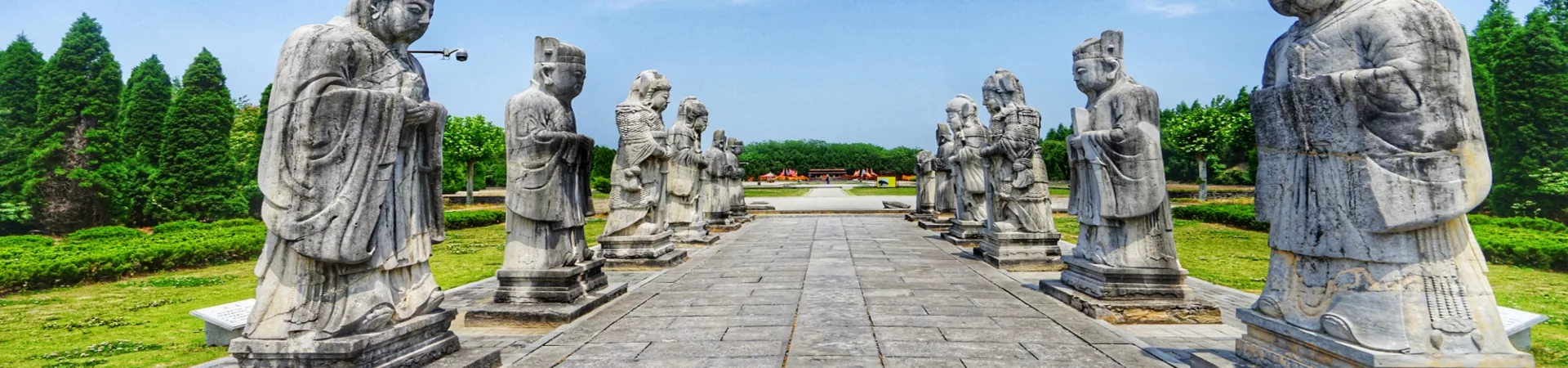
For centuries, the mausoleum lay hidden, submerged under the expanding waters of the nearby Hongze Lake. Its rediscovery in 1963, as lake waters receded, was an archaeological revelation. The site gradually emerged, revealing artifacts scattered along a 250-meter central axis. The most striking finds were 20 pairs of large stone statues of men and animals (stone xiang sheng), toppled and lying in the mud. Beneath the murky waters of a large pond, several arched gateways became faintly visible, marking the entrance to the underground burial chambers. Below these arches lie six coffins arranged side-by-side. The central coffins were intended for Zhu Yuanzhang's grandparents, flanked by those for his great-grandparents and great-great-grandparents. Significantly, these coffins contain only ceremonial regalia—dragon robes, jade belts, phoenix crowns, and official capes—confirming the site's nature as a cenotaph. Historical accounts suggest that Zhu Yuanzhang, fearing the disruption of the site's potent feng shui (geomancy) and the supposed "dragon vein" that promised imperial fortune, chose not to relocate his grandparents' actual remains. Their bodies were interred in a separate burial mound on a nearby high ridge, with the grand Ming Zuling constructed beside it as a magnificent symbolic tribute.
3. Restoration and the Modern Site: Preservation Against the Elements
Since 1997, concerted preservation and restoration efforts have transformed the once-submerged relic into a protected historical park. The primary challenge has been the ever-present threat from Hongze Lake. To safeguard the site, a massive 2,706-meter-long flood defense embankment now encircles it. A critical 600-meter section, deemed most vulnerable, has been reinforced with stone revetment. Extensive landscaping has introduced over 60,000 trees, including pines, cypresses, metasequoias, and phoenix trees, creating a serene and dignified atmosphere. Modern facilities, such as a cultural relics exhibition hall and a pumping station to manage groundwater, have been added to aid conservation and enhance the visitor experience. Today, Ming Zuling stands as a testament to both Ming dynasty grandeur and modern archaeological perseverance.
4. Practical Visitor Information
4.1. Ticket and Opening Hours * Ticket Price: 50 RMB per person. * Opening Hours: 08:00 - 17:00 daily (last entry at 16:30). These hours apply year-round.
4.2. Transportation Guide Reaching Ming Zuling requires some planning. Public buses departing from the Xuyi County long-distance bus station head towards the general area. The fare is approximately 5 RMB, with departures roughly every 30 minutes. Crucially, visitors must inform the driver upon boarding that they are going to the "Ming Zuling Jingqu" (明祖陵景区), or the Ming Zuling Scenic Area. Otherwise, the bus may terminate its journey in Mingzuling Town, which is still some distance from the actual mausoleum site. For the return trip, public transport is less frequent. It is often necessary to call the shuttle bus dispatch number (15189689688) to arrange for a vehicle to pick you up from the site.
4.3. Suggested Duration and Contact * Suggested Visit Duration: 1 to 3 hours, allowing sufficient time to explore the spirit way with its restored stone statues, the burial mound area, the exhibition hall, and the scenic lakeside embankment. * Contact Telephone: For inquiries, you may call 0517-80974747 or 0517-80970707.
Information last updated: July 14, 2023. Credit and thanks to contributors including Jim Zheng and Qing Cheng.