Memorial Temple of Lord Bao
An In-Depth Visitor's Guide to Lord Bao's Memorial Temple in Hefei
Nestled in the heart of Hefei City, Anhui Province, the Lord Bao's Memorial Temple (包孝肃公祠, Bāo Xiàosù Gōng Cí) stands as a profound tribute to one of China's most iconic historical figures, Bao Zheng (包拯, 999-1062). Revered as "Lord Bao" or "Justice Bao," he was a Song Dynasty official whose legendary integrity, impartiality, and dedication to justice have made him a timeless symbol of moral character in Chinese culture. Alongside the Mingjiao Temple and the Xiaoyaojin Park, the memorial temple forms the trio of Hefei's most celebrated historical sites. For any visitor, it offers not just an architectural tour, but a deep dive into the ethos of a man whose story has shaped Chinese ideals of law and governance for nearly a millennium.
The temple complex is a harmonious blend of solemn memorial halls, tranquil gardens, and narrative exhibits, centered around a large, serene pond. Its layout encourages contemplation, leading visitors through spaces dedicated to honoring Bao Zheng's life, his legendary deeds, and his enduring spirit.
Architectural Layout and Key Structures The temple grounds are meticulously arranged, featuring the main hall, flanking corridors, historical pavilions, and the expansive water and garden scenery that creates an atmosphere of quiet dignity.
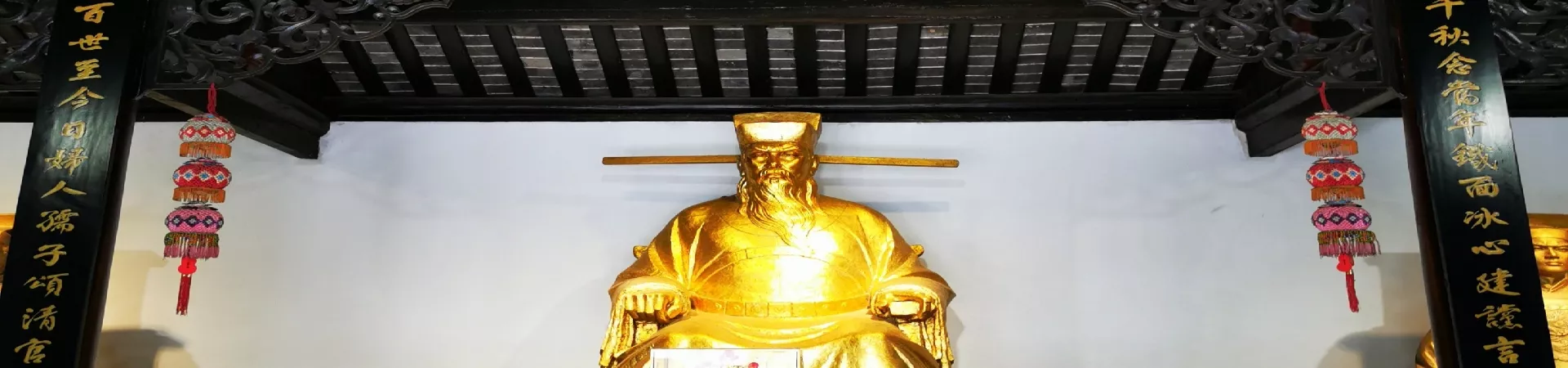
The Main Hall (享堂): This is the spiritual and architectural core of the complex. Dominating the hall is an imposing, eight-foot-tall statue of Bao Zheng, seated in his official robes with an expression of solemn authority and benevolence. Flanking him are statues of his four loyal guards—Wang Chao, Ma Han, Zhang Long, and Zhao Hu—figures immortalized in countless folk tales and operas. Perhaps the most striking exhibits here are the replicas of the three legendary execution blades: the Dragon-Head, Tiger-Head, and Dog-Head铡刀. These symbols represent the severity of Bao Zheng's justice, which he applied impartially to nobles, officials, and commoners alike.
The Eastern and Western Corridors: These side halls often host exhibitions detailing Bao Zheng's historical context, his administrative achievements, and the evolution of his public veneration.
Historical Sites Within the Garden Scattered throughout the landscaped gardens are sites steeped in history and folklore, each adding a layer of meaning to the visit.
The "Lian Quan" (廉泉) - The Well of Integrity: Located within a picturesque hexagonal pavilion east of the main hall, this ancient well carries a powerful moral tale. An inscription by Li Guoheng, a late Qing Dynasty scholar, records that a corrupt magistrate once drank from this well on a hot day and was immediately afflicted with a severe headache. This gave rise to the belief that the well's water—dubbed "Lian Quan" or "Well of Integrity"—would reject the unvirtuous. The well's rim is visibly grooved by centuries of rope friction, a tangible mark of its long history. The pavilion itself dates back to a Ming Dynasty restoration of the temple.
The "Liu Fang Ting" (流芳亭) - The Pavilion of Lasting Fragrance: Situated to the west of the complex, this pavilion marks the reputed spot where a young Bao Zheng studied and played. Its name, implying that one's good reputation will "flow fragrance" through the ages, perfectly encapsulates his legacy.
The "Hui Lan Xuan" (回澜轩) - The Pavilion of Returning Waves: This hall employs the intricate art of "Ou Sculpture" (瓯塑), a form of colored relief sculpture, to vividly depict the major chapters of Bao Zheng's life and career. It serves as a visual biography, bringing his story from historical text into vibrant, three-dimensional form.
The Bao Zheng Story Waxwork Museum A key highlight for many visitors is the Bao Zheng Story Waxwork Museum. This modern exhibit within the classical setting uses detailed, life-sized wax figures to stage dramatic scenes from the most famous anecdotes and cases judged by Lord Bao. These tableaux vividly illustrate the core virtues associated with him: his incorruptibility, his fair-mindedness, his investigative acumen, and his fearless defiance of corrupt power. It is an engaging, accessible way to connect with the folklore that has kept his legend alive.
Practical Visitor Information
Transportation: The temple is conveniently accessible by public bus. Visitors can take bus routes 109, 11, or 17 and alight at the "Ningguo Lu Caichang (Ningguo Road Market)" bus stop. The temple is a short walk from there.
Ticketing:
- Combo Ticket (Bao Park): 40 RMB. Includes entry to the Bao Zheng Memorial Temple, Bao Zheng's Tomb, and the Fuzhuang Garden.
- Bao Zheng Memorial Temple Only: 20 RMB.
- Bao Zheng's Tomb (including Fuzhuang Garden): 25 RMB.
- Concessions: Half-price tickets are available for full-time undergraduate students and below (with valid ID).
- Free Admission: Granted to: 1) Minors under 18 nationwide (with ID); 2) Seniors aged 60 and above nationwide (with ID); 3) Active-duty military personnel and retired army officers (with valid certificate); 4) Persons with disabilities (with disability certificate).
Opening Hours:
- Summer (May 1st - September 30th): 08:00 - 18:00, Monday through Sunday.
- Winter (October 1st - April 30th of the following year): 08:00 - 17:30, Monday through Sunday.
Suggested Duration: A thorough visit to appreciate the halls, exhibits, and gardens typically requires 1 to 3 hours.
Contact: For any inquiries, visitors can call 0551-62876300.
A visit to the Lord Bao's Memorial Temple is more than a sightseeing stop; it is an immersion into a foundational narrative of Chinese civilization. It allows one to walk in the footsteps of a historical figure whose life was transformed into a moral compass, exploring the very spaces designed to perpetuate his values of justice, duty, and integrity for generations to come.