Hefei Baoyuan Park
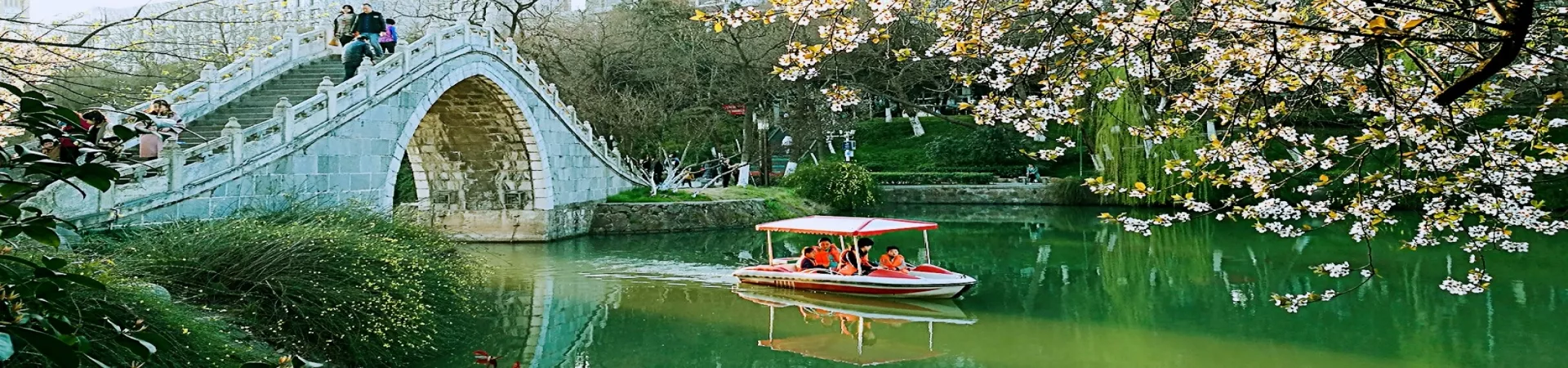
A Visitor's Guide to Hefei's Bao Park: Honoring a Legendary Statesman
Nestled along the ancient city moat in the southern part of Hefei, Anhui Province, Bao Park (包公园, Bāo Gōngyuán) stands as the city's premier cultural destination, dedicated to commemorating the life and legacy of Bao Zheng (包拯, 999-1062), the revered Northern Song Dynasty official known universally as "Lord Bao" or "Justice Bao." More than just a single park, it is a sprawling complex integrating history, architecture, horticulture, and folklore around the theme of this iconic symbol of justice, integrity, and incorruptibility. The park complex, built alongside a section of the old city moat now poetically named Baohe (包河, Bao River), encompasses four main attractions: the Bao Memorial Temple (包公祠), Bao's Tomb (包公墓), the Qingfeng Pavilion (清风阁), and the Floating Village (浮庄). Each site offers a unique perspective on the enduring legend, set within a serene landscape of water and classical gardens.
Exploring the Four Core Sites
Bao Memorial Temple (包公祠) The spiritual heart of the park is the Bao Memorial Temple, a traditional ancestral hall complex. The main hall houses a statue of Bao Zheng, seated in his official robes with a solemn and dignified expression. It's important to note that the original statue was destroyed during the Cultural Revolution; the present one is a careful reconstruction from the 1980s. Above the statue hangs a significant plaque inscribed with four characters: "色正芒寒" (Sè Zhèng Máng Hán). This匾额 (biǎn'é), or horizontal inscribed board, was a gift from Li Hanzhang, the older brother of the famous Qing statesman Li Hongzhang, who served as Viceroy of Huguang. The phrase metaphorically describes Bao's unwavering and awe-inspiring integrity in law enforcement, comparing his righteousness to the pure color and chilling sharpness of a blade. Interestingly, this plaque, along with another nearby that reads "清风亮节" (Qīng Fēng Liàng Jié, meaning "Pure Wind and Bright Virtue"), are both examples of palindrome匾额—they can be read meaningfully from left to right or right to left, a clever literary device underscoring the timeless and universal nature of the virtues they describe.
Bao's Tomb (包公墓) Adjacent to the temple area lies the solemn and historically significant Bao's Tomb. This is a reconstructed burial site built to honor the official's final resting place. The tomb complex provides a contemplative space for visitors to reflect on Bao Zheng's mortality and the lasting impact of his principles. Its proximity to the Qingfeng Pavilion creates a thoughtful historical pathway between the sites commemorating his life and death.
Qingfeng Pavilion (清风阁) Dominating the park's skyline is the magnificent Qingfeng Pavilion, a towering 42-meter (138-foot) pagoda-style阁楼 (gélóu) built in the distinctive architectural style of the Song Dynasty. Constructed in 1999 to mark the 1000th anniversary of Bao Zheng's birth, this imposing structure covers an area of 2.2 hectares. Its design features five visible stories with four additional hidden mezzanine levels, making nine stories in total—a common auspicious number in Chinese architecture. The primary reason to visit the Qingfeng Pavilion is for the breathtaking panoramic view. From the top observation deck, visitors are rewarded with a sweeping vista of modern Hefei's cityscape juxtaposed with the tranquil, green expanse of the entire Bao Park below. Beyond the view, the pavilion actively keeps Bao's story alive through cultural performances. A traditional opera stage inside the building hosts periodic performances of various Chinese opera genres, all centered on the stories and legends of Justice Bao. On certain occasions, visitors may even be invited to participate in interactive elements of these performances, offering a unique and immersive cultural experience.
Floating Village (浮庄) Offering a change of pace, the Floating Village is situated on a large island in the eastern part of Baohe. Its name derives from its picturesque appearance: from a distance, the slender, landscaped island resembles a willow leaf floating gently on the water's surface, while the cluster of classical buildings evokes the image of a small, ancient riverside hamlet. The entrance gate is a classic example of Hui-style architecture, with whitewashed walls and dark grey tiles, crowned by a plaque bearing the calligraphic inscription "浮庄" (Fú Zhuāng) penned by General Zhang Aiping, a former Chinese State Councillor and Minister of National Defense. Just inside the gate stands a bronze statue not of Bao Zheng himself, but of Mr. Bao Zhaolong, the father of the world-renowned shipping magnate Sir Y. K. Pao (Bao Yugang) and a 28th-generation direct descendant of Bao Zheng. Erected by the provincial and municipal governments, this statue honors Mr. Bao Zhaolong and fulfills his wish to "have his leaves return to the roots"—to be symbolically connected to his illustrious ancestor's homeland. The island's architecture is a masterful blend of garden design styles from Suzhou, Yangzhou, and Huizhou, harmoniously adapted to the waterside terrain. It showcases the elegant, refined aesthetics of Jiangnan (south of the Yangtze) gardens combined with the elegant simplicity of Anhui's own徽派 (Huīpài) architectural tradition. For modern convenience, the Floating Village also houses a café and intimate seating areas, making it a perfect spot to relax, enjoy a refreshment, and soak in the serene atmosphere.
Practical Information for Your Visit
Ticket Information: Visitors can purchase individual tickets for each site or opt for a cost-effective联票 (liánpiào), or combination ticket. As of the last update, the full-priced联票 covering all four attractions is 50 RMB. Individual tickets are approximately: Bao Memorial Temple (20 RMB), Bao's Tomb (35 RMB), Qingfeng Pavilion (included in combo or often with the tomb), and Floating Village (5 RMB). Discounted半票 (bànpiào) are available for full-time undergraduate students and below with valid ID. Free admission免票 (miǎnpiào) is granted to seniors over 60, organized groups of minors under 18 (with reservation), active-duty and retired military personnel with valid证件 (zhèngjiàn), and individuals with disabilities. Please note: All prices and policies are subject to change, and it is advisable to verify with the park on the day of your visit.
Opening Hours: The park operates seasonally. During the summer months (June 1st - August 31st), hours are typically 08:00 to 18:00, with last entry at 17:00. In the winter season (December 1st - February 28th/29th), hours are usually 08:00 to 17:30, with last entry at 16:30.
Getting There: Bao Park is easily accessible by public transportation. Multiple bus routes, including numbers 6, 11, 119, and 154, stop at the "包公园" (Bao Gongyuan) bus station. From the stop, it is a short and straightforward walk to the park entrances.
Suggested Duration: To fully appreciate the historical context, explore the buildings, enjoy the views from the pavilion, and stroll through the Floating Village, a visit of 1 to 3 hours is recommended.