Huaxi Park
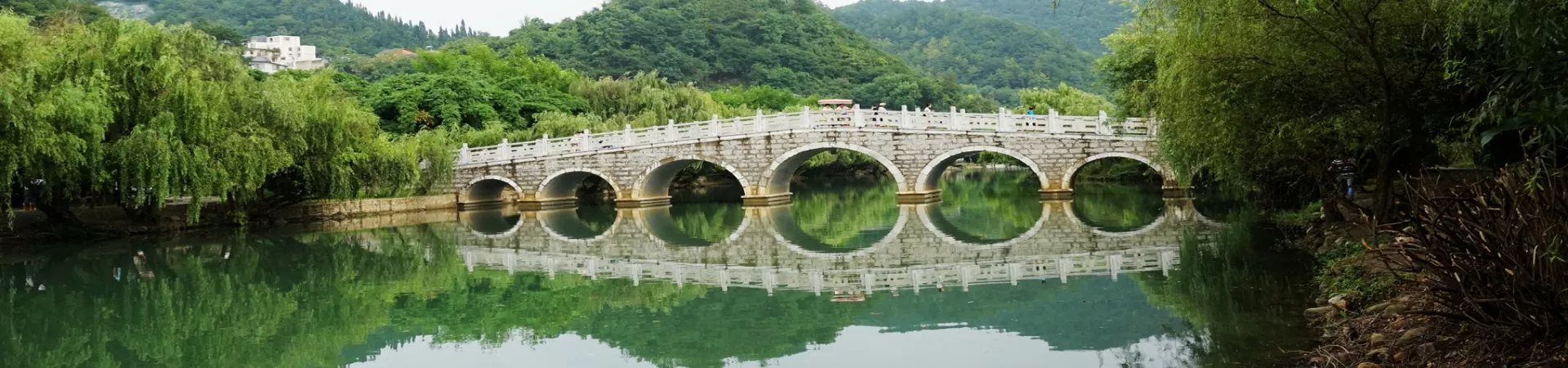
Subtitle: A Stroll Through History and Natural Harmony
1. Introduction Nestled along the serene banks of the Huaxi River, Huaxi Park in Guiyang stands as a testament to both natural artistry and historical resonance. Far more than a simple green space, it is a meticulously composed landscape where geology, hydrology, and human history intertwine. The park's layout gracefully unfolds around four emblematic hills—Scale Hill (Lin Shan), Phoenix Hill (Feng Shan), Tortoise Hill (Gui Shan), and Snake Hill (She Shan)—each contributing a unique character and vantage point to the scenery. This creates a dynamic interplay of landforms and water, where every turn offers a new perspective, a fresh composition of rock, foliage, and reflective stream. It is a place designed for contemplation, leisurely exploration, and a tangible connection to moments that have shaped modern Chinese cultural and political narratives.
2. A Landscape of Mythical Proportions and Poetic Charm 2.1. The Four Guardians: Lin, Feng, Gui, and She Hills The soul of Huaxi Park's natural beauty lies in its four central hills. These are not mere geological features but are imbued with symbolic significance, representing the mythical creatures of the dragon (scale), phoenix, tortoise, and snake. Lin Shan (Scale Hill), often considered the park's focal point, provides a panoramic view of the entire area from its summit. Feng Shan (Phoenix Hill) evokes elegance and rebirth with its rolling contours. Gui Shan (Tortoise Hill) suggests stability and longevity, while She Shan (Snake Hill) adds a sense of flowing,蜿蜒 movement to the landscape. Together, they form a protective, harmonious circle, anchoring the park's design in ancient Chinese cosmological principles and offering visitors a diverse hiking experience with varying levels of challenge and reward.
2.2. The Centerpiece: The Hundred-Step Bridge (Baibu Qiao) Undoubtedly the park's most iconic and beloved feature is the Hundred-Step Bridge. This is no ordinary crossing; it is a poetic and playful interaction with the water itself. Consisting of a series of flat, stepping-stone piers that wind and zigzag across a calm section of the Huaxi River, it requires and rewards a mindful pace. Crossing it is an activity in itself—a dance over the water where one focuses on the next step, the sound of the flow, and the slight thrill of the passage. It perfectly encapsulates the park's philosophy of immersive, experiential enjoyment of nature, inviting visitors not just to view the scenery but to become part of it.
3. Echoes of History: A Sanctuary for Icons Huaxi Park's tranquility and beauty have long attracted figures of great renown, weaving a rich layer of modern history into its natural fabric. It is famously known as the site where the celebrated literary couple, author Ba Jin and his wife Xiao Shan, chose to hold their wedding, adding a layer of romantic literary heritage to the gardens. Perhaps even more significantly, the park was a retreat for political leaders. Premier Zhou Enlai and his wife Deng Yingchao were known to have enjoyed boating on the Huaxi River here, and numerous other state leaders have visited its peaceful confines. This legacy transforms a walk through the park into a walk alongside history, where the same paths and vistas that inspired writers and provided respite for statesmen are now open to all.
4. Exploring the Architectural and Scenic Highlights Beyond the hills and the famous bridge, Huaxi Park is dotted with charming structures and sites that merit exploration. These landmarks serve as perfect rest stops or focal points for exploration.
4.1. Bashang Bridge and the Western Lodge (Xi She) The Bashang Bridge, another graceful bridge structure, offers different views of the river and its banks. Nearby, the Western Lodge (Xi She) stands as a quiet, traditional-style building, often surrounded by lush plantings, providing a shady spot for repose and reflection on the park's serene atmosphere.
4.2. The Chess Pavilion (Qi Ting) and Eastern Lodge (Dong She) For a taste of classical Chinese leisure, the Chess Pavilion (Qi Ting) is a must-visit. As the name suggests, it evokes images of scholars or friends engaged in a thoughtful game of chess amidst nature. The Eastern Lodge (Dong She), counterpart to the Western Lodge, offers further architectural interest and a sense of the park's symmetrical design principles.
5. Practical Visitor Information 5.1. Transportation The park is easily accessible by public bus from downtown Guiyang. Visitors can take bus routes 223 or B267 and alight at the Huaxi (Xibei Road) bus stop. From there, it is a short and straightforward walk to the park entrances.
5.2. Admission and Opening Hours Huaxi Park maintains a very accessible policy. It is open 24 hours a day, every day of the year, allowing for visits from morning exercise to moonlit strolls. An admission fee of 6 RMB is required for entry. As operational details can occasionally change, it is always advisable to verify this information with the park directly on the day of your visit.