Yuwangting Museum
A Journey Through Time: Exploring the Yuwangting Museum in Yucheng
Introduction: A Portal to Ancient Legends and Cultural Heritage
Nestled approximately three kilometers northwest of downtown Yucheng City in Shandong Province, the Yuwangting Museum stands as a modern tribute to ancient history and a revered cultural figure. Opened to the public in 1997, this expansive 136.5-acre complex is more than just a museum; it is a meticulously planned cultural park that seamlessly blends architectural grandeur, archaeological significance, and serene natural landscapes. Dedicated to the memory of Yu the Great, the legendary ruler famed for his monumental flood control feats in Chinese mythology, the museum offers visitors a multifaceted experience. It invites exploration of classical Chinese courtyard architecture, contemplation at a genuine Neolithic archaeological site, and peaceful reflection by a picturesque lake, all while unraveling the enduring legacy of a key chapter in China's foundational narratives.
Architectural Grandeur: The Main Courtyard Complex
The heart of the museum is its imposing main courtyard, a north-south facing architectural ensemble that immediately captures the visitor's attention with its novel, compact, and majestic layout, characterized by a古朴典雅 (simple, unsophisticated yet elegant) aesthetic.
The Mountain Gate and Sacred Path: The journey begins at the southern entrance, a ceremonial牌坊式山门 (pailou-style mountain gate). Crowned with the inscribed handwriting of Emperor Qianlong of the Qing Dynasty, reading "禹王亭" (Yuwang Ting), the gate sets a historical tone. Passing through, visitors walk along a six-meter-wide north-south甬道 (pathway), flanked by solemn pine and cypress trees. This path serves as a processional axis, leading the eye and spirit towards the main hall. Along this path, stone steles record the history of the pavilion's restoration and acknowledge the benefactors who made the park possible.
The East and West Wing Halls: Flanking the northern part of the courtyard are two symmetrical wing halls, each comprising eleven bays in a traditional ancient style. These structures likely house exhibition spaces or auxiliary functions, complementing the central focus of the complex.
The Yuwang Grand Hall: The甬道 culminates at the magnificent Yuwang Grand Hall, a structure modeled after the architectural conventions of the Ming and Qing dynasties. Encompassing over 300 square meters, its imposing presence is marked by a five-bay wide facade, double-eaved歇山 (hip-and-gable) roof with nine ridges, reaching a total height of 16.7 meters. The hall is a spectacle of traditional craftsmanship: a gilded plaque reading "禹王殿" (Yuwang Hall) hangs between the eaves, paired couplets adorn the columns by the main door, and the roof glitters with琉璃瓦 (glazed tiles) adorned with和玺彩画 (Hexi-style painted patterns), creating a resplendent and golden aura.
- The Sacred Interior: Within the hall, the centerpiece is a majestic seated statue of Yu the Great, approximately six meters tall. The figure exudes authority and benevolence, attended by two jade maidens holding fans behind him. This sacred space is dedicated to venerating the cultural hero and contemplating his mythical achievements.
Historical Foundations: The Juqiu Site and the Yuwang Pavilion
Beyond the northern gate of the main courtyard lies the authentic historical core of the museum grounds – the Juqiu site. This section bridges millennia, connecting legendary lore with tangible archaeological evidence.
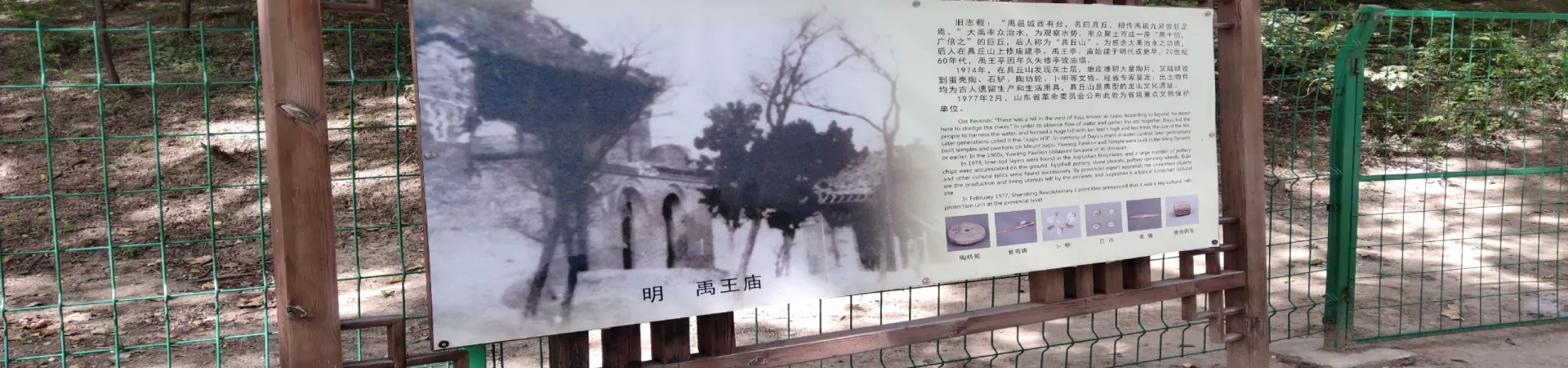
Juqiu: The Ancient Observatory: The site centers on "Juqiu Hill," an earthen mound measuring 45 meters north-south, 50 meters east-west, and 8 meters high. Local historical records assert that Yu the Great himself erected this mound to observe and assess floodwaters during his legendary taming of the rivers. While structures from later Ming and Qing dynasties that once stood here are long gone, the hill itself, now covered in wild grasses and shrubs, remains a potent symbol.
Archaeological Significance: The hill's importance was confirmed in 1974 when archaeological investigations uncovered an ash layer and retrieved ancient artifacts, including single-hole stone spades, eggshell pottery fragments, stone axes, ceramic pellets, and spinning whorls. Authenticated by the Shandong Provincial Museum, these relics date the site to the Longshan Culture (circa 3000-1900 BCE), officially designating Juqiu as a "Longshan Culture遗址" (archaeological site). This discovery grounds the location's legendary associations in a profound prehistoric reality.
The Modern Yuwang Pavilion: In 1995, during the park's major construction, a new, larger 15-meter-high mound was erected adjacent to the northeast of the ancient Juqiu. Stabilized with concrete framing and accessed by a 64-step stone staircase on its southern side, this mound supports the park's namesake structure. The current Yuwang Pavilion, an octagonal traditional-style pavilion standing eight meters tall, is supported by sixteen vermilion pillars. Its wooden ceiling and walls are adorned with paintings depicting scenes from the stories of Yu the Great taming the floods. Ascending to this pavilion offers a dual reward: it fosters a reflective connection to the ancient past and its heroes, while also providing a commanding panoramic view of modern Yucheng City and the surrounding pastoral countryside.
Tranquil Reflections: The Yuwang Lake and Additional Features
Complementing the historical and architectural elements is a carefully crafted landscape designed for visitor enjoyment and contemplation.
Serene Waters: To the southeast of the Yuwang Pavilion lies the man-made "Yuwang Lake," a 25-acre body of water with a depth of two meters, noted for its清澈见底 (clear, see-through to the bottom) quality. Weeping willows grace its shores, their reflections dancing on the surface, creating a classic and tranquil Chinese garden scene ideal for leisurely strolls and quiet moments.
The Stele Forest: An initiative from the year 2000 further enriched the museum's collection. The local government established a文物管理处 (Cultural Relics Management Office) here, which gathered various stone steles, figures, and animals from the surrounding region to create an outdoor碑林 (stele forest). This addition allows visitors to appreciate a diverse array of ancient stone carvings and inscriptions in an open-air setting.
Visitor Information
- Address: Northwest of Yucheng City, Dezhou, Shandong Province, China (approx. 3km from downtown).
- Contact: 0534-7440598
- Admission Fee: 10 RMB.
- Opening Hours:
- June 1 - August 31: 08:00 - 17:30 (Last entry at 17:00), Tuesday to Sunday. Closed on Mondays.
- December 1 - February 28 (of following year): 08:30 - 17:00, Tuesday to Sunday. Closed on Mondays.
- Note: Hours for spring and autumn (March 1 - May 31 & September 1 - November 30) are typically similar but should be confirmed locally. The "全天(全天)" notation for Mondays during the specified periods indicates the park is closed on those days.