Suxianling
A Visitor's Guide to Suxian Ridge: Myth, Poetry, and Natural Serenity in Chenzhou
Nestled approximately two kilometers northeast of downtown Chenzhou in Hunan Province, Suxian Ridge stands as a captivating destination where myth, history, poetry, and natural beauty seamlessly intertwine. Originally named Niupi Hill (Ox Spleen Hill), this modest peak is far more significant than its altitude suggests. It is revered as the legendary site where a man named Su Dan ascended to immortality, earning the ridge its current name and its esteemed reputation as one of China's "Eighteenth Blessed Lands." Beyond its spiritual and historical allure, Suxian Ridge serves as a beloved urban retreat for the residents of Chenzhou, a place for daily exercise, weekend relaxation, and cultural immersion.
The Legend and the Landscape The soul of Suxian Ridge is inextricably linked to the tale of Su Dan. According to local lore, Su Dan was a figure of extraordinary filial piety and virtue who cultivated himself on this mountain. His legend is populated with mystical elements, most notably a white deer that is said to have nurtured him in his youth. This story of transcendence from the earthly to the divine established the mountain's status as a sacred "Fortunate Place" (Fudi), a Daoist concept denoting a site of potent spiritual energy and harmony. This mystical foundation permeates the atmosphere, inviting visitors to explore both the physical paths and the layers of cultural narrative woven into the hillside.
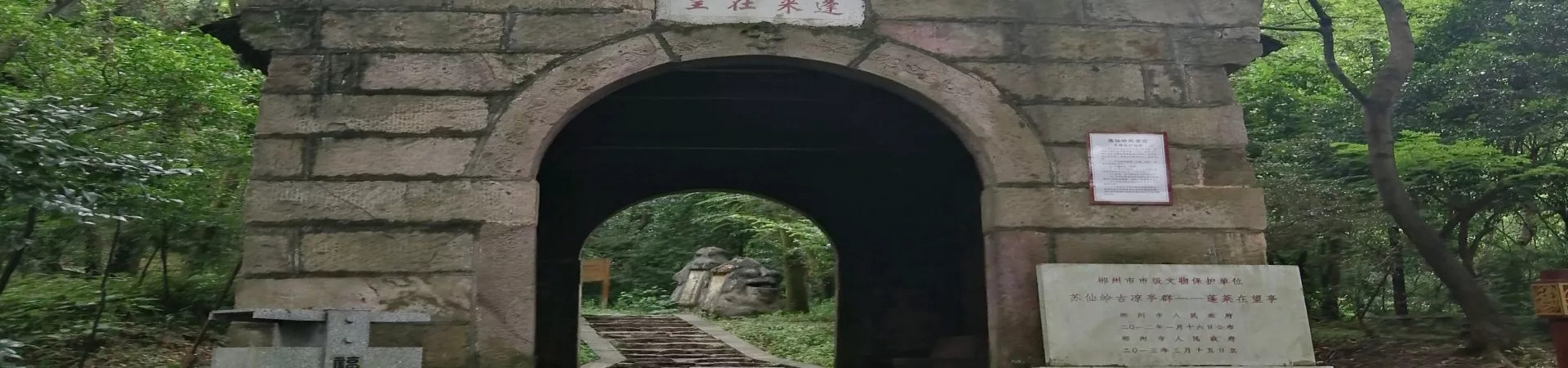
A Journey Up the Ridge: Key Sites and Attractions The ascent of Suxian Ridge is a journey through curated landscapes and historical waypoints. A well-maintained path leads visitors past a series of notable sites, each contributing to the ridge's rich tapestry.
The Starting Point: Taohua Ju (Peach Blossom Residence) The climb traditionally begins at Taohua Ju, a serene complex situated at the mountain's base. True to its name, it faces the gentle Peach Blossom Stream and is enveloped by whispering bamboo groves. This elegantly simple setting, with its tranquil waters and lush greenery, provides a perfectly peaceful prelude to the hike, allowing visitors to transition from the city's bustle to the mountain's calm.
Mythical Encounters: Bailu Dong (White Deer Cave) A short distance uphill from Taohua Ju lies Bailu Dong, or the White Deer Cave. This site is a direct tribute to the mountain's central legend, commemorating the spot where the miraculous white deer allegedly cared for the young Su Dan. It serves as a tangible connection to the mythical origins of the ridge, offering a moment to reflect on the stories that have shaped its identity for centuries.
A Literary Masterpiece: Sanjue Bei (The Three Wonders Stele) Continuing along the stone steps for about 100 meters from the White Deer Cave, visitors will find the Hubei Ting (Stele Protecting Pavilion). Sheltered within is one of Suxian Ridge's most treasured artifacts: the Sanjue Bei, or "Three Wonders Stele." This natural stone slab, standing about four meters high, is a remarkable fusion of literary and artistic genius from the Song Dynasty. The "Three Wonders" are:
- The poignant lyric poem Tasuo Xing · Inn at Chenzhou by the renowned poet Qin Guan, written during his exile.
- A colophon (commentary) added to the poem by the legendary literary figure Su Shi (Su Dongpo).
- The transcription of both the poem and the colophon by the master calligrapher Mi Fu. This convergence of three monumental talents on a single stone makes it a site of profound cultural pilgrimage, elevating the natural setting with deep historical resonance.
The Summit and Beyond: Jingxing Guan, Baziming, Chenxiang Shi, and Suxian Guan The climb proceeds past other intriguing sites. Jingxing Guan is a Daoist temple complex that reinforces the area's religious heritage. Baziming (The Eight-Character Inscription) and Chenxiang Shi (Aloeswood Rock) are scenic spots steeped in their own local tales. Finally, the path culminates at Suxian Guan (Suxian Temple), a temple dedicated to the immortal Su Dan himself. Perched near the summit, it represents the physical and spiritual apex of the journey, providing panoramic views and a space for quiet contemplation.
Practical Information for Your Visit
Admission Fees: The standard entrance ticket is priced at 45 RMB per person. This fee typically grants access to the main scenic area and its historical sites.
Operating Hours: Opening hours vary seasonally to accommodate daylight and visitor patterns.
- Summer Season (June 1 - August 31): The park is open from 6:30 AM to 7:00 PM.
- Winter Season (December 1 - February 28/29): Hours are from 5:30 AM to 9:30 PM.
Suggested Duration: To fully appreciate the hike, explore the key attractions at a leisurely pace, and enjoy the views, a visit of 3 hours or more is recommended. This allows time for both the physical ascent and cultural engagement.
Contact Information: For the latest information or inquiries, you may contact the management at: 0735-2888002 or 0735-2885797.
Suxian Ridge offers a multifaceted experience. It is simultaneously a scenic natural escape, an open-air museum of classical Chinese culture, a living site of folk religion and myth, and a vibrant community park. Whether one seeks inspiration from the literary art of the Three Wonders Stele, contemplates the timeless legend of Su Dan, or simply enjoys a rejuvenating hike amidst bamboo and streams, the ridge provides a deeply rewarding and accessible encounter with the heart of Chenzhou's heritage.