Guangji Gate City Tower
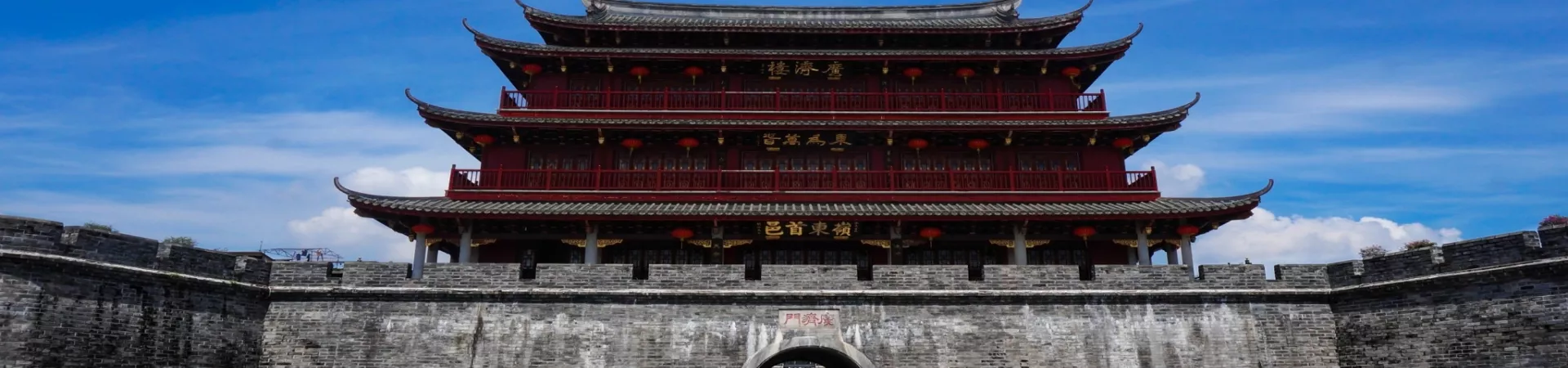
Subtitle: A Timeless Sentinel Over the Han River – Exploring Chaozhou's Guangji Gate Tower
1. Introduction: The Icon of Chaozhou Rising majestically on the eastern bank of the Han River, the Guangji Gate Tower, historically known as Guangji Tower or Hanjiang Tower and affectionately called the "East Gate Tower" by locals, stands as the most magnificent and awe-inspiring structure among the original seven gates of ancient Chaozhou's city walls. More than just an architectural relic, it serves as the quintessential symbol of Chaozhou, a city steeped in history and culture. For centuries, it has functioned as both a proud civic emblem and a crucial strategic floodgate, integral to the city's northern embankment defense system. Its imposing silhouette against the sky offers a tangible connection to the city's glorious past and a perfect starting point for understanding its heritage.
2. Architectural Grandeur: A Palace Over the City 2.1 Historical Foundations and Evolution The story of Guangji Gate Tower began in the third year of the Ming Hongwu era (1370 AD). Its construction marked a significant period of urban fortification and has witnessed the ebb and flow of Chaozhou's history through numerous repairs and restorations across dynasties, with a major renovation recorded in the 20th year of the Republic of China (1931). This continuous care has preserved its essence across the centuries.
2.2 Structural Majesty and Design The tower is a masterpiece of traditional Chinese palatial architecture, designed as a three-story pavilion with a distinctive Xieshan-style roof (a combination of gable and hip roof). It rests upon a tall, solid, and broad stone base, which immediately conveys a sense of enduring strength. The central archway, once inscribed with the gate's name "Dong Wei Wan Chun" (East for Eternal Spring), pierces through this heavy base. The superstructure is a complex and elegant framework, featuring a frontage of seven bays and a depth of five. Ingeniously, its weight is borne by a hybrid system of wooden and stone pillars. A particularly notable architectural feature is its overhanging section that projects outwards over the city wall, forming a characteristic "qilou" or arcade-style structure.
2.3 Artistic Details and Craftsmanship Every detail of the tower speaks of refined artistry. The roof is layered with double rows of large, dark blue-grey tiles, while the edges of each sweeping, upturned eave are adorned with vibrant blue-glazed tiles ("goutou" and "dishui"), creating a striking contrast against the wooden structure. Intricately carved balustrades, painted beams, and pillars decorated with motifs ("diaolan huadong") showcase the skill of ancient craftsmen. Numerous latticed windows on all four sides allow light and air to flood the interior, contributing to its ethereal, "flying pavilion" aesthetic. The overall color scheme of rich vermilion, green, blue, and gold, often described as "feige liudan" (flying pavilions with flowing crimson), completes the picture of majestic and vibrant grandeur.
3. The Panoramic Vista: A Living Landscape Painting The true reward of a visit lies in ascending to the upper floors. The tower offers a commanding, 360-degree panorama that has inspired poets and painters for generations. To the north, the vast Han River ("Han Shui") flows steadily downstream. Directly to the east lies the tower's legendary counterpart, the Guangji Bridge (also known as the Xiangzi Bridge), appearing like a stone dragon reclining upon the waves ("chang qiao wo bo"). Beyond, the distant mountains fade into hues of deep blue, resembling traditional ink-wash paintings ("yuan shan ru dai").
3.1 The Dynamic River Scene This vista is not static but changes character with the seasons. During the late summer and autumn floods, the scene transforms dramatically. The river swells, its current becomes urgent and powerful, and the water level rises. At this time, the view becomes animated with clusters of boat sails dotting the broad river surface, gliding downstream with the swift current. The relentless force of the river is palpable as waves crash against the bridge piers and occasionally send sprays of white foam splashing against the riverbanks. This dynamic interplay of water, architecture, and human activity composes a living landscape of immense poetic and pictorial beauty ("hua yi shi qing"), offering a profound sense of appreciation for nature's power and the enduring human presence beside it.
4. Visitor Information 4.1 Suggested Duration To fully appreciate the Guangji Gate Tower—exploring its architectural details, learning about its history, and soaking in the panoramic views—a visit of 1 to 3 hours is recommended. This allows for a leisurely pace to experience both the structure itself and its role within the surrounding riverscape.
4.2 Opening Hours The external viewing areas of the Guangji Gate Tower and its immediate surroundings are accessible 24 hours a day, every day of the year. This provides exceptional flexibility for visitors. You can witness the majestic structure under the bright sun, see its silhouette at sunset against the colored sky, or admire it illuminated at night, when it casts a golden reflection upon the dark waters of the Han River. Please note that access to the interior museum or exhibition halls, if available, may be subject to separate operating hours, which are typically posted on-site.