Guangji Bridge
Subtitle: A Journey Through Time and Ingenuity on the Han River
1. An Architectural Marvel and Historical Icon
Nestled in the heart of Chaozhou City, Guangdong Province, the Guangji Bridge stands as a monumental testament to ancient Chinese engineering and aesthetic philosophy. More commonly and affectionately known to locals as the Xiangzi Bridge, its history stretches back to the Southern Song Dynasty, with its initial construction dating to 1171 AD. Its historical significance is so profound that it is revered as one of the "Four Great Ancient Bridges of China," sharing this distinguished title with the Zhaozhou Bridge, Luoyang Bridge, and Lugou Bridge. For centuries, it has been the defining symbol of Chaozhou, giving rise to the popular saying, "A trip to Chaozhou is wasted without visiting the bridge." It is far more than a mere river crossing; it is an open-air museum, a cultural artifact, and a living piece of history that continues to function and fascinate.
2. A Unique Structural Masterpiece
2.1. The Hybrid Design What truly sets the Guangji Bridge apart and makes it a unique specimen in the world's bridge architecture is its ingenious hybrid design. It is a stunning amalgamation of three distinct bridge types: beam bridge, arch bridge, and pontoon bridge. The western section is a sturdy stone beam bridge, while the eastern section utilizes the arch principle. The most remarkable feature, however, lies at its heart.
2.2. The Floating Pontoon Section Connecting the two fixed stone sections is a movable floating bridge composed of 18 wooden pontoon boats. This central segment is designed to be opened and closed. During the day, the boats are linked together, fastened to the stone piers, allowing visitors to walk seamlessly across the entire structure. This "beam-boat combination" creates a fascinating interplay of rigidity and flexibility, of stone and wood, offering a walking experience that is both stable and gently undulating with the flow of the Han River beneath.
2.3. The Daily "Bridge Dismantling" Spectacle The floating design served a crucial practical purpose: facilitating river traffic. Every day, around 5:30 PM, a captivating ritual takes place. The connections between the pontoon boats are released, and the entire floating section is towed away to the sides of the river. This process opens a wide channel for cargo ships and boats to pass through. For observers, it presents the rare and somewhat paradoxical sight of "dismantling the bridge to cross the river"—a functional spectacle that is both ingenious and visually striking. It is a daily demonstration of the bridge's timeless practicality.
3. A Gallery of Pavilions and a Cultural Promenade
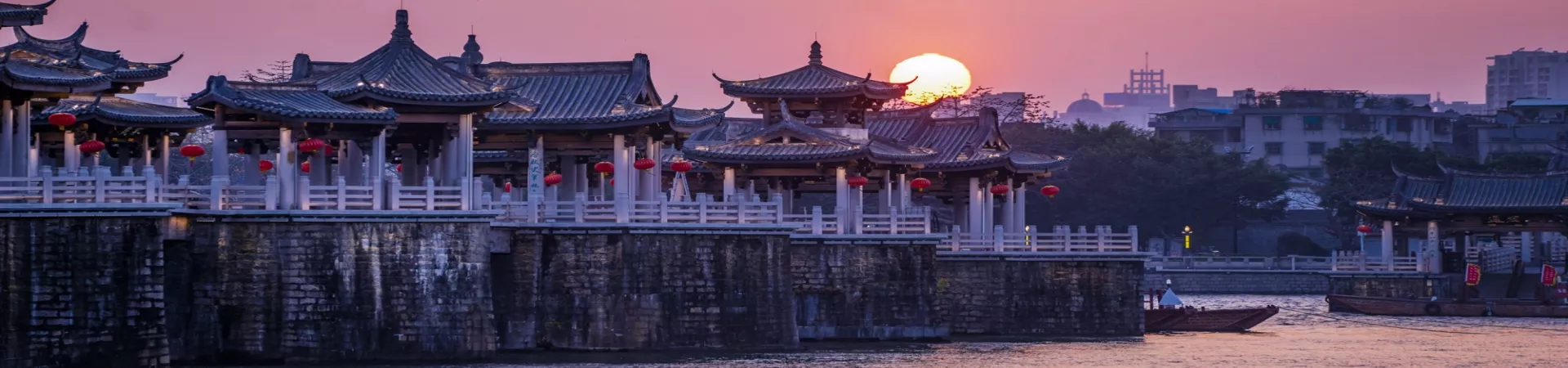
3.1. Architectural Ornaments on the Bridge The Guangji Bridge is not merely an engineering feat but also a splendid architectural gallery. Its stone piers are crowned with an elegant array of pavilions, towers, and ornamental pailous (decorative archways). Historically, there were 24 such pavilions, each with a distinct design—hence the lore of "24 pavilions, each different in style." While the current structures have been restored, they faithfully recreate the grandeur of the Ming and Qing Dynasties, when the bridge resembled a bustling, elevated street market. Walking across the bridge is a journey through a line of exquisite classical Chinese architecture, with each pavilion offering a shaded spot to rest and a framed view of the river and city.
3.2. The Walking Experience Strolling across the Guangji Bridge is the quintessential Chaozhou experience. The walkway, paved with worn stone slabs, exudes a timeless,古香古色 (ancient fragrance and color) charm. The perspective shifts with every step: from the solidity of the stone sections to the lively bounce of the pontoons, from close-up admiration of carved pavilion details to panoramic vistas of the Han River winding through the city. It is a multisensory journey, blending history, architecture, and the natural environment into one unforgettable promenade.
4. Practical Visitor Information
4.1. Ticket Information * General Admission: 20 RMB for adults. * Concession Tickets (10 RMB): Applicable to children with a height between 1.2m and 1.5m, and full-time students (undergraduate and below) upon presentation of a valid student ID. * Free Admission: Children under 1.2m in height. * Note: Ticket prices and policies are subject to change. It is advisable to verify the latest information at the ticket office on the day of your visit.
4.2. Opening Hours The operating hours vary seasonally: * Summer Period (June 1 - August 31): * Monday to Friday: 10:00 - 17:30 (Last entry at 17:00) * Saturday & Sunday: 09:00 - 17:00 (Last entry at 17:00) * Winter Period (December 1 - February 28/29): * Monday to Friday: 10:00 - 16:30 (Last entry at 16:00) * Saturday & Sunday: 09:00 - 17:30 (Last entry at 17:00) * Important: The pontoon bridge is typically disconnected daily around 17:30 to allow for ship passage. Plan your crossing accordingly.
4.3. Transportation The most convenient access is via the Chaozhou tourist battery bus routes D1 or D2. Alight at the Xiashuimen (Lower Water Gate) bus stop. The bridge's entrance is approximately a 30-meter walk from the stop.
4.4. Suggested Visit Duration To fully appreciate the bridge's architecture, walk its entire length, explore the pavilions, and witness the pontoon disconnection, a visit of 1 to 3 hours is recommended.
4.5. Contact For any inquiries, you may contact the management at: 0768-2222683 or 0768-2222682.
Information last updated: January 2023.