Half Moon Mountain Giant Buddha
Subtitle: A Journey Through Time: Unveiling the Grandeur and Resilience of the Ziyang Half-Moon Mountain Buddha
1. Introduction: A Colossal Presence Carved in Stone
Nestled within the serene landscape of Ziyang, Sichuan Province, the Half-Moon Mountain Buddha (Banyueshan Dafo) stands as a monumental testament to centuries of unwavering faith and artistic dedication. This majestic statue is a prime example of Chinese cliffside carving, where the living rock of a mountain cliff was transformed into a sacred image. As a seated statue of Maitreya, the Buddha of the Future, it belongs to the iconographic tradition of the Pure Land school of Buddhism. The sheer scale of the figure is the first to command attention: seated within a rectangular niche and facing north, the Buddha measures an awe-inspiring 22.24 meters in height with a chest width of 11.2 meters. Its structure is robust and unadorned, exuding an ancient, powerful grandeur that instantly inspires reverence. Yet, upon closer observation, the statue reveals a profound humanity. The face is full and benevolent, with elongated earlobes and a serene, tranquil expression. Its eyes gaze gently downward, seemingly bestowing a look of compassionate attention upon worshippers below, blending majestic authority with an approachable, venerable warmth.
2. A Chronicle in Stone: Inscriptions and Historical Layers
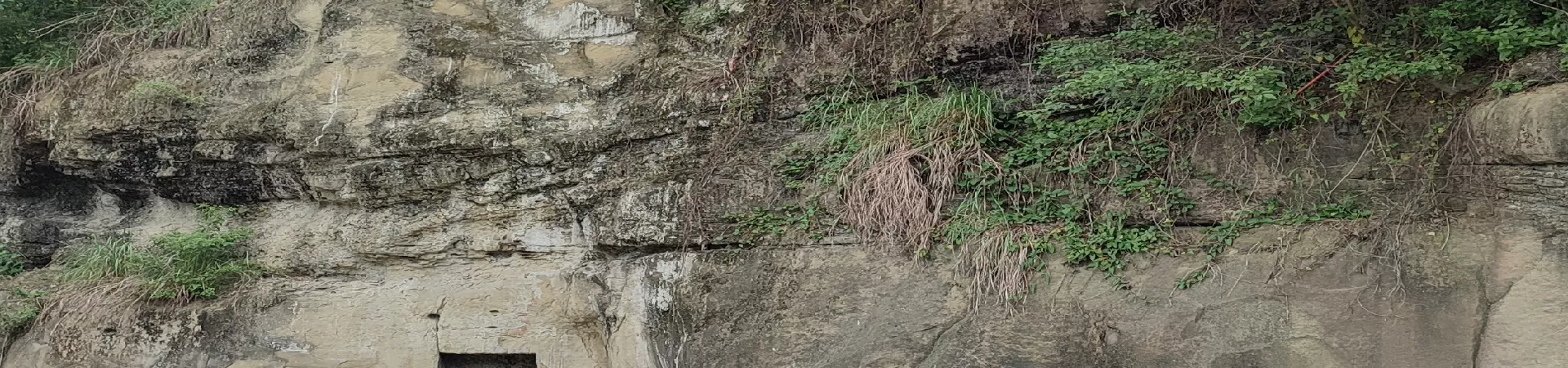
The cliff face surrounding the Buddha serves as a fragmented historical archive, with inscriptions offering glimpses into its past.
2.1. Tang Dynasty Origins and Records On the upper left side of the niche, a wall inscription bears the clearly legible date "the 15th day of the eighth month in the ninth year of the Zhenyuan era" (793 AD), marking a significant point in its long history. While other characters in this section have eroded, this date remains a crucial anchor. The middle section features the engraved text of the "Great Buddha Association Stele Preface," a document likely detailing the devotional societies that supported the statue's creation and upkeep.
2.2. Later Dynastic Mentions Further historical context is provided by other carvings on the Half-Moon Mountain cliff. A Northern Song Dynasty inscription from the second year of the Zhidao era (996 AD) mentions that the mountain was formerly known as Fusheng Mountain (Mountain of Blessed Victory), though most of its text is now worn away. Additionally, a poetic engraving from the Southern Song Dynasty's Qiandao period (1165-1173 AD) offers a lyrical snapshot of the site, reading: "A famous temple of the Tang, a great daochang (place of practice) in Zichuan. Cliffs hang low over emerald mugwort, rough stones mingle with tall bamboos. Recalling antiquity, I seek its traces; leaning on the heights, I enter a wondrous land. The west window holds fine views, a good place to rest in the abbot's chamber."
3. An Epic of Creation: Centuries of Uninterrupted Labor
The story of the Half-Moon Mountain Buddha's construction is an epic narrative of perseverance spanning nearly half a millennium.
3.1. The Tang Dynasty Foundation Historical accounts indicate that the colossal project began during the Tang Dynasty. One record points to the 17th year of the Zhenguan era under Emperor Taizong (643 AD), while another suggests initiation in 793 AD (the Zhenyuan era of Emperor Dezong). Regardless of the precise start date, the initial phase of carving the Buddha's basic form from the sheer cliff was a Herculean effort. Tradition holds that this stage alone required approximately 150 years of continuous work, a legacy passed down through seven generations of artisans.
3.2. The Song Dynasty Completion The rough-hewn figure awaited its final detailing for centuries. It was not until 1131 AD, during the Shaoxing era of the Southern Song Emperor Gaozong, that the project reached its culmination. A lay Buddhist scholar from southern Sichuan named Mei Xiu, alongside master carver Zhou Yi and his team, undertook the critical task of sculpting the Buddha's eyes, eyebrows, and final facial features, bringing the statue to complete fruition. From its earliest inception to this final touch, the creation of the Half-Moon Mountain Buddha spanned an incredible 484 years.
3.3. The Flourishing Monastery Complex The sacred site continued to evolve. In 1456 AD, during the Ming Dynasty, individuals named Yan Zigong and Luo Shu, together with the monk Hai Ming, led an initiative to build a monastery beside the great Buddha. Over the next 16 years, a magnificent temple complex, named the Great Buddha Temple (Dafo Si), took shape at the base of the cliff. Following traditional Buddhist temple layout, it included a Heavenly King Hall, Maitreya Hall, Great Hero Hall (Daxiong Baodian), Guan Yu Hall, and a Three Stars Hall. The monastery was renowned for its majestic architecture and exquisite carvings, which notably included a full narrative of the classic "Journey to the West." This development transformed the site into a vibrant center of worship and community. From the first strike of the chisel on the cliff to the completion of the monastery, the entire endeavor represents over 800 years of continuous human devotion, skill, and labor, transcending mere religious significance to become a cultural and artistic monument of immense value.
4. Trials of Time: Damage and Preservation
The millennium-long journey of the Half-Moon Mountain Buddha has not been without severe trials, reflecting the tumultuous chapters of Chinese history.
4.1. Natural and Human-Induced Erosion While centuries of natural weathering have taken their inevitable toll, the most devastating damage occurred during the Cultural Revolution (1966-1976). The statue and its temple were targeted as part of the "Four Olds" (old customs, culture, habits, and ideas) to be eradicated. The Buddha suffered significant harm, and all its ancillary structures and temple fittings were systematically dismantled and destroyed.
4.2. The Loss of the Temple Complex The Great Buddha Temple itself was repurposed, first as a school and later as a township government office. These secular uses were followed by its physical demolition in 1971 and 1972 to make way for new school and government buildings. The final remnants of the historic monastery were destroyed in 1977. Furthermore, extensive quarrying operations on the mountain behind the Buddha in later years inflicted additional scars on the cliffside and the surrounding environment, leaving the great statue isolated and bearing visible wounds from its modern-day ordeals.
5. Practical Information for Visitors
5.1. Getting There The Half-Moon Mountain Buddha is located in the Banyue Village area. Visitors can take a direct bus from the Ziyang City Passenger Transport Center to the site. Alternatively, buses heading to Peilong or Falun also pass by; simply alight at Banyue Village.
5.2. Admission and Hours * Opening Hours: The site is accessible 24 hours a day, every day of the year. * Admission Fees: For the most current information on ticket prices, it is advisable to contact the scenic area management directly, as policies may change.
5.3. Suggested Duration A visit to appreciate the grandeur of the Buddha, explore the remaining cliff inscriptions, and contemplate its history typically requires 1 to 3 hours.