Baohua Mountain National Forest Park
Subtitle: A Journey into the Sacred Forests and Ancient Temples of Zhenjiang
1. Introduction: The Mountain of Flowers and Faith Nestled within the Jiangsu province, just outside the historic city of Zhenjiang, lies Baohua Mountain National Forest Park. This serene destination offers a profound escape, masterfully blending breathtaking natural scenery with deep-rooted spiritual heritage. Its name, Baohua, meaning "Treasure Flower," originates from two distinct chapters in its history. Initially, it was known for the vibrant yellow blossoms that blanket its slopes each spring. Later, its identity was forever transformed when the revered monk Baozhi of the Liang Dynasty during the Northern and Southern Dynasties period chose this mountain to establish a hermitage and preach Buddhist scriptures, lending it his name and sanctity. For centuries, it has captivated visitors, from pious pilgrims to emperors, most notably the Qianlong Emperor, who is said to have visited six times during his seven legendary tours of southern China. Today, the park stands as a protected sanctuary where the "Four Wonders" described in classical texts—the beauty of its forested foothills, the elegance of its peaks, the depth of its ravines, and the magnificence of its mist and haze—continue to inspire awe.
2. The Natural Splendor: Exploring the "Four Wonders" 2.1. A Tapestry of Forests and Peaks The park's landscape is a masterpiece of natural diversity. Dense, verdant forests of pine, bamboo, and broadleaf trees cloak the mountain, creating a cool, tranquil canopy alive with birdsong. Well-maintained hiking trails wind through these woods, leading explorers to secluded streams and quiet clearings. The mountain's contours rise and fall in a series of graceful peaks and ridges, offering strategically placed viewpoints. From these vantage points, visitors are rewarded with sweeping panoramas of the rolling forested terrain and, on clear days, distant vistas that stretch towards the Yangtze River.
2.2. Depths and Mists: The Atmospheric Drama Beyond the flora and topography, the park's character is profoundly shaped by its geology and climate. Deep, rocky gullies and quiet valleys cut into the mountain's flesh, hinting at its ancient geological past and providing habitats for diverse wildlife. However, the most ethereal of the "Four Wonders" is the spectacle of the mist and clouds. Particularly in the early mornings or after rainfall, tendrils of mist weave through the trees and cling to the mountain slopes. This natural phenomenon transforms the landscape into a living ink-wash painting, blurring the lines between earth and sky and amplifying the sense of peace and timelessness.
3. The Spiritual Heart: Baohua Mountain's Cultural Core 3.1. Longchang Temple: The First Mountain of the Vinaya School At the cultural and spiritual core of the park, nestled quietly within the embrace of the forest, lies the Longchang Temple. This is not merely a temple; it is the most sacred site of the Buddhist Vinaya (Discipline) School in China, earning the mountain its title as the "Foremost Mountain of the Vinaya Sect." For hundreds of years, it has attracted monks and lay Buddhists from across Asia who come to study its strict monastic codes. The temple's unparalleled reputation is underscored by the historical devotion of Emperor Qianlong, whose repeated pilgrimages here cemented its status as a center of Buddhist authority and learning.
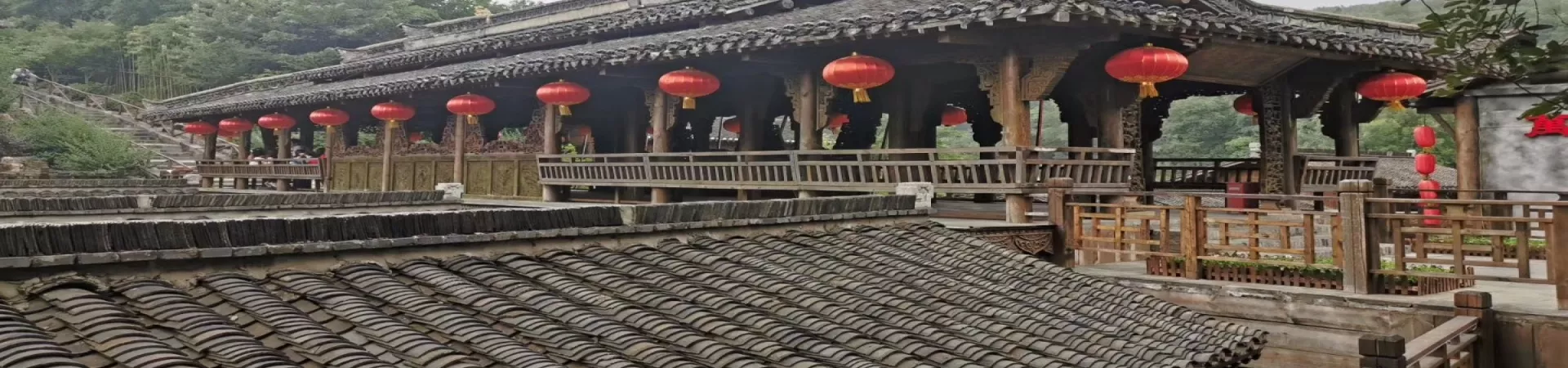
3.2. Architectural Uniqueness: A Monastery of Courtyards Architecturally, Longchang Temple presents a fascinating departure from typical grand Chinese Buddhist temple layouts. Constructed primarily during the Ming and Qing dynasties, its design resembles a sprawling, sophisticated Siheyuan (traditional Chinese courtyard residence). The complex is composed of multiple enclosed courtyards arranged in a harmonious, dispersed pattern, all characterized by simple white walls and dark grey tiles.
3.2.1. The Central Axis and Main Halls The temple's layout, while seemingly decentralized, is organized around a subtle central axis. This axis begins at the Mahavira Hall (Daxiong Baodian), which houses statues of the Buddha, and extends to the Busa Hall opposite, dedicated to the guardian Skanda. This arrangement forms the spiritual and administrative backbone of the temple.
3.2.2. The Secluded Courtyards: Copper Hall and Beamless Hall Moving behind the Mahavira Hall along the axis, visitors discover more intimate and architecturally significant spaces. Here lies a secluded courtyard housing two remarkable structures: the Copper Hall and the Beamless Hall. The Beamless Hall, built entirely of brick and stone without wooden beams, is a marvel of ancient engineering and a testament to the skill of its builders. These quieter courtyards exemplify the temple's "coarse on the outside, refined on the inside" philosophy—a seemingly simple cluster of buildings that contains intricate spaces for worship, meditation, and study, all designed to facilitate disciplined monastic life.
4. Practical Visitor Information 4.1. Transportation Reaching Baohua Mountain National Forest Park from Nanjing is straightforward. A convenient route involves taking Nanjing Metro Line 4 to Xianlinhu Station. Upon exiting, transfer to public bus 191 at the south side of the station. Alight at the Baohua Mountain stop, from which the park entrance is within walking distance.
4.2. Admission and Hours The park operates with separate daytime and evening visiting periods. The general admission fee is approximately 50 RMB. It is crucial to note that this price is for reference only, and visitors should verify the latest fees through official channels prior to their visit. * Daytime Operation: The park is open from 8:30 AM to 5:00 PM, with last entry typically at 4:30 PM. * Night Operation: A separate night session is often available from 5:00 PM to 9:00 PM, with last entry at 8:30 PM. The night experience often features illuminated pathways and a different atmospheric perspective on the temple and forests.
4.3. Suggested Duration To fully appreciate both the natural trails and the historical depth of Longchang Temple, a visit of at least three to four hours is recommended. Those wishing to embark on longer hikes or engage in more contemplative exploration should allocate a half-day or more.