Zhongyue Temple
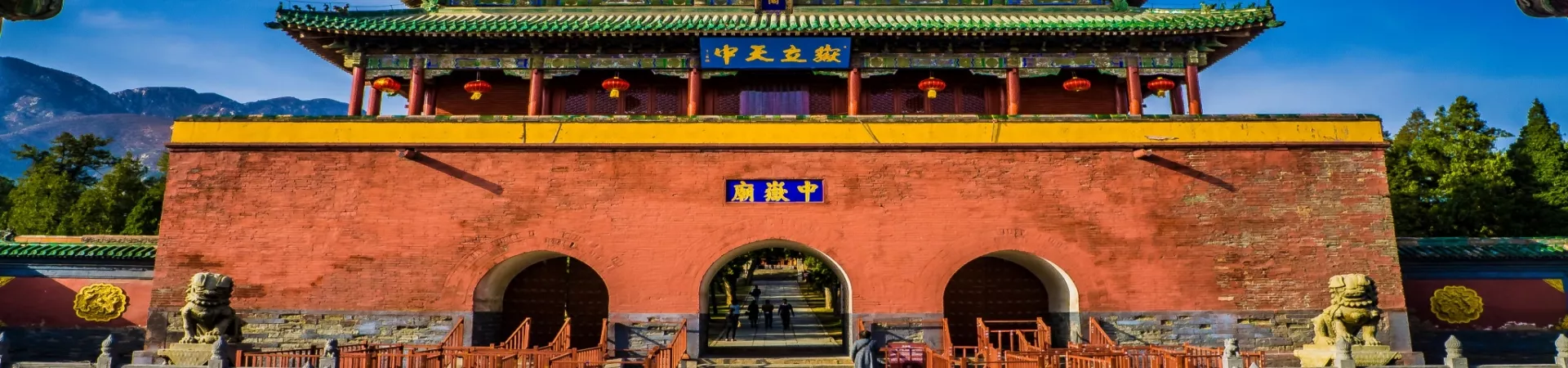
Subtitle: The Sacred Heart of the Songshan Mountains: A Journey Through the Zhongyue Temple
1. Introduction: A Spiritual Citadel Amidst Peaks Nestled at the foot of the majestic Taishi Mountain on the southern slopes of the sacred Songshan range, approximately 4 kilometers east of Dengfeng City in Henan Province, stands the Zhongyue Temple. More than just an ancient architectural complex, it is a spiritual epicenter, revered as a holy sanctuary for the Quanzhen School, one of the most influential branches of Daoism in the world. Its strategic and profoundly symbolic location is a masterpiece of ancient Chinese geomancy (feng shui), cradled protectively by an ensemble of peaks: backed by the Huanggai Peak, facing the Yu'an Mountain, flanked by the Wangchao Ridge to the west and the Muzi Hill to the east. This natural amphitheater sets the stage for a man-made marvel of harmonious design, where vibrant red walls and brilliant yellow glazed tiles create a dazzling spectacle of gold and crimson against the verdant mountain backdrop, embodying the celestial order on earth.
2. Architectural Grandeur and Historical Legacy 2.1. Scale and Significance in Chinese Heritage The Zhongyue Temple is not merely a regional treasure but a monument of national importance. It holds the distinguished title of being the finest and most expansive temple complex in central China's Henan province. Its significance is further elevated as the largest and most completely preserved ancient architectural ensemble among all the temples dedicated to the Five Sacred Mountains (Wu Yue) of China. The sheer scale and meticulous preservation of its structures make it a rare exemplar—a site where grandeur seamlessly blends with an aura of serene solemnity and elegant refinement, offering a tangible connection to the profound depths of Chinese civilization and its Daoist traditions.
2.2. A Phoenix from the Ashes: Destruction and Reconstruction The temple's journey through history has been marked by both glory and tribulation. Its most devastating trial came in the 17th century when, in the 17th year of the Ming Chongzhen era (1644), a great fire reduced much of the complex to ashes. The magnificent structures visible today are primarily the result of extensive reconstruction and renovation undertaken during the subsequent Qing Dynasty. While echoing the grandeur of its past incarnations, the present layout and buildings reflect the architectural sensibilities and imperial patronage of the Qing period, symbolizing resilience and the enduring power of faith across dynastic changes.
3. Practical Information for Visitors 3.1. Planning Your Visit: Hours and Duration To fully appreciate the temple's sprawling courtyards, numerous halls, and intricate details, a visit of 1 to 3 hours is recommended. The opening hours vary slightly by season, so careful planning is advised: * Summer Season (June 1 - August 31): The temple is open from 08:00 to 18:00, with the last admission at 17:00. * Winter Season (December 1 - February 28): Operating hours are from 08:00 to 18:00, with final entry permitted until 16:30.
3.2. Admission and Ticketing Options Access to the Zhongyue Temple requires an admission ticket. A standard adult ticket is priced at 30 RMB and is valid year-round. For travelers interested in exploring more of the Songshan area's cultural highlights, a cost-effective option is available: * Songshan Zhongyue Scenic Area Combo Ticket: Priced at 80 RMB per person, this ticket grants entry to three significant sites: the Zhongyue Temple itself, the picturesque Luyai Waterfalls, and the ancient Gaocheng Observatory (Guanxing Tai), one of the oldest astronomical observatories in the world. This combo ticket is ideal for a full day of cultural and natural exploration.
3.3. Contact Information For the most current information, especially regarding special events, temporary closures, or detailed inquiries, visitors can contact the temple administration directly via telephone at 0371-62850819 or 0371-62745000.
Information last verified/updated: February 2, 2023. Credit and thanks to contributor Yueqian Huayue for collaborative editing.