Henan Museum
Subtitle: A Journey Through Five Millennia: The Essential Guide to Henan Museum
1. Introduction: A Century-Long Custodian of Civilization
Established in 1927, the Henan Museum stands not merely as a building housing artifacts but as a monumental chronicle of Chinese civilization, rightfully considered one of the country's most essential and captivating museums. For any visitor to Zhengzhou or indeed to China, a trip here is less an optional activity and more a fundamental pilgrimage to understand the very roots of Chinese culture. The museum serves as the definitive showcase of Henan Province's 5,000-year historical continuum, a region often called the "Cradle of Chinese Civilization" for its central role in the dawn of dynasties, philosophy, and technological innovation. With a staggering collection of over 140,000 cultural relics, each hall and exhibit offers a profound window into the epochs that shaped not just Henan, but the entire nation.
2. Navigating the Treasures: Galleries and Must-See Artifacts
The museum's permanent exhibition is brilliantly organized into eight major galleries, arranged chronologically to guide visitors on a coherent journey through time from prehistoric eras to the modern age.
2.1. The Architectural and Thematic Layout This logical, time-based flow allows one to appreciate the evolution of artistic styles, craftsmanship, social structures, and technological advancements. The galleries are meticulously curated, moving from the nebulous beginnings of society in the Paleolithic and Neolithic periods, through the dawn of bronze casting and state formation in the Xia and Shang dynasties, into the philosophical ferment and imperial unification of the Zhou, Qin, and Han periods, and onward through the golden ages of the Tang and Song, right up to the Qing dynasty and beyond.
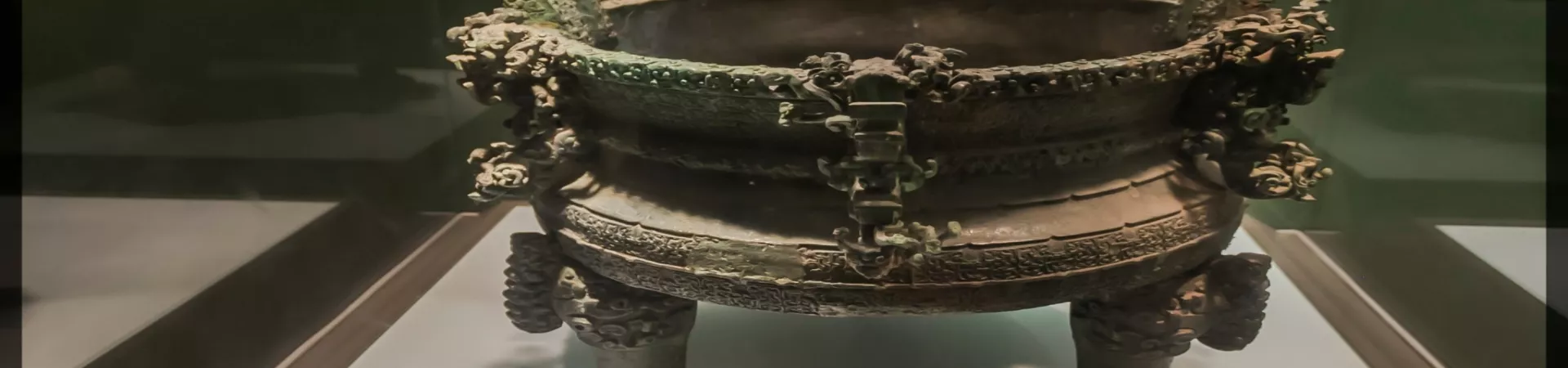
2.2. Unmissable Masterpieces: The Soul of the Collection While every item holds significance, certain national treasures transcend history to become icons of artistic and cultural achievement. Foremost among these is the Lotus and Crane Square Pot (Lianhe Fanghu) from the Spring and Autumn Period (circa 771-476 BC). This exquisite bronze wine vessel, adorned with coiled dragons, leaping beasts, and a central pillar supporting a graceful crane standing atop a double layer of lotus petals, epitomizes the technical mastery and creative spirit of the pre-Qin era. It is a masterpiece where solemn ritual form meets dynamic, almost romantic naturalism. Other highlights typically include intricately inscribed oracle bones from the Shang dynasty, majestic and awe-inspiring ritual bronzes like ding tripods and zun vases, the famous Jade Burial Suit sewn with gold thread from the Han dynasty, and sublime Tang dynasty tri-color glazed pottery (Sancai). Each piece is a chapter in a grand narrative, and missing them would be to miss the heart of the museum's story.
3. The Living Past: Performances and Cultural Experiences
Beyond the silent eloquence of its artifacts, the Henan Museum brings history to life through sensory experiences. A particularly enchanting program is the Ancient Chinese Music Performance (Huaxia Guyue).
3.1. Performance Details and Scheduling Held in a dedicated auditorium, these performances are scheduled every Tuesday through Sunday at 11:00 AM and 4:00 PM, with each concert lasting approximately 20 minutes. It is highly advisable to check the daily schedule upon arrival, as times can be subject to change.
3.2. The Experience and Its Significance The performances feature skilled musicians playing faithful replicas of ancient instruments excavated from archaeological sites in Henan, such as bone flutes, stone chimes (qing), bronze bells (bianzhong), and ancient zithers. The music, reconstructed based on historical research, offers an audible bridge to the past, allowing visitors to hear the same melodies that might have entertained royalty, accompanied rituals, or filled palace halls millennia ago. This auditory layer adds a deeply moving and memorable dimension to the visual feast of the galleries.
4. Essential Visitor Information
To ensure a smooth and enriching visit, please take note of the following practical details.
4.1. Admission, Hours, and Best Times to Visit Admission to the Henan Museum is free of charge for all visitors. Operating hours vary by season: * Summer Hours (June 1 - August 31): Open from 9:00 AM to 5:30 PM, with last entry at 4:30 PM. The museum is closed on Mondays for maintenance, except for national holidays. * Winter Hours (December 1 - February 28/29): Open from 9:00 AM to 5:00 PM, with last entry at 4:00 PM. The museum is similarly closed on Mondays.
It is recommended to allocate at least 2 to 3 hours for a comprehensive visit. Mornings on weekdays tend to be less crowded. Always carry a valid form of identification (passport for foreign visitors), as it may be required for ticket collection.
4.2. Location and Transportation The museum is located in central Zhengzhou. The most convenient public transportation option is to take Bus B11 or B18 and alight at the "Bowuyuan" (Museum) station, which is a Bus Rapid Transit (BRT) stop. From there, it is a short and easy walk of approximately 200 meters to the museum entrance. Taxis and ride-hailing services are also widely available throughout the city.
4.3. Contact Information For the most current information regarding special exhibitions, performance cancellations, or holiday schedules, you can contact the museum directly: * Telephone: +86 371 6351 1237 or +86 371 6351 1239.
The museum's imposing main building, inspired by ancient astronomical observatories, is itself a modern architectural landmark. Its design symbolizes the unbroken connection between the earth (the central pyramid) and the heavens (the radiating slopes), a fitting metaphor for a museum that connects the present to China's profound and ancient past. A visit here is an immersive dialogue with history, where every artifact, from the smallest coin to the grandest bronze, has a story waiting to be discovered.