Tianshi Family Temple
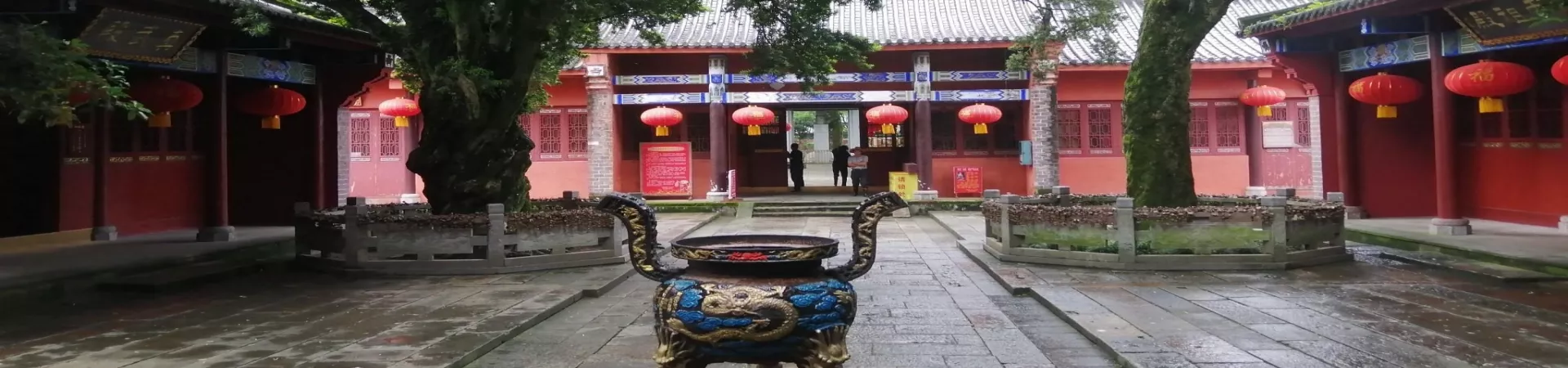
Subtitle: A Journey into the Heart of Taoist Heritage: The Celestial Master's Ancestral Temple in Longhu Shan
1. Introduction: The Spiritual Epicenter of Taoism Nestled at the foot of the serene Longhu Mountain (Dragon and Tiger Mountain) in Yingtan City, Jiangxi Province, lies a site of profound spiritual significance—the Celestial Master's Ancestral Temple. More than just a historical monument, this temple complex serves as the ancestral home and the spiritual nucleus of Taoism, China's indigenous philosophical and religious tradition. For over two millennia, it has been inextricably linked to the Zhang family lineage, the hereditary Celestial Masters who have guided the development of Taoism since the Eastern Han Dynasty. A visit here is not merely a sightseeing excursion; it is a pilgrimage into the living heart of a tradition that emphasizes harmony with the natural order, or the Dao.
2. Historical Legacy: From Zhang Daoling to a Global Faith 2.1 The Founding Vision of the First Celestial Master The temple's origins are deeply entwined with the legendary figure Zhang Daoling (34-156 AD). It is believed that around 142 AD, the deified Laozi, author of the Taoist classic Daodejing, revealed himself to Zhang Daoling on Longhu Mountain. This divine encounter bestowed upon Zhang the title of "Celestial Master" and the mandate to reform local religious practices and establish Orthodox Unity Taoism (Zhengyi Dao). The mountain, with its striking peaks resembling a dragon and a tiger in confrontation, became the sacred geographical anchor for this new spiritual movement.
2.2 The Seat of a Hereditary Lineage Following Zhang Daoling, the leadership of Orthodox Unity Taoism became hereditary, passing down through the Zhang family for 63 generations. The Ancestral Temple evolved into the administrative and ceremonial center of this spiritual dynasty. Throughout Chinese history, from imperial endorsements to periods of suppression, the temple stood as a resilient symbol of the Zhang lineage's authority and the continuity of Taoist practice. It functioned as the central hub for ordaining priests, compiling scriptures, and conducting grand rituals that connected the celestial and earthly realms.
2.3 Architectural Phoenix: Destruction and Reconstruction The temple's physical journey has been one of cyclical destruction and rebirth, mirroring Taoist concepts of transformation. The original complex, which once rivaled the Confucian Temple in Qufu in scale, suffered severe damage during the mid-20th century. The current structures are largely meticulous reconstructions completed in the late 1980s and onwards, based on historical records and traditional architectural principles. This careful restoration has revived the temple's majestic presence, allowing visitors to experience the grandeur that once defined this central place of Taoist power.
3. Architectural Layout and Symbolic Spaces The temple complex is a masterpiece of traditional Chinese temple architecture, organized along a central north-south axis in accordance with Feng Shui principles and hierarchical order, reflecting the structured yet harmonious universe of Taoist belief.
3.1 The Approaching Path: Setting the Atmosphere The visit begins with a long, solemn flagstone path leading to the main entrance. This approach is designed to quiet the mind, separating the visitor from the mundane world and preparing the spirit for entry into a sacred space. The surrounding ancient trees and the distant view of Longhu Shan's mist-shrouded peaks enhance the sense of tranquility and timelessness.
3.2 Core Structures Along the Central Axis * The Main Gate (Shan Men): The imposing entrance gate marks the formal threshold into the temple grounds. Flanked by formidable stone lions, it symbolizes the transition from the profane to the sacred. * The Yuhuang Hall (Jade Emperor Hall): As the first major hall, it is dedicated to the Jade Emperor, the supreme deity in the Taoist pantheon. The hall's elevated position and ornate decorations, including intricate wood carvings and murals, emphasize his celestial authority. * The Sanqing Hall (Three Pure Ones Hall): This is the theological and architectural centerpiece of the complex. It houses the statues of the Three Pure Ones—the supreme manifestations of the Dao. The hall's spacious interior and solemn atmosphere are intended for high-level meditation and ritual, representing the ultimate Taoist pursuit of spiritual purity and union with the Dao. * The Ancestral Hall (Zushi Hall): Located in the innermost and most revered section, this hall is dedicated to Zhang Daoling, the First Celestial Master, and the successive masters of the Zhang lineage. It is the most intimate space within the complex, focusing on veneration of the founders and the living history of the tradition. The hall serves as a powerful reminder of the human lineage that has shepherded this faith for centuries.
3.3 Integration with the Natural Landscape The architecture does not dominate nature but converses with it. Courtyards are strategically placed between halls, allowing in sunlight, air, and views of the surrounding greenery and mountain scenery. This design philosophy embodies the core Taoist principle of "Wu Wei" (non-action) and the seamless integration of human construction with the natural environment, creating a holistic space for spiritual cultivation.
4. Cultural Significance and Living Tradition 4.1 A Repository of Taoist Arts and Rituals The temple is a vibrant cultural repository. Its walls are adorned with frescoes depicting Taoist mythology, and its altars feature exquisite statues and ritual implements. The air may carry the scent of incense and the sound of chanting or the rhythmic beats from ritual ceremonies, which are still actively performed by resident Taoist priests. These rituals, including the grand "Jiao" (Offering) ceremonies, are intangible cultural heritage, offering a direct window into ancient Chinese religious practices.
4.2 The Heart of the Zhang Lineage Despite the historical disruptions, the temple remains the symbolic heart of the Zhang family and Orthodox Unity Taoism. While the 63rd Celestial Master resides in Taiwan, the temple in Longhu Shan continues to be recognized as the ancestral home. It attracts Taoist devotees from across the Chinese world and beyond who come to pay respects, seek blessings, and connect with the source of their faith.
4.3 A Bridge for Modern Understanding For the non-religious visitor, the Celestial Master's Ancestral Temple offers a profound educational experience. It provides a tangible context for understanding Taoism's philosophical depth, its historical influence on Chinese culture, medicine, and martial arts, and its enduring aesthetic. Walking through its halls and courtyards, one gains insight into a worldview that values balance, natural harmony, and spiritual introspection—a perspective increasingly relevant in the modern world.
In essence, the Celestial Master's Ancestral Temple is a multidimensional treasure. It is a historical archive of a 2,000-year lineage, an architectural symphony in harmony with nature, an active center of worship, and a serene sanctuary for personal reflection. Its reconstructed halls stand not as mere replicas of the past, but as a living testament to the resilience and enduring appeal of Taoist wisdom.