Bo people hang coffins
Subtitle: A Journey to the Cliffside Tombs of the Bo People, Yibin's Ancient Enigma
1. Introduction: Echoes from the Cliffs
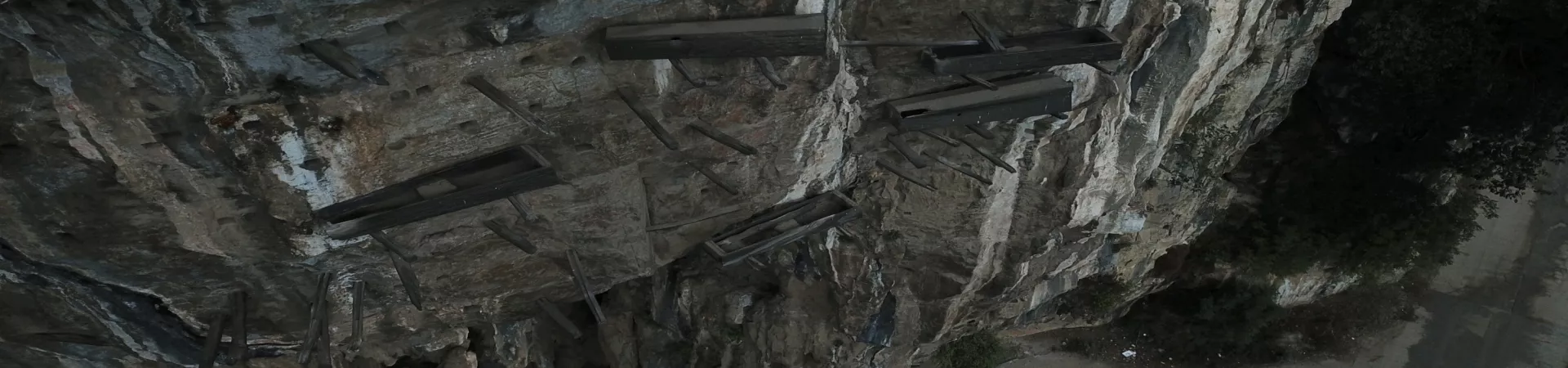
Nestled within the dramatic limestone landscapes of southern Sichuan Province, near the city of Yibin, lies one of China's most captivating and mysterious archaeological wonders: the Hanging Coffins of the Bo People. Distributed across the counties of Gongxian, Xingwen, and Junlian, these ancient coffins, perched precariously on wooden stakes driven into sheer cliff faces or placed within natural caverns high above the river valleys, silently challenge the passage of time. They are not merely tombs but profound statements of a lost culture's beliefs, technological skill, and reverence for the afterlife. Recognized as a provincial-level protected site as early as 1956 and now holding the status of a Major Historical and Cultural Site Protected at the National Level, the Bo Hanging Coffins are often hailed as a "peerless wonder of Ba-Shu" and a site of global archaeological significance. This area, bordering Yunnan province, was once the heartland of the ancient "Southwestern Yi" tribes. During the Han Dynasty, when Emperor Wu expanded into the Yelang region and established the Qianwei Commandery, this land fell under the administration of Bodao County, home to the Bo people.
2. Historical and Cultural Context: The People Who Defied Gravity
2.1. A Widespread Funerary Tradition The practice of cliff burial, or "hanging coffin" interment, was not unique to a single group but was a custom shared by several ancient ethnicities in southern China, including the Baiyue, Ganyue, and Liao peoples. However, the most renowned and visually striking examples are undoubtedly the Bo coffins in Sichuan and the boat-shaped coffins in Fujian province. As the Gong County Annals succinctly state, "Gong was originally Bo land, and the Bo people often placed their coffins on cliffs." This practice, which seems to defy logic and gravity, offers a tangible connection to the spiritual world of these ancient communities.
2.2. The Enigmatic Bo People The Bo (also historically referred to as the Duzhang people) were the predominant ethnic group in this region for centuries. Their cliff burial customs are believed to be driven by several possible motivations: to bring the deceased closer to heaven, to protect the tombs from animals and desecration, and to demonstrate the family's prestige and devotion through the immense effort required for such an undertaking. The coffins themselves, primarily carved from single logs of nanmu wood, and the personal artifacts found within, provide invaluable, though fragmented, insights into their daily life, craftsmanship, and social structure. The mystery deepens as the Bo people as a distinct cultural entity largely faded from historical records after the Ming Dynasty, leaving their silent cliffside necropolises as their most enduring legacy.
3. Planning Your Visit: Practical Information
3.1. Location and Access The primary sites for viewing the Hanging Coffins are located in Gongxian and Xingwen counties, approximately a two to three-hour drive from Yibin city center. The journey itself winds through the picturesque, rolling hills of southern Sichuan.
3.1.1. Driving Directions (Example from Gongxian County Center): For visitors opting for a self-drive tour from the Gongxian county area, the route involves navigating local roads towards the specific scenic area (often referred to as "Boren Xuanguan" on maps). A general directional outline is as follows: From the county center, head east and follow local roads (such as Gugaolu). Key turns typically involve merging onto or following routes like Binhe West Street and the S309 provincial road towards Luobiao Town, where the main scenic area is located. It is highly recommended to use a reliable GPS navigation app updated with detailed maps of Sichuan for the most accurate and real-time routing, as road names and conditions can vary.
3.2. Admission and Operating Hours * Ticket Fee: The standard admission fee is approximately 18 RMB per person. Prices are subject to change, and it is advisable to verify before your visit. * Opening Hours: The site is generally open daily from 8:00 AM to 7:00 PM. Last admission is typically at 7:00 PM. These hours apply throughout the year but may be adjusted during national holidays or for maintenance; checking ahead is always prudent.
4. The On-Site Experience: Observation and Interpretation
4.1. Viewing Platforms and Trails Upon arrival, visitors will find constructed viewing platforms and walking paths that offer the safest and clearest vantage points of the coffin clusters across the gorge. The sight of these dark, oblong shapes embedded in the towering, vegetated cliff face is both awe-inspiring and humbling. Telescopes or binoculars are often available for a closer look, revealing the details of the wooden stakes (or "cantilevers") and the placement of the coffins.
4.2. The Enduring Mysteries As you gaze upon the coffins, the central questions become palpable: How did they achieve this? The most accepted theories suggest a combination of techniques—lowering coffins from the cliff top using ropes, constructing temporary wooden scaffolds from the bottom, or navigating ancient, now-eroded pathways along the rock face. Each theory speaks to the extraordinary determination and engineering ingenuity of the Bo people. The onsite museum or informational displays usually present these theories, alongside artifacts like bronze drums, pottery, and textiles recovered from the area, helping to piece together the narrative of this vanished culture.
4.3. The Natural Setting The experience is profoundly shaped by its natural context. The cliffs are part of a karst topography, often shrouded in mist, which adds an ethereal, timeless quality to the scene. The rustling of leaves and the flow of the river below are the only sounds, emphasizing the profound silence and permanence of the cliffs against which the Bo people staged their final farewells. A visit here is as much about contemplating human history as it is about appreciating a powerful and majestic natural landscape that has served as a sacred cemetery for millennia.