Mount Wutai
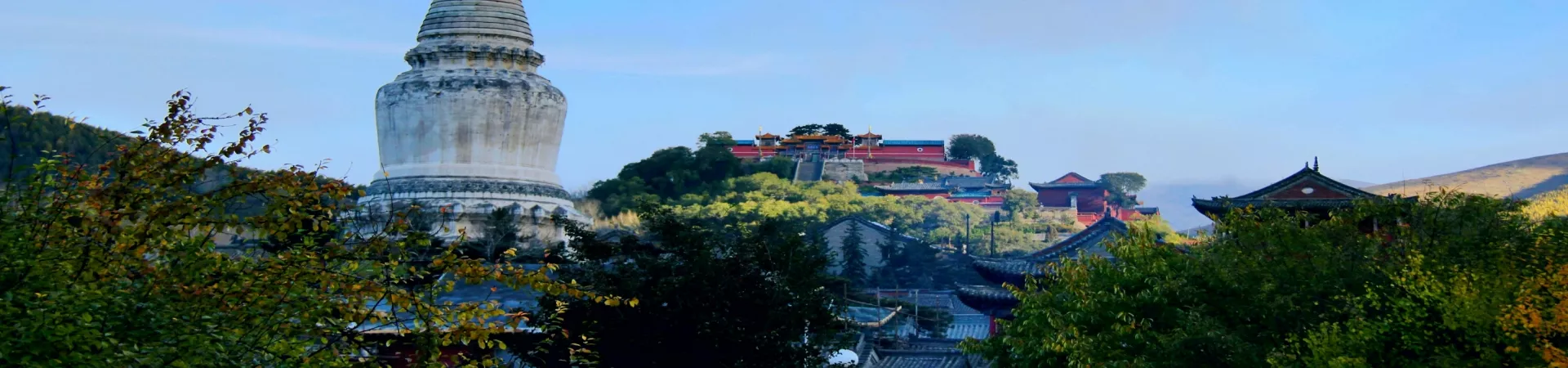
Discovering the Timeless Beauty of Wutai Mountain in Xinzhou
Nestled in the northeastern part of Shanxi province, Wutai Mountain resides within the boundaries of Wutai County. With an average elevation exceeding 1000 meters, this enchanting mountain range reaches its zenith at the Yemeng Peak, standing at an elevation of approximately 3058 meters. Aptly known as the "Roof of Northern China," Wutai Mountain spans a radius of about 300 kilometers.
Majestic Peaks and Spiritual Heritage: Wutai Mountain, named for its five towering peaks resembling colossal pillars, presents an awe-inspiring landscape where peaks rise dramatically, creating a majestic silhouette against the sky. The flat mountain tops, resembling platforms, contribute to the name "Wutai." Furthermore, owing to its refreshing climate, the mountain is also known as the "Cool Clear Mountain." This region seamlessly integrates natural beauty, historical relics, ancient architectural art, Buddhist culture, local customs, and a haven for summer retreats.
Buddhist Sanctuary and Cultural Marvel: Renowned both nationally and internationally as a Buddhist sanctuary, Wutai Mountain is considered the sacred abode of Manjushri Bodhisattva. Its historical significance, vastness, and the grandeur of its temples position it as the foremost among China's Four Sacred Buddhist Mountains, earning it the illustrious title of "Golden Wutai." Globally, Wutai Mountain shares the spotlight with Nepal's Lumbini Garden, India's Deer Park, Bodh Gaya, and Sarnath, collectively recognized as the Five Great Buddhist Holy Sites. Its fame extends to countries like Japan, India, Sri Lanka, Myanmar, and Nepal.
Roots in Daoism and Buddhist Legacy: Legend has it that Wutai Mountain was originally a Daoist domain, known as "Purple Mansion Mountain" in Daoist scriptures, housing the Purple Mansion Temple. Records from "Qingliang Mountain Annals" suggest that when Buddhist worship of Manjushri Bodhisattva began, he resided in a stone basin cave within the Daoist Xuanzhen Temple. This hints at the mountain's Daoist roots.
Buddhism's Arrival and Enduring Influence: The formal introduction of Buddhism to Wutai Mountain is historically traced back to the Eastern Han dynasty, around 67 AD. Emperor Ming of Han dispatched envoys to seek Buddhist scriptures in India, leading to the arrival of two prominent Indian monks, Shemoteng and Zhufalan, in Luoyang. By the 11th year of the Yongping era, Shemoteng and Zhufalan had reached Wutai Mountain, then known as Qingliang Mountain. Faced with opposition due to the dominance of Daoism, they reported to Emperor Ming. To settle the dispute, a public burning of scriptures was proposed, where Daoist texts were obliterated while Buddhist scriptures remained unscathed, granting the monks the right to build temples.
Contact Information: Telephone: 4001666236
Recommended Duration: Approximately 1 day
Transportation: Getting to the Scenic Area:
- Bus: Take a bus from Taiyuan East Bus Station to Wutai Mountain.
- Train: Trains from Taiyuan Station to Wutai Mountain are available. Wutai Mountain Station is located in Shahe Town, Fanzhi County, approximately 54 kilometers from the scenic area. Buses to Taihuai Town are available in front of the train station. Internal Transportation:
- Eco-friendly Vehicles: Eco-friendly vehicles circulate between various attractions and hotels within the scenic area. A ticket must be purchased, whether or not you choose to ride.
- Summit Vehicles: To reach the summit of Wutai Mountain, take a summit vehicle from Dailuo Peak.
As we delve into the exquisite details of Wutai Mountain in Xinzhou, one can't help but marvel at its spiritual significance, cultural richness, and the seamless integration of natural wonders with profound historical heritage. Welcome to Wutai Mountain, where time seems to stand still, and every step echoes the whispers of a bygone era.