White Cloud Cave of Mount Kong
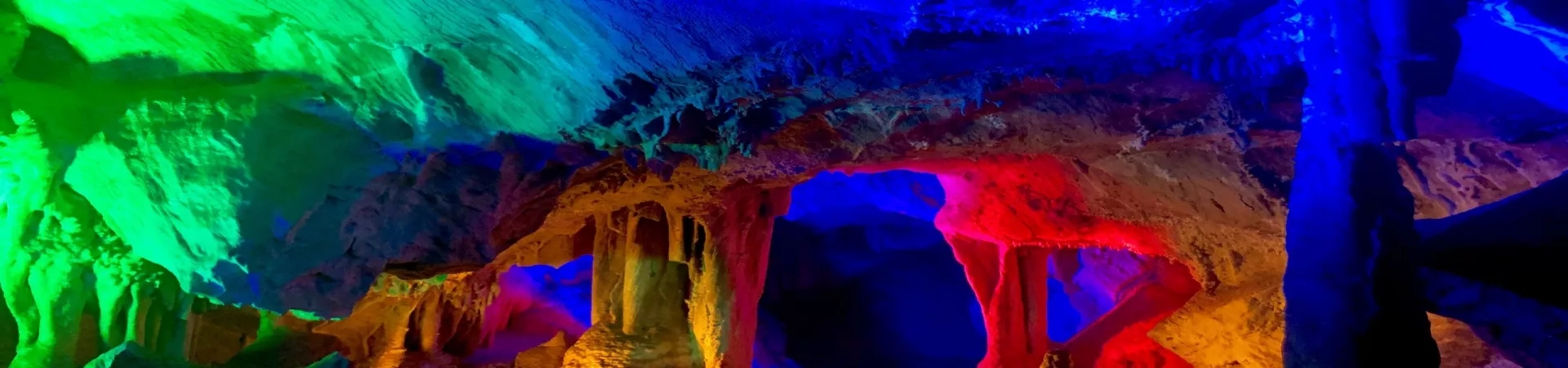
Exploring Xingtai's Kongsan Baiyundong: A Subterranean Marvel
Situated within the confines of Licheng County in Xingtai, Kongsan Baiyundong beckons travelers with its geological wonders and cultural richness. Positioned 56 kilometers south of Xingtai and 86 kilometers north of Shijiazhuang, the journey to Kongsan Baiyundong via the Jingguang Railway, Jingshen Expressway, and National Highway 107 is remarkably convenient. Dating back 500 million years to the Middle Cambrian period, Kongsan Baiyundong stands as a rare karst cave landscape in northern China. With five explored and open caverns, a total trail length of 4,000 meters, and diverse formations spanning 2170 square meters, this underground marvel unfolds an intricate tapestry of sights and sensations.
The Five Enchanting Caverns
Renjian (Human Realm): The first cavern, spacious and grand, mirrors a tranquil earthly paradise with mountains and water, creating a serene human realm.
Tiantang (Heaven): The second cavern, adorned with hanging curtains and majestic scenery, evokes the opulence of heavenly abodes.
Difu (Underworld): The third cavern, adorned with bizarre rocks, exudes an eerie and terrifying atmosphere reminiscent of the underworld.
Longgong (Dragon Palace): The fourth cavern captivates with interwoven branches, scattered water pools, resembling the mythical Dragon Palace.
Mile (Mystic Joy): The fifth cavern, with rugged and winding rocks, unfolds a hidden paradise. Each cavern boasts unique features, creating a diverse and captivating underground world.
Geological Marvels
Within these caverns, an array of captivating carbonate formations, including stalactites, stalagmites, curtains, and cascades, come to life in an explosion of colors and shapes. Rare formations such as the web-like "outside-growing branches," "linear stone pipes," and the exquisite "colorful stone curtains" and "stone grapes" are exceptionally rare among other caves in China. The cave houses an impressive 109 anthropomorphic and scenic formations, ranging from massive pillars and curtains to delicate stone needles.
Historical Significance
Discovered on July 18, 1988, by local farmers during quarrying, Kongsan Baiyundong was swiftly recognized for its geological importance. The local government formed a leadership group for the protection and development of Kongsan Baiyundong, implementing measures for cave preservation. In 1989, with meticulous planning from China University of Geosciences, Geological Brigade 11 of the Ministry of Geology, and the Institute of Geography at Hebei Academy of Sciences, Kongsan Baiyundong underwent development, opening its gates to the public on July 1, 1990.
Cultural Landscape
A focal point for tourism in the region, Kongsan Baiyundong has spearheaded the development of a 250-square-kilometer tourist belt, incorporating caves, mountains, water bodies, pristine secondary forests, and cultural landmarks. It stands at the forefront of national geological parks, earning the distinction of a 4A-level scenic area. The journey through Kongsan Baiyundong unfurls a mesmerizing subterranean "museum" and "labyrinth," offering diverse artistic delights, blending form, line, and space in an underground spectacle.
Contact Information
Phone: 0319-7098688
Embark on an extensive odyssey through the depths of Kongsan Baiyundong in Xingtai, where geological wonders meet cultural treasures, narrated in a vivid tapestry of American English without a single Chinese character.