Guangji Temple
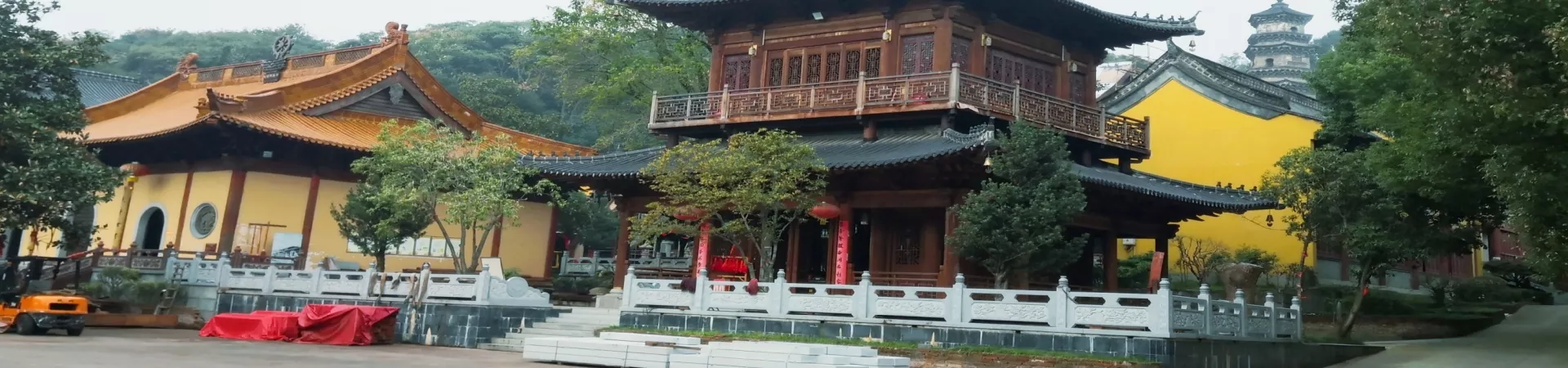
Subtitle: A Journey Through Time and Faith on the Hill of Zheshan
1. Introduction: The Sacred Hill of Zheshan Nestled within the vibrant city of Wuhu in Anhui Province, China, the Guangji Temple complex offers far more than a simple religious site; it presents a profound journey through Buddhist history, architectural harmony with nature, and enduring spiritual legacy. Perched upon the slopes of Zheshan Hill, a verdant oasis rising 86 meters above the urban landscape, the temple has served for centuries as both a serene sanctuary and the city's premier vantage point. The hill itself, celebrated for its lush forests of pine and bamboo and its fragrant blooms, provides a breathtaking panorama described historically as commanding the mighty Yangtze River, with its endless stream of vessels, while offering a picturesque, bird's-eye view of the city below. It is upon this storied hill that Guangji Temple, a nationally protected key Buddhist monastery, unfolds its layered history and spiritual significance.
2. Historical Evolution: From Tang Dynasty to National Treasure The story of Guangji Temple is a tapestry woven over more than a millennium. Its foundations were first laid during the Tang Dynasty's Qianning era (894-898 AD). Within a few years, during the Guanghua period (898-901), it was known as the Yongqing Temple. The temple received its enduring name, Guangji Temple, during the Northern Song Dynasty's Dazhong Xiangfu era (1008-1023). Through subsequent dynasties, it underwent necessary repairs and renovations, notably during the Ming Dynasty's Jingtai reign and the Qing Dynasty's Qianlong and Jiaqing periods. A major reconstruction followed the temple's damage in the turbulent Xianfeng era (1851-1868). This long, continuous history is not merely recorded in texts but is physically embodied in the temple's very structures and its most precious artifact.
2.1. The Legend of Golden Kṣitigarbha (Jin Dizang) The spiritual importance of Guangji Temple is inextricably linked to one of the most revered figures in East Asian Buddhism: Jin Qiaojue, a prince from the Korean kingdom of Silla. In 653 AD, this devout monk journeyed to China. Historical accounts and local tradition hold that he first traveled to Wuhu, preaching and expounding Buddhist sutras at the sites of Sihe Hill and later on Zheshan Hill itself, at the location of the present-day Guangji Temple. His journey culminated at Mount Jiuhua, where he attained great enlightenment and, after his death, was venerated as an incarnation of Kṣitigarbha Bodhisattva (Dizang Pusa), becoming known as Jin Dizang or "Golden Kṣitigarbha." This direct connection transformed Guangji Temple into a sacred precursor to the great Mount Jiuhua.
2.2. The "Little Jiuhua" and the Sacred Golden Seal Due to its foundational role in the journey of Jin Dizang, Guangji Temple earned the venerable title "Little Jiuhua." For centuries, it became an established tradition for pilgrims journeying to the main sacred site of Mount Jiuhua to first offer incense at Guangji Temple, making it an essential and thriving pilgrimage destination in its own right. The temple safeguards a tangible link to this ancient past: a priceless golden seal. Cast in pure砂金 (sand gold) in 757 AD (the second year of the Tang Dezong's Zhide era) by temple monks to commemorate Jin Dizang, this artifact weighs approximately 7 Jin (roughly 4.2 kilograms). Its knob is exquisitely adorned with a "Nine Dragons Playing with a Pearl" motif, and its face is inscribed with the positive characters "地藏利成方颖" (Dizang Licheng Fangying) and the date "唐至德二年" (Second Year of Tang Zhide). This seal stands as a powerful symbol of the temple's ancient origins and its deep devotion to the Bodhisattva.
3. Architectural Layout: A Spiritual Ascent The architecture of Guangji Temple is a masterful example of integration with the natural landscape, designed to symbolize a pilgrim's progressive spiritual ascent. The complex is built directly into the hillside, consisting of three major tiers of halls. Each level is connected to the next, with structures rising one behind and above the other, creating a striking visual effect where the rear hall soars over ten meters above the one before it. This vertical arrangement guides visitors on a physical and metaphorical upward journey.
3.1. The 88-Step Pathway The connection between the temple's levels is achieved via a central stone staircase flanked by protective iron chains. This staircase consists of 88 steps—a number often considered auspicious in Chinese culture. The climb is not merely a physical act but a meditative process, leaving the mundane world below and approaching the higher realms of enlightenment step by step.
3.2. Hierarchy of Halls The ascent takes pilgrims through a sequence of important devotional halls. The journey typically begins at the Heavenly King Hall (Tianwang Dian) at the lower levels, guarding the entrance. Further up, one may encounter halls such as the Medicine Buddha Hall (Yaoshi Dian), dedicated to healing and wellness. The Great Hero Hall (Daxiong Baodian), or main Buddha hall, often houses the primary statues of Śākyamuni Buddha and his attendants. Each hall serves a distinct purpose within Buddhist worship.
3.3. The Summit: The Dizang Hall (Kṣitigarbha Hall) Crowning the temple complex at the highest tier is the magnificent Dizang Hall. This hall is architecturally modeled after the famed Yue Shen Hall (Moon Body Hall) on Mount Jiuhua, the very site of Jin Dizang's eternal rest. As the primary sanctuary of Guangji Temple, it is dedicated to Kṣitigarbha Bodhisattva, the embodiment of the vow to save all beings, especially those suffering in the hell realms. Reaching this hall represents the culmination of the pilgrim's climb, offering a space for profound reverence before the Bodhisattva whose legacy initiated the temple's sacred status.
4. Visitor Information and Experience Today, Guangji Temple remains an active center of Buddhist practice and a culturally rich destination for visitors. Open daily from 6:30 AM to 5:00 PM throughout the year, it invites exploration. A visit here is a multi-layered experience: it is a historical exploration through dynastic changes, an architectural study of adaptive religious construction, an active pilgrimage following ancient footsteps, and a chance for quiet contemplation amidst the natural beauty of Zheshan Hill. The temple's designation as a National Key Buddhist Temple underscores its irreplaceable value in China's religious and cultural heritage. Whether one is drawn by faith, history, architecture, or simply the promise of a stunning view over Wuhu, Guangji Temple offers a resonant and unforgettable encounter.