Mount Fanjing
Subtitle: A Journey to the Sacred Summit: Exploring Fanjingshan's Natural and Spiritual Wonders
1. Introduction: The Mountain of Pure Lands Nestled in the northeastern part of Tongren City, Guizhou Province, Fanjingshan (Mount Fanjing) stands as a monumental testament to both natural resilience and spiritual devotion. Its name, derived from the Buddhist term "Fanjing," meaning "Brahma's Pure Land," perfectly encapsulates its dual identity as a pristine ecological sanctuary and a revered Buddhist mountain. Recognized as a UNESCO World Natural Heritage site, Fanjingshan offers visitors an unparalleled opportunity to immerse themselves in ancient, untouched wilderness while tracing the footsteps of pilgrims on one of China's most significant sacred peaks. Far from the bustling urban centers, this mountain serves as a summer retreat, a biodiversity hotspot, and a profound spiritual destination, promising an experience that engages the senses, challenges the body, and calms the mind.
2. A Tapestry of Natural Wonders 2.1. A Preserved Primordial Ecosystem Fanjingshan's foremost allure lies in its exceptionally well-preserved primitive ecosystem. The mountain has largely escaped extensive artificial development, allowing its ancient forests, jagged peaks, and unique geological formations to exist in a state of near-original purity. This careful preservation has created a refuge for a stunning array of biodiversity. The area is a vital habitat for numerous rare and endemic species, including the elusive Guizhou golden monkey (Rhinopithecus brelichi), the Chinese giant salamander, and a rich variety of plant life, such as the dove tree (Davidia involucrata) and countless ancient firs and rhododendrons. Hiking its trails feels like stepping back in time, surrounded by the whispers of a primeval world.
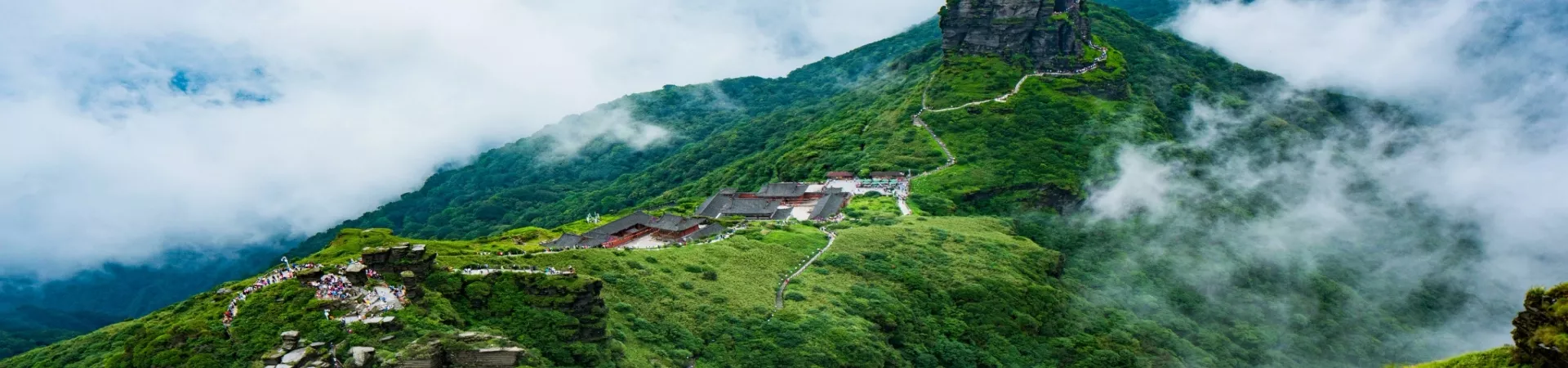
2.2. The Iconic Mushroom Stone The undisputed symbol of Fanjingshan's geological majesty is the legendary Mushroom Stone. This astonishing rock formation, perched precariously on a high ridge, defies gravity with its distinctive shape: a massive, flat-topped slab balanced atop a dramatically narrower stone pedestal. Standing approximately ten meters tall, this natural sculpture is estimated to be over one billion years old, a silent witness to unimaginable epochs of geological change. It is more than just a scenic photo opportunity; it is a humbling monument to the patient, powerful forces of nature that have shaped our planet. The sight of the Mushroom Stone against the backdrop of swirling clouds and vast valleys is an image that etches itself permanently into memory.
3. The Heart of Buddhist Pilgrimage 3.1. A Major Buddhist Sanctuary Beyond its physical beauty, Fanjingshan holds profound spiritual significance as one of China's Five Great Buddhist Mountains. It is renowned nationwide as the principal Bodhimanda (Dao Chang) of Maitreya Buddha, the Buddha of the Future. This designation places it at the very heart of Buddhist worship and pilgrimage, attracting devotees who seek blessings and spiritual merit. For centuries, the mountain has been a center for Buddhist practice, contemplation, and scholarship, its serene atmosphere considered conducive to enlightenment and inner peace.
3.2. Architectural Feats of Faith This deep spirituality is physically manifested in the astonishing temples built atop its highest peaks. The most remarkable are the Temple of the Buddha and the Temple of Maitreya, constructed on the sheer, isolated pinnacles of the Red Clouds Golden Summit. Reaching these temples involves ascending steep, sometimes vertigo-inducing staircases carved into or clinging to the mountain face. The journey itself is a form of pilgrimage, a test of devotion and resolve. To stand at these temples, enveloped in clouds with breathtaking panoramic views, is to experience a powerful sense of tranquility and awe, understanding why this site was chosen for communion with the divine.
4. Essential Visitor Information 4.1. Planning Your Ascent: Tickets and Operating Hours A successful visit requires careful planning due to daily visitor limits designed to protect the environment. The park operates on a ticketing system that typically includes an entrance fee and a mandatory shuttle bus ride from the visitor center to the trailhead or cable car station. A cable car is available for most of the ascent, significantly reducing hiking time, though the final climb to the summits must be done on foot. It is strongly advised to purchase tickets online in advance, especially during holidays and peak seasons (March to October). Operating hours vary seasonally: generally from 7:00/8:00 AM to 3:00/4:00 PM, with last entry often by mid-afternoon to ensure all visitors can descend safely. Always verify the latest times and prices on official platforms before your trip.
4.2. Getting There: Transportation Guide Fanjingshan is accessible via the city of Tongren. * By Air/Train: Travelers can fly into Tongren Fenghuang Airport or arrive by high-speed train at Tongren Station. * By Long-Distance Bus: Direct buses to Fanjingshan are available from several cities in Hunan province, including Zhangjiajie, Changde, Jishou, and the popular tourist town of Fenghuang. These often terminate at Tongren's main bus station. * Final Leg: From Tongren, during the peak season, tourist buses frequently depart from the Tongren North Bus Station (near the railway station) directly to the Fanjingshan scenic area. In the off-peak season, you may need to take a bus first to Jiangkou County, and then transfer to a local bus or taxi for the remaining journey to the mountain.
4.3. Making the Most of Your Visit * Suggested Duration: A full day is recommended to adequately experience the main highlights, accounting for travel to the summit, exploration, and return. Very fit hikers opting to forego the cable car may require additional time. * What to Wear and Bring: The weather is highly changeable. Wear sturdy, comfortable hiking shoes with good grip for steep, often wet stone steps. Dress in layers, as temperatures can be cool at the summit even in summer. Bring rain gear, sun protection, water, and high-energy snacks. * Respect the Environment: As a World Heritage site, it is crucial to follow the principle of "take only pictures, leave only footprints." Stay on designated paths, do not disturb wildlife or vegetation, and carry out all trash.
Information last verified: August 2023.