Luzhi Ancient Town
Subtitle: A Journey Through Time in the "Venice of the East"
1. Introduction: The Ancient Water Town of Luzhi
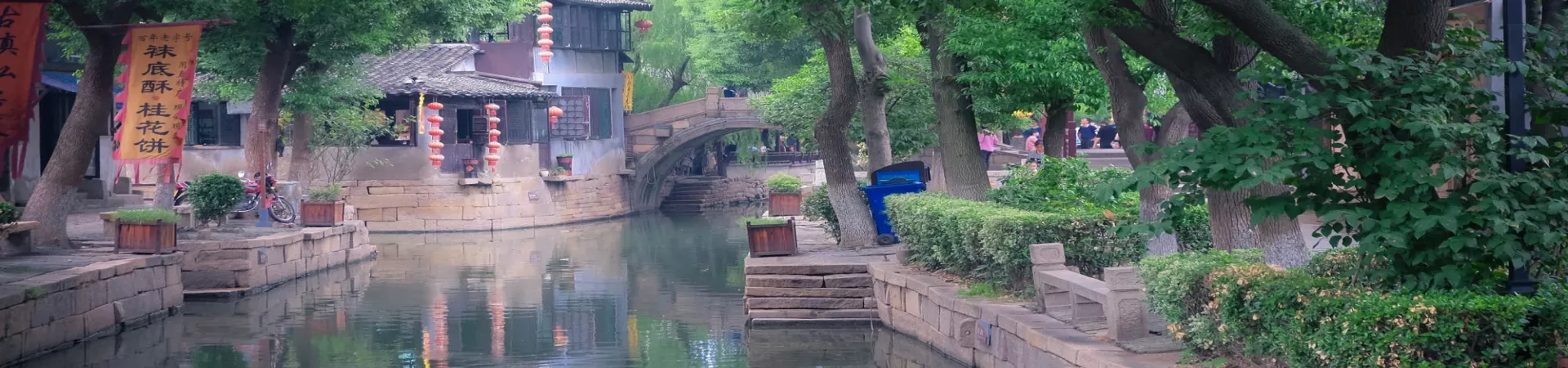
Nestled in the Jiangsu province, approximately 25 kilometers east of downtown Suzhou, lies the ancient water town of Luzhi. With a history stretching back over 2,500 years, Luzhi is not merely a scenic spot but a living museum of traditional Chinese water-town architecture and culture. Its very essence is defined by water. An intricate network of canals, streams, and rivers crisscrosses the town, earning it the evocative historical titles "Hall of Five Lakes" and "Confluence of Six Waterways." This aqueous landscape has shaped every aspect of life here, from its iconic stone bridges to the charming houses built directly along the waterways. Unlike some of its more commercialized counterparts, Luzhi retains a palpable sense of tranquility and authenticity, offering visitors a profound glimpse into the timeless rhythm of life in the Jiangnan region.
2. The Architectural Soul: Bridges and Canals
2.1. A Gallery of Stone Bridges The most defining architectural features of Luzhi are undoubtedly its ancient stone bridges. An astonishing collection of 41 bridges from various dynasties spans the canals, each with its own unique character and design. Ranging from simple, elegant single-arch spans to more elaborate structures, they form a veritable gallery of Chinese bridge-building history. Walking along the cobbled pathways, one encounters bridges adorned with intricate carvings, weathered by centuries of footsteps and weather, standing as silent witnesses to the town's long narrative.
2.2. The Unique Charm of "Double Bridges" Among these, the most fascinating are Luzhi's famous "double bridges" (Shuangqiao). In five separate locations within the town, two bridges are constructed at right angles to each other, connecting three different pathways over intersecting canals. The most renowned set is the Zhengyang Bridge and the Yong'an Bridge. Viewing these elegant pairs, especially from a specific vantage point on the water or the opposite bank, presents a picturesque and geometrically pleasing scene that has captivated artists and photographers for generations. They are a testament to the ingenious urban planning of ancient times and symbolize the interconnectedness of the community.
3. Cultural and Historical Treasures
Beyond its waterways and bridges, Luzhi is rich in cultural heritage sites that tell stories of art, literature, and daily life.
3.1. Baosheng Temple and the Tang Dynasty Buddhist Sculptures The Baosheng Temple is one of Luzhi's crown jewels. Originally built during the Tang Dynasty (c. 503 AD), it is one of the oldest temples in the region. While the temple structures themselves have been rebuilt over centuries, its true treasure lies within: a renowned collection of Nine Tang Dynasty Buddhist Clay Sculptures. These exquisitely preserved statues of arhats (enlightened disciples of Buddha) are celebrated for their vivid expressions, detailed craftsmanship, and profound spiritual aura. They represent a rare and priceless example of early Chinese Buddhist art.
3.2. Former Residences of Notable Figures Luzhi was home to several influential figures. Shen's Residence (Shen Zhai) is a well-preserved example of a wealthy Qing Dynasty merchant's home, offering insight into the domestic architecture and lifestyle of the era. The Wang Tao Memorial Hall commemorates the life and work of Wang Tao, a pioneering journalist, reformist thinker, and publisher of the late Qing Dynasty. His former residence has been converted into a museum detailing his contributions to modern Chinese journalism and his intellectual exchanges with the West.
3.3. The Famous Wansheng Rice Shop No visit is complete without seeing the Wansheng Rice Shop (Wansheng Mihang). This is not just any old shop; it was immortalized in modern Chinese literature through the famous short story "The Wansheng Rice Shop" by Ye Shengtao, a native of Luzhi. The story critically depicted the hardships of farmers in the 1920s. The restored shopfront and interior now serve as a museum, illustrating the central role rice trade played in the local economy and social life.
3.4. Xiao Fangfang Performance Art Hall For a touch of more recent cultural history, the Xiao Fangfang Performance Art Hall is dedicated to the celebrated Hong Kong actress and singer, Xiao Fangfang. The museum showcases her career, costumes, and memorabilia, highlighting her artistic achievements and connection to the region.
4. Practical Visitor Information
4.1. Location and Transportation Luzhi Ancient Town is located in Wuzhong District, Suzhou, Jiangsu Province. * By Public Bus: The most economical way from Suzhou city center is to take bus numbers 521, 523, or 563 and alight at the "Luzhi Ancient Town" (甪直古镇) stop. From there, it is a short walk to the main entrance.
4.2. Ticketing and Fees * Standard Ticket: 55 RMB per adult. * Parent-Child Ticket: 80 RMB for one adult and one child. * Concession Tickets (Half-price): * Children over 1.4 meters tall and under 18 years old (with ID or household register). * Full-time students with a valid student ID. * Seniors aged 60-69 (with valid ID). * Free Admission: * Children 1.4 meters tall and below. * Seniors aged 70 and above (with valid ID). * Active-duty military personnel (with valid ID). * Note: Prices and policies are subject to change; verifying before your visit is advisable.
4.3. Opening Hours The town's ticketed attractions are generally open from 8:30 AM to 5:00 PM, daily throughout the year.
4.4. Suggested Duration To fully appreciate the canals, explore the major historical sites, wander the quieter alleyways, and perhaps enjoy a meal or tea by the water, a visit of at least 3 hours is recommended. A more leisurely pace to soak in the atmosphere could easily fill half a day.
4.5. Contact For general inquiries, you can contact the scenic area at: +86 512 66191668.