Humble Administrator Garden
Subtitle: A Journey Through Time and Tranquility in Suzhou's Masterpiece of Classical Garden Design
I. An Introduction to a World Heritage Treasure
Nestled in the ancient city of Suzhou, the Humble Administrator’s Garden stands as a monumental testament to the refined artistry and philosophical depth of Chinese classical garden design. Recognized as one of China’s Four Great Classical Gardens alongside the Summer Palace in Beijing, the Mountain Resort in Chengde, and the Lingering Garden in Suzhou itself, it represents the pinnacle of the Jiangnan region's landscaping tradition. As the largest classical garden in Suzhou, its significance extends beyond its physical beauty, offering a profound, three-dimensional expression of a harmonious ideal where humanity, architecture, and nature exist in perfect balance. A visit here is not merely a walk through a scenic park but an immersive experience into a living canvas, where every rock, pond, plant, and pavilion is a deliberate brushstroke in a masterpiece of poetic symbolism and serene aesthetics.
II. Exploring the Garden's Artistic Layout and Highlights
The garden’s ingenious layout, evolving through centuries since its initial creation in the early 16th century during the Ming Dynasty, is a study in contrast and composition, masterfully organized around a central aquatic theme.
A. The Central and Western Districts: The Essence of the Garden
The heart and soul of the Humble Administrator’s Garden is its expansive central district. True to the garden’s aquatic focus, a vast, serene pool forms the nucleus, around which the entire scene gracefully unfolds. The artistry is most evident in the treatment of this water body: islands have been meticulously constructed within the pool using carefully selected Taihu rocks, famous for their porous, sculptural forms. These man-made hills, adorned with lush trees and fragrant plants, create a miniature landscape of lakes and mountains, embodying the traditional Chinese love for condensing the grandeur of nature into contemplative microcosms. Elegant pavilions, terraces, halls, and towers, with names like the "Hall of Drifting Fragrance" and the "Pavilion of the Lotus Breeze from All Sides," are strategically positioned along the water’s edge or connected by zigzagging bridges. These structures offer ever-changing, framed perspectives of the scenery, ensuring that each step reveals a new, picture-perfect view, much like unrolling a landscape scroll.
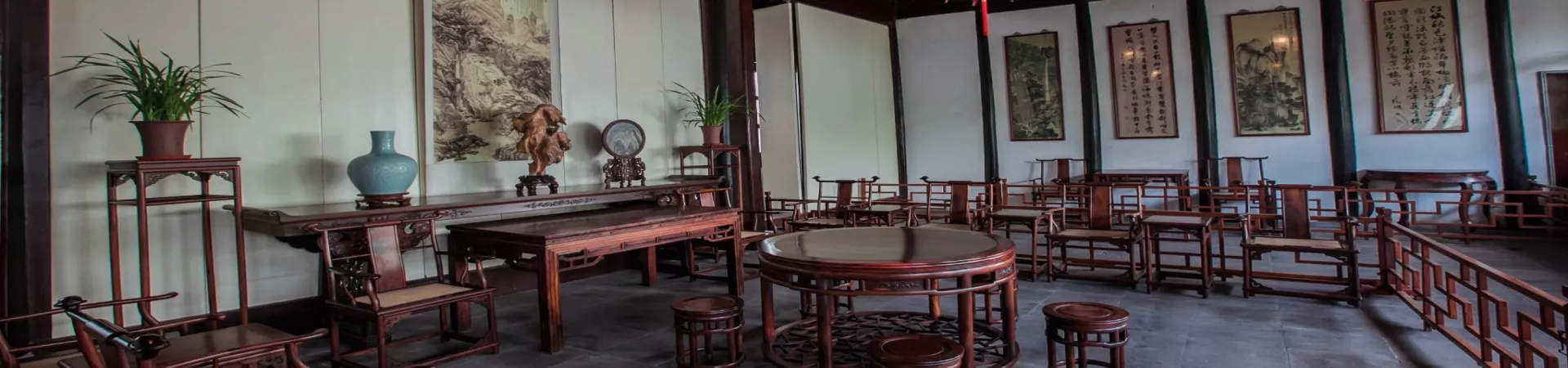
Adjacent to this, the western district presents a more intimate and architecturally dense character. Winding streams replace the open lake, and the buildings appear more closely nestled together, creating a sense of secluded, labyrinthine charm. The architecture here is notably ornate, featuring intricate latticework, elegantly furnished interiors, and cleverly designed windows that serve as living paintings, framing specific garden elements.
B. The Eastern District and the Garden Museum
In stark contrast, the eastern section of the garden feels open, sparse, and pastoral. Lawns, bamboo groves, rolling mounds, and simple thatched pavilions dominate this area, evoking a rustic, woodland atmosphere. This deliberate simplicity provides a visual and experiential counterpoint to the richness of the central and western parts, completing the garden’s narrative of dynamic balance.
At the southern part of the garden complex, within a traditional Jiangnan-style architectural compound, visitors will find the Suzhou Garden Museum. As China’s only museum dedicated specifically to the art of classical garden design, it offers invaluable context. Through models, historical artifacts, diagrams, and explanations, the museum elucidates the design principles, philosophical underpinnings, and historical evolution that make gardens like the Humble Administrator’s Garden so exceptional. A visit here deepens one’s appreciation, transforming a beautiful stroll into an educated understanding of a UNESCO World Heritage cultural practice.
III. Seasonal Splendor and Cultural Events
The garden’s beauty is dynamic, changing its character and highlights with the seasons, celebrated through annual floral festivals. In spring, the Azalea Festival blankets sections of the garden in a vibrant carpet of color. Summer brings the Lotus Festival, where the central ponds become a stage for the majestic bloom of lotuses, a symbol of purity in Chinese culture. In autumn, the Chrysanthemum Exhibition showcases the beauty of this beloved flower, often featuring artistic displays and rare varieties. These events are not just floral displays but cultural traditions that connect the garden’s aesthetic to the cyclical rhythm of nature.
IV. Essential Visitor Information
A. Transportation The garden is conveniently accessible via public transport. Visitors can take Suzhou bus routes 40 or 313 and alight at Beiyuan Lu Station. Alternatively, community bus lines 9016 or 9025 stop at the Suzhou Museum Station, from which the garden is a short and pleasant walk away. Its location in the historic center makes it easily combinable with visits to the nearby Suzhou Museum and other historic sites.
B. Ticketing The garden operates a tiered ticketing system: * Peak Season Ticket (Year-round): 80 RMB for adults. * Concession Tickets (Half-price): Available for minors aged 6 to 18 (inclusive); full-time undergraduate students and below with valid ID; seniors aged 60 to 69 (inclusive) with valid ID. * Free Admission: Granted to active-duty Chinese military personnel; retired military cadres; visitors with disabilities (with one free companion for those requiring severe disability assistance); seniors aged 70 and above; and children under 1.4 meters in height or under 6 years old (with valid document).
C. Opening Hours Operating hours vary slightly by season: * March 1 to November 15: 7:30 AM – 5:30 PM (last entry at 5:30 PM). * November 16 to February 28/29 of the following year: 7:30 AM – 5:00 PM (last entry at 4:30 PM). It is advisable to allocate at least 2 to 3 hours for a thorough exploration to fully absorb the details and atmosphere of the different garden sections.