Danjiangkou Dam
Subtitle: A Monument to Modern Engineering and Water Management
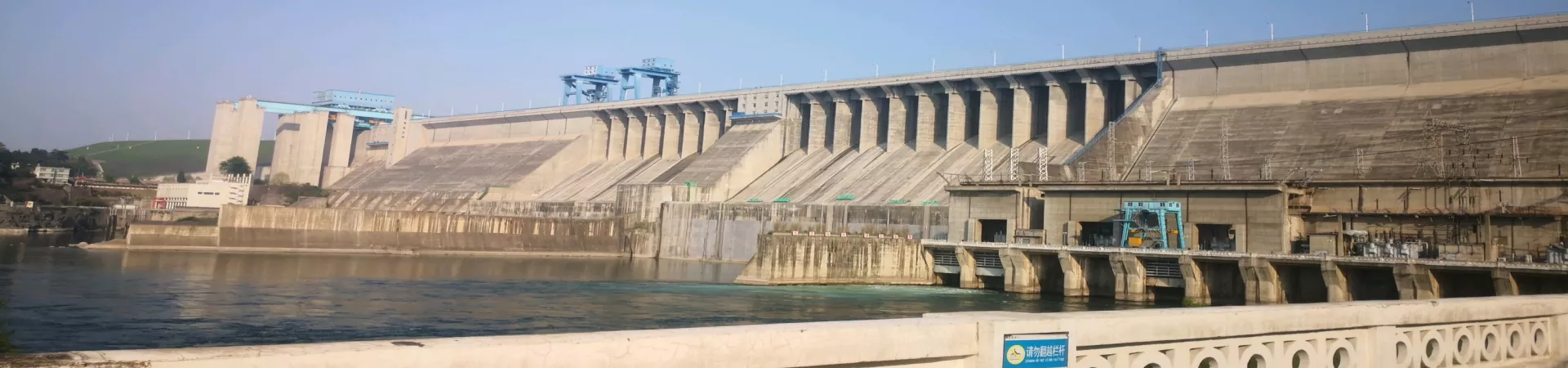
1. Introduction and Historical Significance The Danjiangkou Dam, a colossal hydrocomplex situated approximately 800 meters downstream from the confluence of the Han River and its tributary, the Dan River, stands as a defining landmark of Danjiangkou City. More than just a local attraction, it represents a pivotal chapter in China's modern industrial and hydrological history. Its primary significance lies in being one of the first major water conservancy projects designed and constructed entirely through domestic expertise following the founding of the People's Republic of China. This undertaking was a monumental testament to the nation's growing engineering capabilities in the mid-20th century. Originally completed in the early 1970s and subsequently heightened in the 21st century for the ambitious South-North Water Transfer Project, the dam's purpose has always been multifaceted. It was conceived not for a single function but as a comprehensive hub integrating power generation, agricultural irrigation, river navigation, and aquaculture, showcasing a holistic approach to harnessing and managing vital water resources for regional development.
2. Architectural and Engineering Composition The dam's imposing structure is a complex assembly of several key components, each serving a critical role in its overall operation.
2.1. The Main Dam and Reservoir At its heart is a massive concrete gravity dam, which creates the vast Danjiangkou Reservoir. This reservoir is among the largest artificial freshwater bodies in Asia and serves as the critical source for the central route of the South-North Water Transfer Project. The sheer scale of the dam wall, holding back this immense volume of water, is the first and most awe-inspiring sight for visitors, offering a tangible sense of human ingenuity applied on a grand scale.
2.2. Power Generation Facilities Integrated into the dam structure is the hydroelectric power station. Utilizing the substantial hydraulic head created by the reservoir, the station converts the potential energy of the stored water into clean electricity. This generated power feeds into the regional grid, contributing significantly to the energy supply of Hubei province and surrounding areas, fulfilling one of the dam's core utilitarian roles.
2.3. Navigation Systems: The Ship Lift To mitigate the dam's interruption of the Han River's natural course for shipping, a sophisticated ship lift was constructed. This engineering marvel functions as a "water elevator" for vessels, lifting or lowering them between the reservoir level and the river downstream. Observing this system in operation provides a fascinating glimpse into the solutions engineered to balance development with existing commercial and transport needs.
2.4. Water Diversion Infrastructure Extending the dam's reach are two major diversion channels located approximately 30 kilometers upstream. These channels are integral to the dam's irrigation and water transfer functions, systematically directing water to vast agricultural areas and, crucially, into the main canal of the South-North Water Transfer Project, which carries water northward to arid regions.
3. Practical Visitor Information For those planning a visit to this significant site, the following practical details are essential.
3.1. Admission and Operating Hours A standard admission ticket is priced at 65 RMB. It is important to note that operating hours vary seasonally. During the peak summer period (June 1st to August 31st), the site is open from 08:00 to 18:00, with last entry at 18:00. In the winter months (December 1st to February 28th of the following year), hours are shorter, from 08:30 to 17:30, with last entry at 17:00. Visitors are advised to plan their arrival accordingly to ensure sufficient time for exploration.
3.2. Contact Information For inquiries regarding tours, accessibility, or other specific questions, the dam's administrative office can be reached via telephone at 0719-5372391.
4. The Visitor Experience and Broader Context A visit to the Danjiangkou Dam is an immersive experience in scale and purpose. The panoramic view from the top of the dam is staggering, revealing the vast expanse of the reservoir on one side, often dotted with green islands, and the controlled flow of the Han River on the other. Informative plaques and potential guided tours detail the project's history, technical specifications, and its indispensable role in the world's largest water transfer endeavor. The site transcends its physical form; it is a powerful symbol of water resource management, regional economic transformation, and a key node in a project of national strategic importance. It invites reflection on the interplay between human ambition, technological achievement, and the stewardship of natural resources. The surrounding area, including the reservoir's shores, has also developed into a scenic zone, offering boat tours and viewpoints that allow appreciation of the project's integration with, and impact upon, the landscape.