Shipaotai Park (Park of Stone Barbette)
Subtitle: A Journey Through Time: Exploring Shantou's Coastal Fortress, the Shipaotai Park
I. Introduction: A Sentinel Overlooking the Sea Nestled on the southeastern fringe of old Shantou, Shantou Shipaotai Park is a unique historical and commemorative park centered around its magnificent core: the Qilu Fortress. This grand coastal defense structure, colloquially known as "Shi Pao Tai" or the "Stone Fort," stands as a silent, stoic witness to over a century of Chinese history, from the twilight of the Qing Dynasty to the modern vibrancy of today's Shantou. More than just a green space, the park offers visitors a profound opportunity to walk through the annals of time, exploring the formidable architecture of a bygone military era while reflecting on the pivotal historical currents that led to its construction. It is a place where the whispers of the past meet the tranquility of the present, inviting exploration and contemplation.
II. Historical Context: The Birth of a Fortress in an Era of Change A. The Imperative for Defense The genesis of the Qilu Fortress is inextricably linked to a period of national crisis and transformation in 19th-century China. Following the First and Second Opium Wars, the weakened Qing government was forced to sign a series of unequal treaties, including the Treaty of Tianjin, which opened several ports, including Shantou (then Swatow), to foreign trade. The subsequent influx of foreign merchant ships, coupled with perceived vulnerabilities in coastal defense, created significant local anxiety. In response to these concerns and popular sentiment, Fang Yao, the Regional Commander of the Chaozhou region, petitioned the imperial court for the construction of a new fortification. His rationale, "to ensure clear borders and stringent coastal defense for the Chaozhou sea," was approved, leading to the ambitious project.
B. A Monumental Undertaking Construction began in the 13th year of the Tongzhi Emperor's reign (1874) and was completed five years later in the 5th year of the Guangxu Emperor's reign (1879). The project represented a significant investment of resources and labor, costing 80,000 silver dollars. Its strategic location was meticulously chosen: positioned at a critical point to control the entrance and exit of Shantou Bay, it formed a defensive crossfire with another fort on the Su'an Hill across the water. This placement underscored its vital role as a key coastal defense installation for eastern Guangdong during the late Qing period.
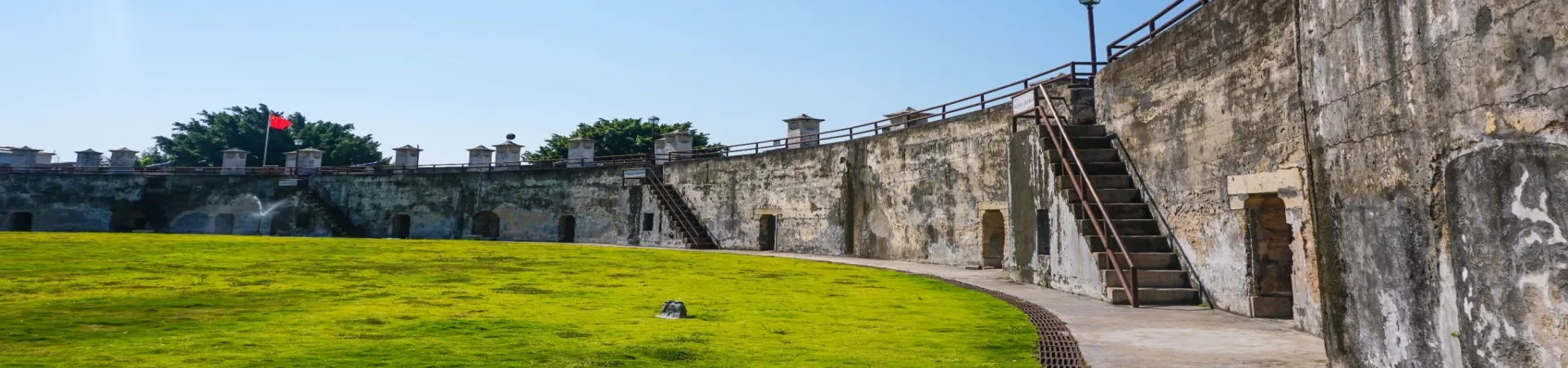
III. Architectural Marvel: Exploring the Structure of Qilu Fortress A. Layout and Scale The Qilu Fortress is an impressive example of military architecture, characterized by its unique circular castle design. Encompassing a total area of 19,607 square meters, the fortress itself covers 10,568 square meters. It is surrounded by a protective moat, 23 meters wide and 3 meters deep, which originally isolated it from land access. The structure's dimensions are imposing: the outer wall stands 6 meters high, while the inner wall is 5.15 meters high. The internal parade ground has a diameter of 85 meters, and the entire fort measures 116 meters in diameter.
B. Construction and Design Ingenuity The fortress's construction materials and methods are a testament to traditional engineering. The main walls were built using a resilient mixture of shell-lime mortar, glutinous rice paste, and brown sugar syrup, tamped layer by layer. This composition provided remarkable durability. In contrast, the main gate and the extensive cannon corridors were constructed from precisely cut granite blocks, giving rise to its enduring nickname, the "Stone Fort."
The interior is a labyrinthine network spread across two levels, each featuring 18 artillery emplacements and numerous rifle ports. The lower level contains the remarkable cannon corridors, which are 4.1 meters wide and stretch approximately 300 meters in a deep,迂回 (winding and intricate) path designed for protected movement and storage.
C. Functional Features Several ingenious design elements highlight the fortress's practicality: 1. The Corrugated Ramp: A 27-step, wave-patterned stone ramp allowed for the heavy artillery pieces to be hauled up to the top platform with relative ease. 2. Ventilation and Communication Towers: The upper platform features 72 ventilation towers, arranged in groups of three forming a triangular pattern. These served the dual purpose of providing light and air to the lower levels and acting as conduits for communication between the floors. 3. The Command Platform and Spiral Staircase: On the northeast side, a crescent-shaped command platform was used for directing troops and observing drills. A concealed spiral stone staircase in its northwest corner provided a discreet route for troop movement and ammunition supply during combat. 4. The Freshwater Well: A particularly fascinating feature is the freshwater well located in the northeast corner of the parade ground. Despite being merely tens of meters from the sea, it provided sweet, pure drinking water for the garrison—a crucial logistical asset.
IV. Armament and Strategic Role The fortress was designed to be a formidable deterrent. Its armament included several cannons, the largest of which was reported to be a 5,000-hu (a historical unit of capacity) muzzle-loading cannon of Western design, with an effective range of 15-16 Chinese miles (approximately 8-8.5 kilometers). This firepower, commanding the approaches to the harbor, was intended to pose a serious threat to any potential invader, solidifying Shantou's maritime defense.
V. Transformation into a Public Park and National Heritage For decades after its military service ended, the fortress stood as a historic relic. In 1983, it was incorporated into Shantou's urban development master plan, which proposed expanding the site by 58 acres to create the present-day Shipaotai Park. This transformation made the historical site accessible to the public. Its cultural significance has been formally recognized through several designations: it was listed as a Municipal Key Cultural Relic Protection Unit in 1988, elevated to a Provincial Key Cultural Relic Protection Unit by the Guangdong Provincial Government in 1989, and further designated as a Patriotic Education Base by the Shantou Municipal Committee and Government in 1995.
VI. Visitor Information * Location: Southeastern area of old Shantou, Shantou City, Guangdong Province. * Transportation: The park is accessible via several public bus routes, including numbers 19, 103, and 105, which have stops directly serving the park. * Admission: Entrance to the park is free of charge. * Opening Hours: The park is open daily from 7:30 AM to 11:00 PM, with last entry at 11:00 PM. * Contact: For inquiries, visitors can call 0754-88543120.
(Information last updated: January 10, 2023)