Wang Kou
Subtitle: A Journey Through Time in an Ancient Huizhou Village
1. Introduction: The Legacy of a Millennia-Old "Book Village"
Nestled in the picturesque landscape of Wuyuan County, Jiangxi Province, lies Wangkou, an ancient village that is far more than a mere tourist destination. It is a living museum, a serene testament to a thousand years of Chinese history, culture, and architectural philosophy. Founded during the Da Guan period of the Northern Song Dynasty (circa 1107-1110 AD) by Yu Gao, a high-ranking official of the court, Wangkou boasts an uninterrupted history spanning over eleven centuries. Its name, meaning "Mouth of Vast Water," poetically derives from its geographical setting at the confluence of two rivers. Reflecting the founder's hope for his descendants to flourish as endlessly as flowing water, an alternative name, "Yongchuan" or "Perpetual River," was also adopted from a classical poem. This deep connection to scholarly ideals set the tone for the village's future, earning it the illustrious nickname "The Land of Books." Recognized for its profound cultural heritage, Wangkou is officially listed among the third batch of China's Famous Historical and Cultural Towns and Villages by the State Council.
2. A Landscape of Poetry: The Natural Setting
The village is cradled in a gentle basin of rolling hills, presenting a landscape that has inspired poets for generations. Lush, green mountains embrace the settlement, while the clear, emerald waters of the rivers flow peacefully alongside. The idyllic scenery is perfectly captured in an ancient couplet: "The songs of birds and crows of roosters are heard beyond the borders; the shimmer of water and hues of mountains enter into the pavilion." This harmonious integration with nature is a hallmark of Huizhou village planning, creating an environment of tranquility and timeless beauty that immediately transports visitors away from the modern world.
3. Historical Significance: From Scholarly Excellence to Commercial Hub
3.1. A Tradition of Scholarship and Refinement From the Song Dynasty onward, Wangkou cultivated an exceptional scholarly atmosphere. This commitment to education and civil service produced an extraordinary number of accomplished individuals. Historical records note the village produced 5 Jinshi (the highest-level scholars who passed the imperial examination), 2 Juren (provincial-level scholars), 7 high-ranking officials, 36 military and civil officers above the seventh rank, 10 esteemed scholars, and 33 volumes of published literary works. This remarkable intellectual output solidified its reputation as a center of Confucian learning and bureaucratic excellence, leaving a legacy of refinement that permeates the village's aura.
3.2. A Strategic Crossroads of Trade Beyond its scholarly achievements, Wangkou held significant economic importance due to its strategic location. It served as a vital land passage on the old route from Huizhou Prefecture to Raozhou in Jiangxi via Wuyuan. Simultaneously, it functioned as a key river port, connecting Wuyuan County to its northeastern towns and facilitating waterborne cargo transport to major commercial centers like Leping, Poyang, and Jiujiang. During the Ming and Qing dynasties, this advantageous position transformed Wangkou into a bustling commercial center. Its streets were lined with shops and teeming with merchants, creating a vibrant and prosperous scene. Though the bustle of its trading heyday has faded, the structural and spiritual remnants of this prosperous era are integral to its character.
4. Architectural Crown Jewel: The Yu Family Ancestral Hall
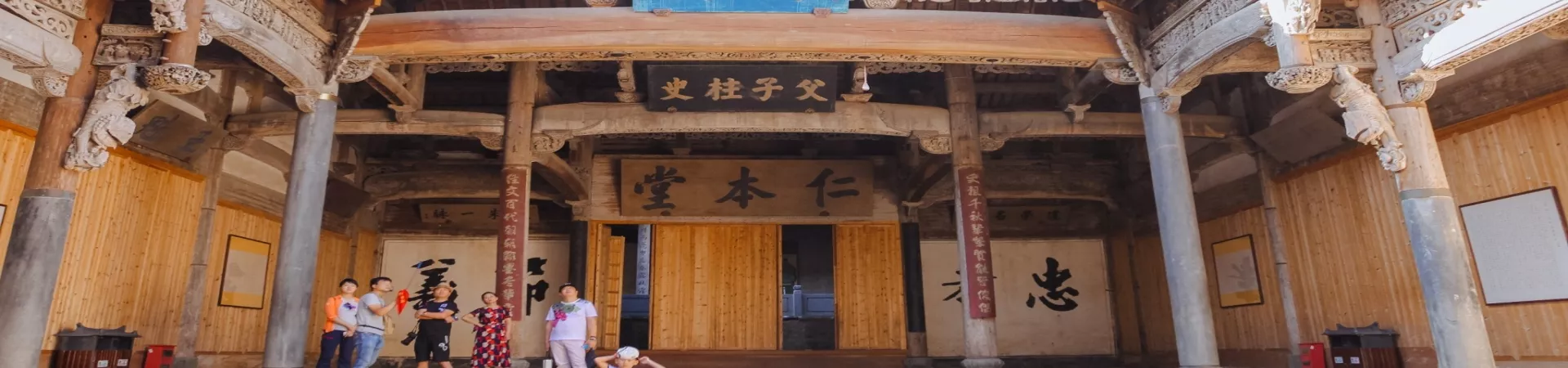
4.1. Overview and Structure The undisputed architectural masterpiece of Wangkou is the Yu Family Ancestral Hall (Yu Shi Zong Ci). Located within the village, approximately 30 kilometers northeast of Wuyuan county town, this imposing structure covers an area of over 1,000 square meters. Built during the Qing Dynasty, it exemplifies the pinnacle of Huizhou ancestral architecture. The hall follows a strict axial layout and is crowned with a Xieshan-style (hip and gable) roof, contributing to its majestic and dignified presence.
4.2. An "Art Treasure House" of Craftsmanship What truly sets the Yu Family Ancestral Hall apart is its breathtaking and meticulous craftsmanship. It is renowned for the "Three Carvings" of Huizhou style: exquisite wood carvings, intricate brick carvings, and elegant stone carvings. Every beam, bracket, door frame, and column is adorned with detailed motifs depicting mythological scenes, symbolic flora and fauna, and patterns representing blessings, longevity, and prosperity. The precision, artistry, and symbolic depth of these carvings are so exceptional that architectural historians have hailed the hall as an "art treasure house." It stands not merely as a place of ancestor worship but as a comprehensive canvas showcasing the artistic soul and technical prowess of Huizhou artisans.
5. Practical Information for Visitors
5.1. Location and Access Wangkou Ancient Village is situated in Wangkou Village, Jiangwan Town, Wuyuan County, Shangrao City, Jiangxi Province. It is a central component of the Wuyuan "East Line" cultural tour, easily accessible by car or local tourist transportation from Wuyuan's main tourist centers.
5.2. Admission and Hours The village charges an admission fee. As of recent information, the standard adult ticket is priced at 55 RMB. The site is generally open daily from 7:30 AM to 5:00 PM, with last admission typically at 4:30 PM. It is advisable to verify the current ticket prices and opening hours before your visit, as these details are subject to change.
5.3. Suggested Duration To fully appreciate the village's ambiance, explore its ancient lanes, and spend adequate time marveling at the details of the Yu Family Ancestral Hall, a visit of approximately 1 to 3 hours is recommended. This allows for a leisurely pace to absorb the historical atmosphere and capture the beauty of its natural and architectural scenery.
5.4. Experience A visit to Wangkou is a step into a slower, more contemplative world. Wandering its quiet, cobbled streets, visitors encounter well-preserved residences, ancient alleyways, and the ever-present murmur of the flowing rivers. The experience is one of immersion in a historical landscape where the values of scholarship, family, commerce, and artistic beauty are etched into the very fabric of the village. It offers a profound and authentic glimpse into the enduring legacy of Huizhou culture.