The Taining Shangshu Building Complex
Subtitle: A Journey Through Ming Dynasty Grandeur in Fujian's Mountainous Heart
Introduction: A Portal to Imperial China
Nestled within the ancient lanes of Taining County, Sanming City, in Fujian Province, lies a remarkable portal to the late Ming Dynasty. The Taining Shangshu Di Architectural Complex, commonly and auspiciously known as "Wu Fu Tang" (Hall of Five Blessings), stands as one of the most well-preserved and grandiose official residential complexes from the Ming era in southern China. More than just a collection of old buildings, it is a stone-and-wood chronicle of power, architectural artistry, and the sophisticated social hierarchy of imperial China, offering visitors an immersive step back into the early 17th century.
1. Historical Significance and Its Builder
The genesis of this magnificent complex is inextricably linked to a powerful figure: Li Chunye. Rising to prominence during the Tianqi reign (1621-1627) of the Ming Dynasty, Li Chunye achieved the highest military and civil honors. His titles—Assistant Administrator of the Capital Garrisons, Minister of War, Junior Guardian, and Tutor to the Crown Prince—reflect a career at the very apex of Ming power. To match his status, he commissioned the construction of his official residence, Shangshu Di (The Minister's Mansion), between 1623 and 1627. The complex served not only as a family dwelling but as a physical manifestation of his authority and scholarly achievement, a testament to the Confucian ideal of a refined literati-official.
2. Architectural Layout and Spatial Philosophy
The complex is a masterpiece of traditional Chinese planning and geomantic principles. Occupying a vast area of over 5,220 square meters, its layout is both imposing and meticulously ordered.
2.1 Orientation and Overall Structure The entire mansion is oriented east-west, sitting facing west—a configuration often associated with auspiciousness and respect. It stretches 87 meters from north to south and 60 meters from east to west, presenting a formidable, fortress-like facade to the outside world. This inward-facing design emphasizes privacy, security, and the internal world of the family.
2.2 The Central Axis and Courtyard System Following classic Siheyuan (courtyard) principles, the buildings are arranged along a strict central axis. A distinctive paved pathway, accessible through two gates at the north and south ends, runs along the front of the complex. The northern entrance leads into ceremonial spaces like the 仪仗厅 (Yizhang Ting), or Guards' Hall, and the 接客厅 (Jieketing), or Reception Hall, where official business and visits were conducted. This separation of ceremonial and purely private family spaces is a key feature of high-status architecture.
3. Artistic Details and Symbolic Motifs
The true splendor of Shangshu Di reveals itself in the exquisite details of its stone and wood craftsmanship, where every element carries symbolic meaning.
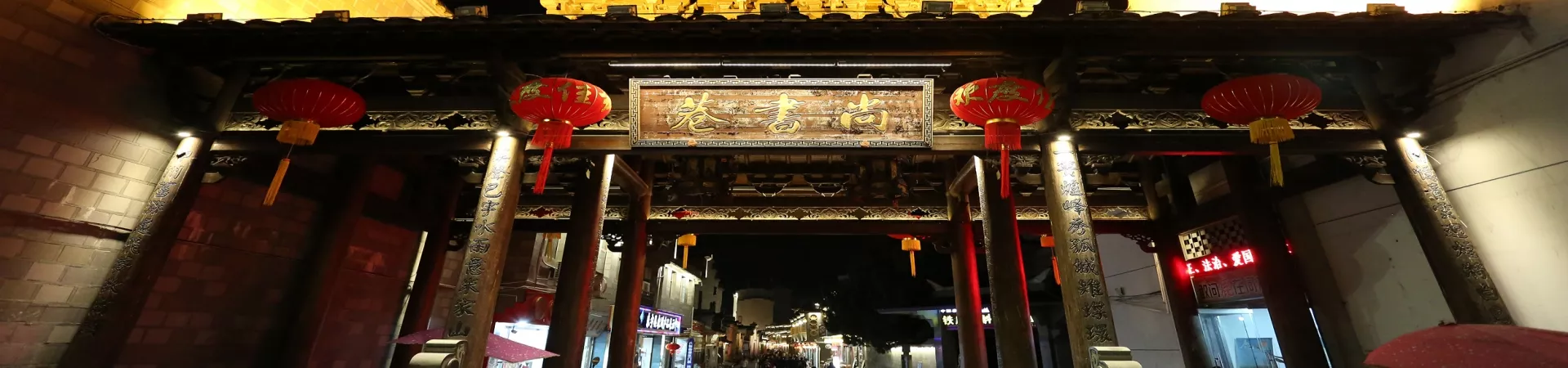
3.1 The Gateways and Stone Inscriptions The approach is marked by a series of five monumental gateways, each crowned with inscribed stone plaques. These plaques, read sequentially, narrate the glory of the Li family: starting with "尚书第" (Minister's Mansion), "柱国少保" (Pillar of the State and Junior Guardian), "四世一品" (Four Generations of First Rank Officials), to virtues like "礼门" (Gate of Propriety) and "义路" (Path of Righteousness). Phrases like "曳履星辰" (Treading the Stars) and "依光日月" (Basking in the Sun and Moon) poetically allude to serving closely under the emperor. The lintels, beams, and column heads framing these plaques are adorned with intricate carvings of flora, fauna, and geometric patterns.
3.2 Guardian Stones and Bas-Reliefs Flanking the main entrance are a pair of towering 抱鼓石 (Baogu Shi), or drum-bearing stones, each standing 2 meters high. These are more than decoration; they are symbols of the family's official rank and guardians of the threshold. Their drum bases are masterfully carved with scenes of 双狮戏球 (Twin Lions Playing with a Brocade Ball), symbolizing power and auspicious joy, alongside 云龙 (Clouds and Dragons), representing imperial authority. The door pier foundations and walls are further embellished with elegant bas-reliefs of 荷墀托 (Lotus Pedestals), 莲裙座 (Lotus-Skirt Bases), and 竹节衬柱 (Bamboo-Joint Pillars), motifs representing purity, integrity, and resilience.
4. Practical Visitor Information
To plan your visit to this historical treasure, here is the essential practical information:
4.1 Location and Access The Shangshu Di complex is located at Fu Tang Lane, Shengli Second Street, in the urban area of Taining County. The most common route is to first take a long-distance bus from Sanming Bus Station to Taining County. From Taining's local bus station or town center, visitors can then hire a taxi or a local motorcycle taxi ("摩的") for the short ride to the scenic area.
4.2 Opening Hours and Admission The site is open to the public daily from 8:30 AM to 4:30 PM, throughout the year. The standard admission fee is 29 RMB per person. It is advisable to allocate approximately 1 to 3 hours for a thorough exploration, allowing time to appreciate both the grand scale of the courtyards and the fine details of the carvings.
4.3 Further Engagement For inquiries, visitors can contact the management at 0598-8266416 or 0598-7863013. While the complex itself is the centerpiece, the surrounding ancient streets of Taining offer a complementary atmosphere, with the county itself being a UNESCO Global Geopark, known for its dramatic Danxia landforms, which can be combined for a fuller day's itinerary blending cultural and natural history.