Anzhen Fort
Subtitle: A Journey Through Time: Exploring the Architectural Marvel and Historical Legacy of Anzhen Fortress
1. Introduction: A Fortified Masterpiece in the Fujian Countryside
Nestled within the Huainan Township of Yong'an City, approximately 110 kilometers from the urban center, stands Anzhen Fortress, a monumental testament to late Qing Dynasty architecture, community planning, and defensive ingenuity. Commonly known locally as "Chiguan City," this vast fortified residence transcends its role as a mere dwelling; it is a self-contained world, a physical narrative of a turbulent era, and one of the most exceptionally preserved ancient rammed-earth structures in Fujian Province. Its significance was nationally recognized in May 2001 when it was designated a Major Historical and Cultural Site Protected at the National Level. For the modern visitor, a trip to Anzhen Fortress is not simply a tour of an old house but an immersive step into a bygone era of scholar-gentry, regional unrest, and profound architectural ambition.
2. Historical Context and Construction: A Legacy Cast in Stone and Earth
The story of Anzhen Fortress is inextricably linked to its founder, Chi Zhanrui, a wealthy local landowner and Gongsheng (a senior licentiate) in the imperial examination system during the waning years of the Qing Dynasty. The period was marked by widespread social instability and rampant banditry. In response to this pervasive threat, Chi Zhanrui made a monumental decision: to invest his substantial fortune, said to be over ten thousand silver dollars, into constructing a secure haven for his extended family and community.
Construction began in the 11th year of the Guangxu Emperor's reign (1885 AD) and was a colossal undertaking that spanned fourteen years before its completion. The scale of the project reflects both the urgency of the need for protection and the vast resources at Chi's disposal. The fortress was designed to be entirely self-sufficient, capable of withstanding prolonged sieges, thereby ensuring the safety and continuity of life for its inhabitants amidst external chaos.
3. Architectural Layout and Defensive Genius
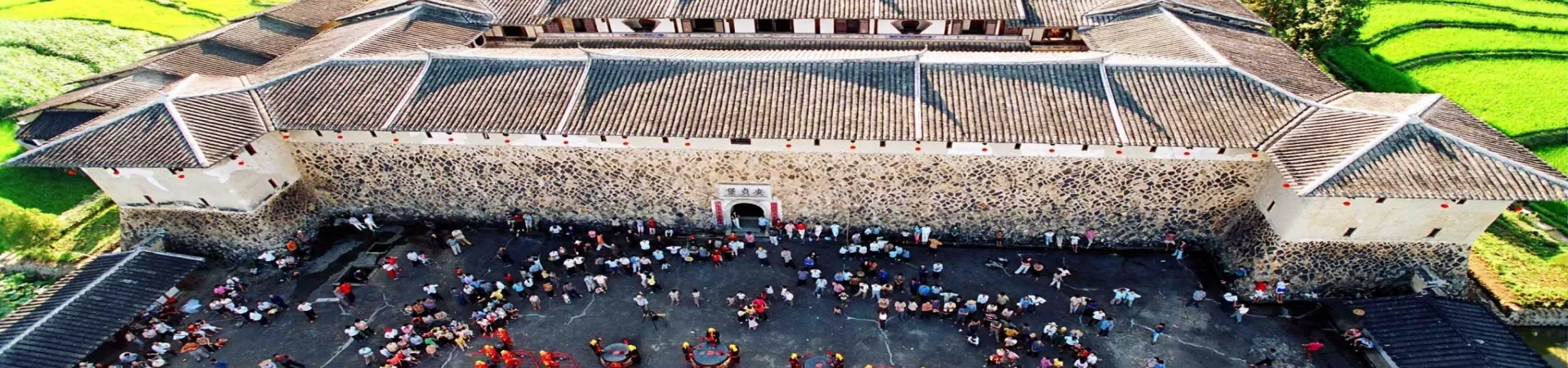
3.1 Overall Structure and Design Philosophy Anzhen Fortress is a magnificent example of a Weilongwu (enclosed dragon house) style building, masterfully integrating the form of a circular Tulou (rammed earth building) with the traditional Han Chinese courtyard layout. The complex covers a total area of approximately 10,000 square meters, with a built-up area of 6,000 square meters. It is oriented west-to-east, strategically built against a mountainside, with its structures rising progressively higher, creating a striking, layered silhouette that commands the landscape.
The layout is ingeniously conceived: the front section is rectangular and formidable, while the rear section gracefully curves into a semi-circle, harmonizing with the topography. This design not only provided structural stability but also offered a symbolic embrace, sheltering those within.
3.2 The Grand Entrance and Primary Defenses The visitor's first encounter with the fortress's defensive might is its imposing main gate. Passing through a vast, open drill ground capable of mustering thousands, one faces a towering arched gateway constructed from massive stone blocks. Above the gate, the name "安贞堡" (An Zhen Bao) is inscribed prominently, flanked by a couplet that encapsulates the fortress's purpose: "安于未雨绸缪固,贞观沐风谧静多," which can be interpreted as "Tranquility lies in preparing for rainstorms; Fortitude is witnessed in enjoying the peaceful breeze."
The gate itself is a masterpiece of defensive engineering. It consists of two heavy layers: an outer set of wooden doors nearly seven inches thick, followed by an inner iron gate. The most ingenious feature, however, is located directly above the gateway: two concealed water channels. In the event of attackers attempting to set fire to the main doors, defenders inside the upper levels could pour water directly down through these channels, dousing the flames instantly. This simple yet highly effective mechanism would have given the inhabitants immense confidence, truly creating a "solid as Mount Tai" feeling.
4. Interior Life: A Self-Sustaining Community
Within the massive fortified walls, Anzhen Fortress was designed as a fully functioning micro-society. It contains over 320 rooms of various sizes, distributed across 18 main halls and subsidiary halls. The scale of its provisions reveals its capacity to support a large population for extended periods. It was equipped with 12 separate kitchens and 5 internal wells, ensuring an independent supply of food and water. Historical estimates suggest the fortress could accommodate and sustain well over a thousand people—the extended Chi family, their retainers, and possibly neighboring villagers seeking refuge.
The interior spaces, from ancestral worship halls to living quarters, storage rooms, and livestock areas, are arranged around a series of courtyards and covered corridors. This layout facilitated daily life, social organization, and internal management, while the towering outer walls and watchtowers provided constant security. The architecture thus represents a perfect balance between the need for communal defense and the requirements of sophisticated, comfortable domestic life for a prominent lineage.
5. Practical Visitor Information
For those planning to explore this historical treasure, the following details are essential: * Location: Huainan Township, Yong'an City, Sanming Prefecture, Fujian Province. * Contact: For inquiries, you may call 0598-3539042 or 15959789522. * Admission Fee: The entrance ticket is priced at 30 RMB. * Opening Hours: The fortress is open daily from 8:30 AM to 5:00 PM. Last admission is at 5:00 PM. These hours are consistent throughout the year (January 1st to December 31st, Monday through Sunday).
Walking through the silent courtyards and along the robust walls of Anzhen Fortress today, one can vividly imagine the bustling life, the sounds of daily activity, and the ever-present vigilance that once filled this space. It stands not as a ruin, but as a remarkably complete portrait of a community's resilience, offering an unparalleled window into the architectural prowess and social history of late imperial rural China.