Screw Field
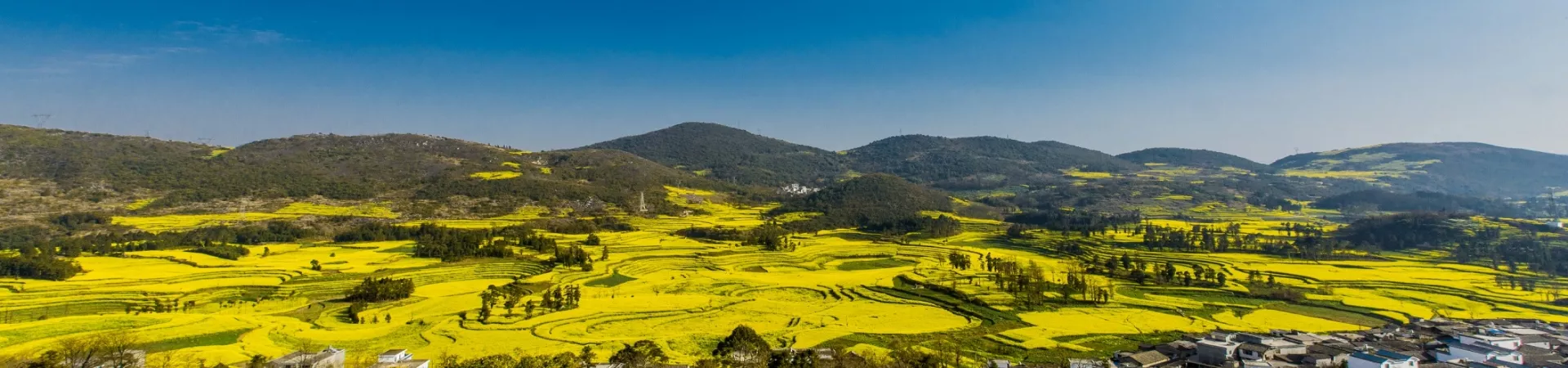
Subtitle: A Captivating Landscape of Concentric Terraces and Seasonal Hues
Introduction Nestled within the stunning region of Luoping, Qujing, in China's Yunnan Province, lies a unique and photogenic agricultural marvel known as Luosi Tian, or "Screw Terraces." This site stands as one of the most iconic and celebrated locations for capturing the beauty of rapeseed flowers (canola flowers) in China, offering a distinct visual experience that contrasts sharply with other famous bloom-viewing spots. Unlike vast, sweeping fields, Luosi Tian presents a meticulously patterned, intricate landscape that resembles a giant natural fingerprint or the intricate spirals on a screw, hence its evocative name. The terraces are a breathtaking testament to human ingenuity harmonizing with natural topography, creating ever-changing artistic canvases throughout the year that attract photographers, nature lovers, and cultural sightseers from across the globe.
The Unique Topography and Design 2.1. Concentric Circle Formation The defining characteristic of the Luosi Tian landscape is its remarkable concentric, circular terraces. Carved into the hillsides surrounding a central, small round basin, these terraces spiral outwards in a series of elegant, diminishing rings. When viewed from a higher vantage point, the pattern is strikingly clear: a series of perfect, coiled lines that seamlessly integrate with the contours of the land. This geometric precision is not accidental but the result of generations of local farmers adapting their cultivation to the specific karst landform of the area, maximizing arable land and irrigation efficiency in a challenging environment.
2.2. A Seasonal Kaleidoscope of Color While renowned for the vibrant yellow sea of rapeseed flowers that blankets the terraces typically from February to March, Luosi Tian's beauty is profoundly dynamic. Across different seasons, farmers plant various crops, which transform the concentric patterns into a living mosaic of shifting colors and textures. One season might see emerald green rice shoots tracing the spirals, another could showcase rich brown earth or golden wheat, and yet another might present a patchwork of different vegetables. This rotational cultivation means that every visit, depending on the time of year, offers a completely unique visual spectacle, making Luosi Tian a destination worthy of multiple returns.
Photographic Appeal and Experience 3.1. Intimate and Artistic Vistas In contrast to the grand, overwhelming expanses of rapeseed fields found at nearby locations like Jinji Peak (Golden Rooster Peak), Luosi Tian provides a more intimate, delicate, and artistically composed scene. The structured spirals create natural leading lines for photography, drawing the viewer's eye into the heart of the landscape. The play of light and shadow across the raised edges of the terraces, especially during sunrise and sunset, adds depth and drama, allowing for stunning photographic compositions that emphasize pattern, form, and color in a way that feels both natural and meticulously designed.
3.2. Accessibility and Viewing Points The terraces are freely accessible for viewing and photography, as they are functioning agricultural lands interwoven with rural villages. Visitors can explore the periphery and find numerous spots along the roads winding through the hills to stop and admire the view. For the most iconic panoramic shots, several established viewing platforms are available, offering elevated perspectives that fully reveal the mesmerizing spiral patterns. The experience is one of immersion in a working rural environment, with the sights and sounds of local life adding to its authenticity.
Practical Visitor Information 4.1. Admission and Opening Hours A significant advantage for visitors is that there is no admission fee to view the Luosi Tian terraces. The site is essentially an open, cultural landscape. Correspondingly, it is accessible 24 hours a day, every day of the year. This allows for complete flexibility in planning visits, whether to catch the soft morning light, the golden hour before sunset, or even to contemplate the patterns under a starry sky. However, the visual impact is, of course, wholly dependent on daylight and the growing season of the crops.
4.2. Recommended Visit Duration To fully appreciate Luosi Tian, a visit of 1 to 3 hours is generally recommended. This provides ample time to drive to different vantage points, walk along suitable paths, and patiently wait for the perfect light for photography. Visitors often combine a trip here with other nearby attractions like the Jinji Peak rapeseed fields to experience the full spectrum of Luoping's floral beauty in a single day.
4.3. Essential Tips for Responsible Visitation It is of paramount importance for visitors to remember that Luosi Tian is not merely a scenic park but the livelihood of local farmers. While access is free, this comes with the responsibility to be a respectful guest. Visitors must strictly avoid walking into or trampling on the cultivated fields and crops. Sticking to designated paths, viewing platforms, and roadside areas is crucial to protect the very beauty everyone comes to see. The preservation of this fragile agricultural artwork depends on the conscientious behavior of all who visit. As with any travel, it is also advisable to verify specific local conditions, as crop schedules and access can vary slightly.