Baiwu Village
Subtitle: A Journey Through Time in Yunnan's Historic Copper Hub
1. Introduction: The "First Village of the Beijing Copper Trail" Nestled within the rolling hills of Qujing, Yunnan Province, lies Baiwu Village, a place where time seems to have stood still. Revered as the "First Village of the Ten-Thousand-Mile Beijing Copper Transport," this ancient settlement is not merely a collection of old houses but a living, breathing museum of China's imperial economic history. Its story is intrinsically linked to the mighty copper trade that fueled the dynasties of Ming and Qing, transforming it from a remote outpost into a thriving, cosmopolitan hub. Today, it offers visitors a rare and profound glimpse into a preserved past, where majestic mountains embrace a community brimming with silent tales etched into its every lane, wall, and courtyard.
2. A Legacy Forged in Copper: The Historical Heartbeat 2.1. The Crossroads of Empire During the Ming and Qing dynasties, Baiwu Village's destiny was irrevocably shaped by the vast copper deposits mined in the nearby Dongchuan region. This copper was crucial for minting imperial currency and crafting ceremonial objects in Beijing. Baiwu, strategically located along the treacherous southern route of this vital supply chain, became the primary logistical and administrative center. Officials, envoys, and merchants from across China converged here, tasked with the押运 (supervision and transport) and procurement of the precious metal.
2.2. Architectural Testaments to Prosperity The immense wealth and importance generated by the copper trade manifested in Baiwu's built environment. To serve the diverse influx of people, the village transformed into a microcosm of imperial China. More than ten grand public buildings, including regional guildhalls (会馆), ancestral temples (祠堂), and various temples (庙宇), were erected. These structures served as commercial bases, social clubs, and spiritual centers for communities far from home. Furthermore, over 150 mercantile establishments (商号) lined its streets, turning the village into a bustling marketplace where deals were struck, caravans were assembled, and cultures intermingled.
3. The Living Museum: Exploring Baiwu's Preserved Fabric 3.1. A Tapestry of Domestic Architecture What makes Baiwu Village exceptionally remarkable is its unparalleled state of preservation. Unlike many historical sites featuring isolated monuments, Baiwu presents an almost complete late imperial-era streetscape. The village retains a stunning collection of more than 3,000 well-preserved traditional residential compounds. Wandering through its narrow, stone-paved lanes, visitors encounter a harmonious ensemble of aged wooden gateways, elegantly carved eaves, sun-drenched courtyards, and sturdy rammed-earth walls. These dwellings, once inhabited by merchants, officials, and local families, form the essential, everyday backdrop to the village's grander history.
3.2. Concentration of Heritage in Nagu Town It is noteworthy that the vast majority of the ancient architectural heritage within Nagu Town is concentrated within Baiwu Village itself. This density creates an immersive historical experience. The village layout, the spatial relationship between the grand public buildings and the dense residential quarters, and the integration with the natural landscape have all survived with great integrity. This concentration allows one to comprehend the full social and economic hierarchy of a Qing-dynasty commercial node, from the imposing guildhall of a wealthy provincial merchant consortium to the humble artisan's workshop.
4. The Enduring Spirit: Atmosphere and Landscape 4.1. An Unchanged Ambiance Despite its historical significance, Baiwu Village has resisted the trappings of overt commercialization. It maintains an atmosphere of ancient simplicity and rustic charm (古老淳朴). Life moves at a gentle pace. The air is filled with a sense of quiet reverence (古韵幽幽), where the echoes of the past are palpable. This is not a reconstructed tourist site but a genuine, inhabited community where daily life unfolds amidst centuries-old surroundings.
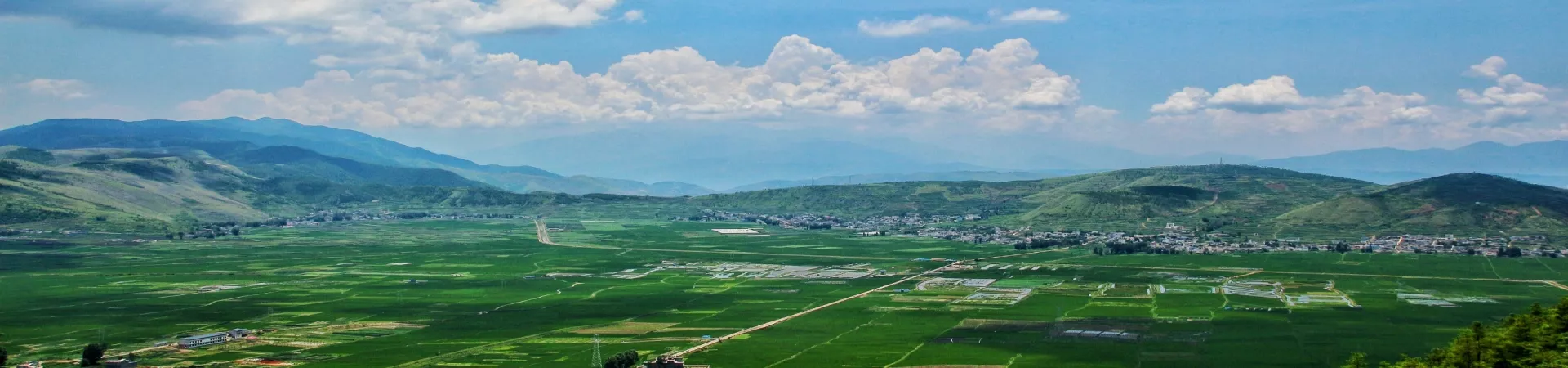
4.2. Harmony with Nature The village's charm is profoundly enhanced by its breathtaking natural setting. It is cradled by层层叠翠 (layer upon layer of emerald-green) mountains, creating a majestic, protective embrace around the historical settlement. The vibrant greenery of the surrounding hills contrasts beautifully with the weathered grays and browns of the ancient architecture. This harmonious blend of cultural heritage and natural beauty defines the essence of Baiwu. The landscape that once posed a challenge to copper-laden caravans now provides a serene and picturesque frame, reminding visitors that this hub of human endeavor was, and always has been, an integral part of the majestic Yunnan terrain.
A visit to Baiwu Village is therefore a multi-layered experience. It is a lesson in economic history, a study in vernacular architecture, and a retreat into a tranquil, scenic landscape. It stands as a powerful testament to a specific chapter of China's development, preserved not under glass, but in the enduring stone, wood, and spirit of a remarkable community.