Heyingqin Former Residence
Subtitle: Exploring the Former Residence of He Yingqin: A Journey Through History in Qianxinan
1. Introduction to the Site
Nestled within the rugged, picturesque landscapes of Qianxinan Buyei and Miao Autonomous Prefecture in Guizhou Province lies a significant historical and cultural landmark: the Former Residence of He Yingqin. This site offers a profound glimpse into the life of one of modern China's most prominent and complex military and political figures. He Yingqin (1890-1987) held pivotal roles throughout the Republican era, serving as the Minister of Military Administration, Chief of the General Staff of the Military Commission, Minister of National Defense, Commander-in-Chief of the Army, and ultimately, the Chairman of the Strategic Advisory Committee in the Taiwan "Presidential Office." His career spanned the Northern Expedition, the Second Sino-Japanese War, and the Chinese Civil War, making his legacy an integral, though debated, part of 20th-century Chinese history. Visiting his former homes is not merely an architectural tour but an immersion into the personal sphere of a man who helped shape a nation's destiny during its most turbulent decades.
2. The Two Residences: New and Old
The He Yingqin residence complex is uniquely divided into two separate sites, each with its own character and historical layer, located a short distance from each other near the town of Nidang.
2.1. The New Residence in Nidang Town
The more accessible and frequently visited of the two is the New Residence, situated within Nidang Town itself. This dwelling represents a later period in He Yingqin's life and status. The architecture is a refined example of Republican-era style, blending local Guizhou elements with more formal, institutional design cues reflective of its owner's high office.
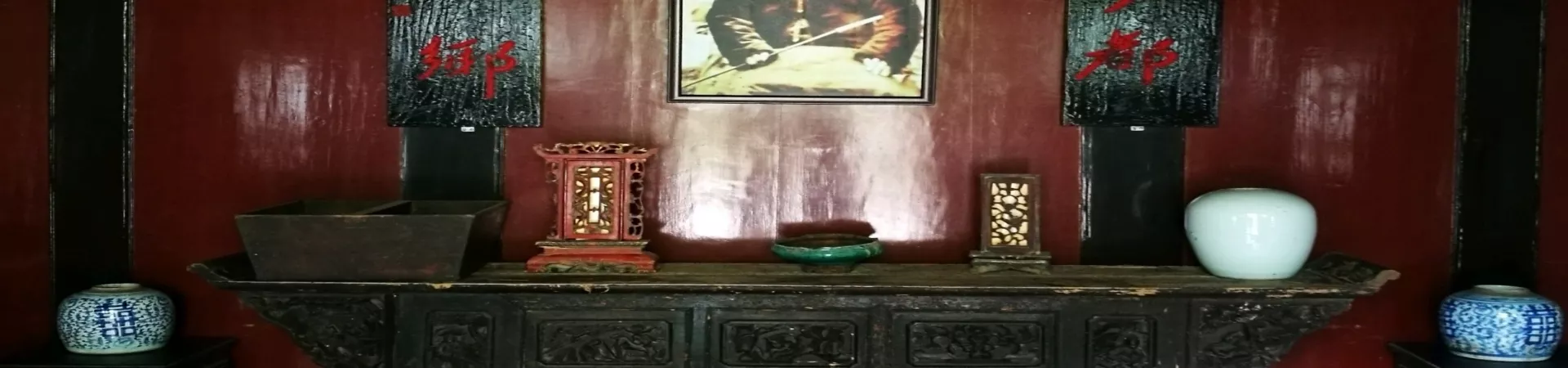
2.1.1. Interior Exhibitions and Collections Upon entering, visitors are greeted by a meticulously curated collection that brings He Yingqin's story to life. The residence has been converted into a compact yet informative museum, displaying a range of personal effects, historical photographs, official documents, and calligraphy pieces either owned or related to He Yingqin. These artifacts serve as tangible connections to key events, from military campaigns to diplomatic engagements. The photographic records are particularly valuable, capturing moments with other contemporary figures and offering a visual narrative of his public life. The calligraphy on display, often featuring aphorisms or personal mottos, provides insight into the philosophical and cultural mindset of the era's elite.
2.1.2. Visitor Services Immediately to the right of the main entrance is the residence management office. Here, visitors can arrange for the services of a knowledgeable guide. Opting for a guide (available for a fee) is highly recommended, as they provide essential context, narrate the stories behind the exhibits, and explain the historical significance of He Yingqin's multifaceted career, ensuring a much richer understanding than a self-guided tour.
2.2. The Old Residence at Fengbowan
Approximately three kilometers from Nidang Town, nestled in the hamlet of Fengbowan, lies the original family home—the Old Residence. This site offers a stark and evocative contrast to the New Residence. It is the birthplace and childhood home of He Yingqin, deeply rooted in the local landscape and tradition.
2.2.1. Architectural Significance and Setting The Old Residence is a magnificent example of traditional local vernacular architecture, built directly into the mountainside. Its design and location are steeped in the principles of Feng Shui. The house is said to be constructed on the precise point of a "hui long zhuan xiang" (回龙转向) formation—literally meaning "a returning dragon turning its direction." This refers to a specific, highly auspicious geographical configuration where a mountain ridge resembles a dragon coiling back upon itself. Building on the "dragon's head" was believed to harness potent earthly energies, promising prosperity and success for the household. The structure itself, with its wooden beams, grey tiles, and courtyards adapted to the slope, feels organic to its environment and speaks of a time before He Yingqin's national prominence.
2.2.2. Atmospheric Experience Visiting the Fengbowan residence is a step back in time. The atmosphere here is quieter, more reflective, and deeply connected to the rural origins of the He family. It allows visitors to contemplate the journey from this modest, geomancy-conscious village home to the halls of national power in Nanjing and beyond. The panoramic views of the surrounding karst hills and valleys from this location are breathtaking, adding a layer of natural beauty to the historical contemplation.
3. Practical Visitor Information
3.1. Recommended Itinerary For an optimal experience that follows both historical and narrative logic, it is suggested to visit the New Residence in Nidang Town first. This site provides the necessary biographical and historical framework through its exhibits. Afterwards, visitors can take a short trip (easily accessible by car or a pleasant walk for the keen hiker) to the Old Residence at Fengbowan. This sequence allows one to first understand the man's public achievements and then trace his roots back to his poignant ancestral home, creating a powerful narrative arc to the visit.
3.2. Transportation and Access * Public Transport: Travelers can reach the site from Xingyi City, the prefectural capital. From the Xingyi South Long-Distance Bus Station, take a regular bus bound for Nidang and disembark at the terminal station in Nidang Town, which is close to the New Residence. * Self-Driving: This is a highly convenient option for exploring both sites. Both the New Residence in town and the Old Residence in Fengbowan have dedicated parking areas, making it easy to drive between them at your own pace and enjoy the scenic countryside roads.
3.3. Admission and Hours * Admission Fee: Entrance to both residences is free of charge. * Guiding Fee: A separate fee of approximately 30 RMB is charged for the professional guiding service at the New Residence, which is a valuable investment for deeper insight. * Opening Hours: The sites are open daily from 9:00 AM to 5:00 PM. The last admission is at 4:30 PM. These hours apply throughout the year, with no closure on weekends, though it is always prudent to confirm ahead of travel on national holidays.
4. Historical and Cultural Context
A visit to the He Yingqin Former Residences is most meaningful when framed within the broader sweep of Chinese history. He Yingqin's life was a microcosm of the Republican period's hopes, conflicts, and fractures. As a senior commander during the War of Resistance against Japan, his role is part of a national narrative of survival and perseverance. His subsequent role in the Civil War and his move to Taiwan also reflect the deep divisions that shaped contemporary China. The residences, therefore, stand as neutral physical repositories of this history. They do not glorify but rather present a chapter, inviting visitors to engage with the complexities of the past. The juxtaposition of the two homes—one symbolizing lofty achievement and the other humble, culturally-rooted beginnings—powerfully illustrates the personal dimensions behind historical figures, reminding us that their stories often begin in quiet, unassuming places like the mountains of Qianxinan.