Bagua Tian
Subtitle: A Journey into the Heart of Guizhou's Karst Landscape
Introduction: The Allure of Qianxinan
Nestled in the southwestern reaches of Guizhou Province, China, the Qianxinan Buyi and Miao Autonomous Prefecture is a land where dramatic geology intertwines with rich ethnic culture. Among its many natural wonders, one formation stands out not just for its visual spectacle but for the fascinating agricultural ingenuity it showcases: the Bagua Tian, or Eight-Trigram Fields. This is not merely a scenic spot; it is a testament to human harmony with nature, a living landscape painting etched into the heart of the majestic Wanfenglin (Ten-Thousand Peak Forest).
1. The Stage: Wanfenglin (Ten-Thousand Peak Forest)
To understand the Bagua Tian, one must first appreciate its breathtaking setting. The area is part of the larger Wanfenglin, a globally renowned karst landscape often described as the "forest of peaks." Imagine a vast expanse, as far as the eye can see, of countless limestone hills rising abruptly from the flat valley floor. These peaks, varying in shape and size, create a surreal, undulating horizon that changes mood with the shifting light—misty and mysterious at dawn, sharply defined under the midday sun, and softly silhouetted at dusk. This spectacular natural canvas forms the perfect amphitheater for the human-made masterpiece at its core.
2. The Masterpiece: Bagua Tian (Eight-Trigram Fields)
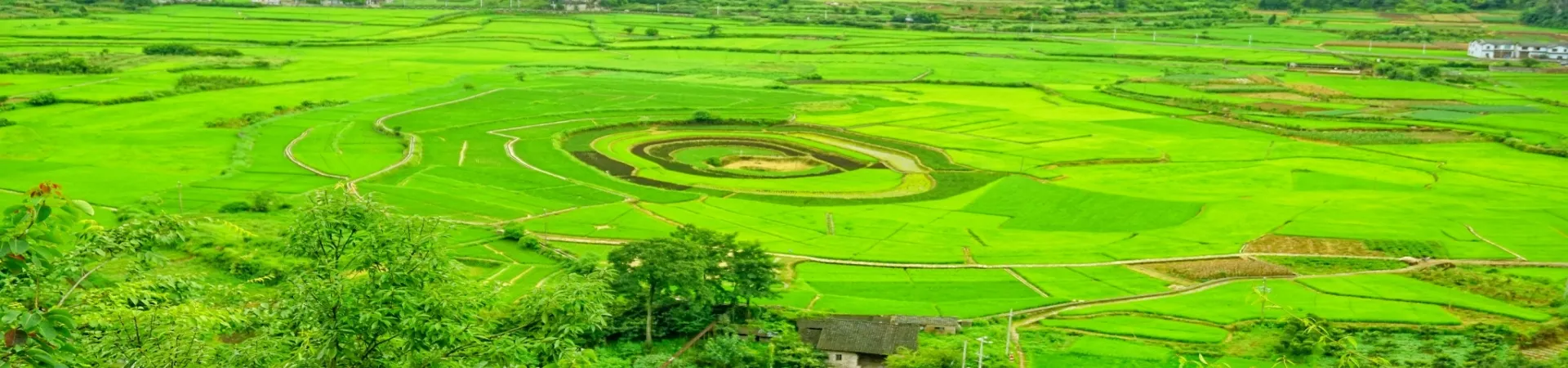
At the center of this valley, surrounded by the silent, watchful peaks, lies the Bagua Tian. This is the focal point of any visit. From a vantage point on the surrounding hills, the view is nothing short of mesmerizing. The fields are arranged in a stunning, concentric circular pattern that radiates outwards from a central water-filled depression, resembling the ancient Chinese Bagua (Eight Trigrams) symbol—a diagram representing fundamental principles of reality and cosmology.
2.1. A Symphony of Form and Function The design is profoundly intelligent. The central pool acts as a natural water source and drainage hub. The raised bunds separating the circular fields are carefully constructed to distribute water evenly to every plot. Each ring of fields is at a slightly different elevation, creating a natural irrigation system that has sustained local farmers for generations. During the planting season, the fields are filled with water, reflecting the sky and peaks like a giant, segmented mirror. As crops like rice and rapeseed grow, the circles transform into vibrant bands of green and, in spring, dazzling yellow, creating a stark and beautiful contrast against the grey-green karst peaks.
2.2. Cultural and Historical Significance This landscape is more than a pretty picture; it is a page from history and a chapter in cultural anthropology. The fields are primarily cultivated by the local Buyi and Miao ethnic communities. Their ancestral knowledge of hydrology and sustainable land use in this challenging karst environment is embodied in this design. The Bagua pattern itself is deeply symbolic, reflecting a traditional philosophy that seeks balance and harmony between heaven, earth, and humanity. Walking along the paths that skirt the fields, visitors witness this philosophy in action—a sustainable, centuries-old agricultural practice that has shaped and preserved the beauty of the land.
3. Practical Information for the Visit
A smooth journey enhances the experience of discovery. Here are the essential details for planning your trip to the Bagua Tian within the Wanfenglin Scenic Area.
3.1. Admission Fees The Wanfenglin Scenic Area, which includes access to the primary viewing platforms for the Bagua Tian, has a structured ticketing system. It is important to note that fees can differ based on the visitor's origin.
- For visitors from outside Guizhou Province: The ticket price is set at 70 RMB per person.
- For residents of Guizhou Province: There is often a discounted rate, but it is advisable to confirm the latest local pricing at the ticket office or via official channels prior to your visit.
- Additional Options: Scenic shuttle buses or sightseeing trams inside the area usually require a separate fee, which is highly recommended to cover the considerable distances between viewpoints.
3.2. Operating Hours The scenic area is open daily throughout the year. The operating hours are consistently from 08:30 to 17:30. It is advisable to arrive earlier in the day to allow ample time for exploration and to capture the best light for photography, particularly in the morning or late afternoon when the low sun accentuates the textures of the peaks and fields.
4. Enhancing the Experience
To truly immerse yourself in the magic of Bagua Tian, consider these suggestions. First, dedicate time to visit the nearby ethnic villages of the Buyi and Miao people, such as Xiawanzhuang or Buxiang. Here, you can see traditional stone houses, observe local crafts, and gain a deeper appreciation for the culture that maintains the fields. Second, for the most iconic panoramic view of the Bagua Tian, the main observation deck on the hillside is a must. However, exploring smaller paths can lead to quieter, equally compelling perspectives. Finally, timing your visit is key. While the fields are impressive year-round, they are most photogenic in late February to March when the rapeseed flowers bloom in a brilliant yellow, and again in late summer when the rice paddies are a lush green before the harvest.
The Bagua Tian of Qianxinan is a profound destination where nature's grandeur and human wisdom converge. It challenges the visitor to see beyond a simple panorama, inviting contemplation on sustainability, cultural heritage, and the timeless pursuit of living in balance with our environment. It is a landscape that remains vividly etched in memory long after the journey ends.