South Shaolin Temple Site
Subtitle: Unraveling the Legacy of Southern Shaolin: A Journey to Putian's Martial and Spiritual Heart
Introduction: A Monastery Shrouded in Mystery and Might
Nestled within the Jiulian Mountain range, near Linshan Village in Xitianwei Town, Putian, Fujian Province, lies an archaeological and cultural site of profound significance: the遗址 of the Southern Shaolin Temple. This hallowed ground, far more than mere ruins, represents a captivating chapter in Chinese history where profound spirituality converged with legendary martial arts prowess. While its official historical records present an intriguing puzzle, the site today stands as a powerful testament to a enduring legacy, meticulously reconstructed to inspire both pilgrims and seekers of ancient warrior traditions. A visit here is not just a tour of temples; it is an immersive step into a world where discipline, faith, and physical mastery were once inextricably woven into the fabric of daily monastic life.
The Historical Enigma: Linquan Court vs. Southern Shaolin
The Documentary Evidence and Scholarly Debate The core of the site's fascination lies in a historical discrepancy that continues to spark debate. Archaeological findings and local chronicles confirm the existence of a large monastery named Linquan Court (林泉院), founded as early as 557 AD during the Southern Chen Dynasty. By the Northern Song Dynasty, particularly around the Jiayou period (1056-1063 AD), this monastery had gained renown for its exceptionally strong "martial wind" (wufeng), evolving into a major center for martial arts training along China's southeastern coast. Its reputation for producing highly skilled warrior monks is a consistent thread in regional history.
The Legend and the Lingering Question However, the leap from "Linquan Court" to "Southern Shaolin Temple" is rooted more in powerful folk tradition and later historical inference than in contemporaneous stone inscriptions or official documents. The popular belief holds that following historical persecutions of the Shaolin order, monks from the famed Songshan Shaolin Temple in Henan fled south, establishing a new sanctuary here in Putian. This southern branch is said to have preserved and further developed Shaolin's unique martial arts philosophies. The absence of the specific characters for "Shaolin" (少林) in ancient records from the site itself remains the central point of contention for some historians. Yet, the overwhelming martial culture, architectural scale, and persistent oral histories have led many experts and the local community to firmly identify this as the legendary Southern Shaolin.
Exploring the Reconstructed Monastery Complex
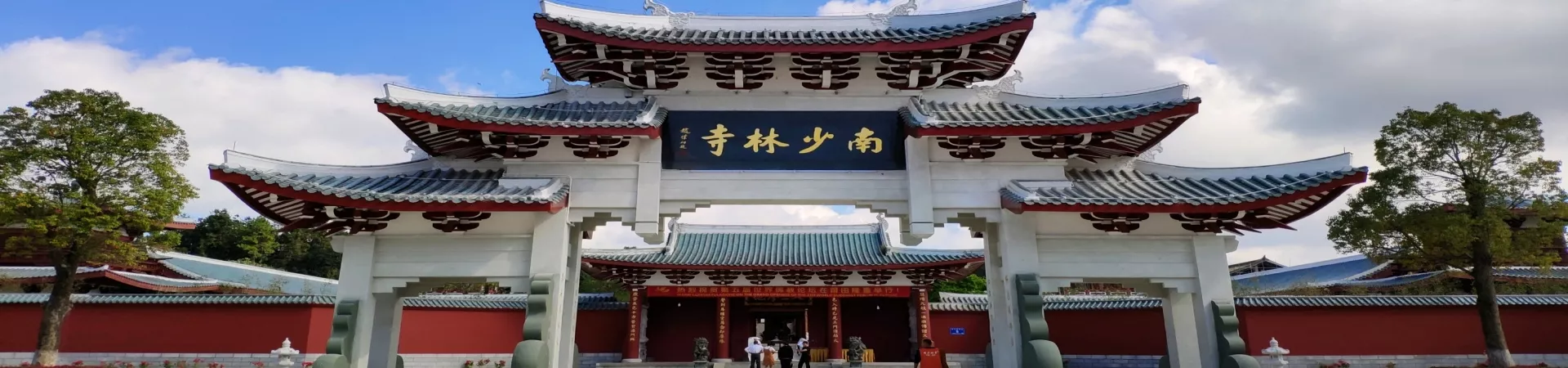
Architectural Grandeur and Spiritual Ambiance Regardless of the academic debate, the physical experience of the site is undeniably impressive. Since the late 20th century, significant reconstruction efforts have revived the temple complex to its former magnificence. Visitors approach through a majestic mountain gate (山门), passing under a towering memorial archway boldly inscribed with "Southern Shaolin," its calligraphy penned by the revered modern Buddhist master and calligrapher, Zhao Puchu. This gateway sets the tone for the splendor within.
The complex unfolds with classical symmetry and grandeur. The Hall of Heavenly Kings (天王殿) houses the iconic, smiling statue of Maitreya Buddha and the formidable Four Heavenly Kings, guardians of the monastic domain. The heart of the temple is the Great Buddha's Hall (大雄宝殿), an awe-inspiring structure with sweeping eaves, intricate woodwork, and a resplendent golden interior. Here, serene statues of the Buddhas preside over an atmosphere of deep tranquility. Flanking the central axis, the Bell and Drum Towers (钟鼓楼) stand sentinel, their ancient instruments once regulating the monks' rigorous daily schedule of meditation, study, and training.
The Extended Sacred Landscape: A Buddhist Sanctuary The Southern Shaolin Temple does not exist in isolation. It forms the nucleus of a vibrant monastic community. The surrounding hills are dotted with smaller but historically connected temples and hermitages, such as Guzhu Temple and Xiawu Court. This constellation of sacred sites recreates the expansive and dynamic atmosphere of a traditional "Ten Directions Forest" (shifang conglin), a large public monastery that was a hub for Buddhist learning and practice from all directions, further solidifying the area's status as a premier spiritual and cultural destination.
Practical Information for the Visit
Location and Access The Southern Shaolin Temple遗址 is situated approximately 15 kilometers northwest of downtown Putian City. It is most conveniently reached by taxi or a hired private car. Public bus services are available but may require transfers. The journey into the Jiulian Mountains offers scenic views of Fujian's lush countryside.
Visiting Details The temple is open to visitors daily from 6:00 AM to 6:00 PM, with last admission at 6:00 PM. It is advisable to allocate 1 to 3 hours for a thorough exploration of the main complex and its immediate surroundings. The site involves some walking on stone paths and steps, so comfortable footwear is recommended. The entrance fee is nominally priced at 10 RMB per person.
Engaging with the Legacy For those seeking a deeper connection, the temple grounds occasionally host martial arts demonstrations or provide contexts where the enduring philosophy of Chan (Zen) Buddhism integrated with physical discipline can be contemplated. The absence of definitive carved words from a thousand years ago ultimately becomes part of the site's mystique, inviting visitors to look beyond text and feel the legacy in the quiet courtyards, the sturdy architecture, and the enduring spirit of resilience and discipline that permeates the air. It is a place where history, legend, and cultural revival meet, offering a unique and powerful glimpse into China's rich martial and spiritual heritage.