Lingguang Temple
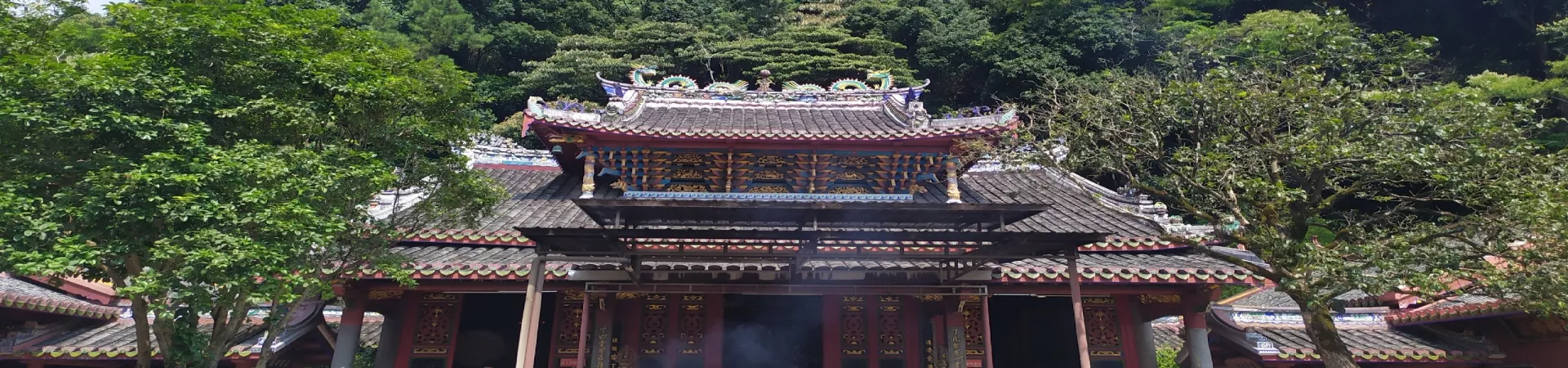
A Guide to Lingguang Temple: Unveiling the Mysteries of Meizhou's Ancient Sanctuary
Nestled at the foot of the majestic Yinna Mountain in YanYang Town, Meixian District, Lingguang Temple stands as a serene testament to centuries of faith, architectural ingenuity, and natural wonder. Officially recognized as a Provincial-Level Cultural Relics Protection Unit and a National 4A Tourist Attraction, this temple complex offers far more than a typical historical site; it presents visitors with a series of captivating enigmas that have endured for hundreds of years.
Historical Foundations: From Tang Dynasty Origins
The temple's story begins in the Tang Dynasty, founded in the second year of the Xiantong era (861 AD). It was originally named Shengshou Temple (Temple of Sacred Longevity). Its most significant transformation came during the Ming Dynasty, when it was substantially expanded in the 18th year of the Hongwu reign (1385 AD) and given the name it carries today—Lingguang Temple, which can be interpreted as the "Temple of Divine Light" or "Spiritual Radiance." This long history is palpably felt within its ancient walls.
Architectural Layout and Sacred Halls
The temple follows a traditional architectural plan, approximately three bays wide and seven bays deep. The complex is a harmonious collection of structures that facilitate worship, meditation, and communal life. Visitors pass through the mountain gate into a courtyard leading to the heart of the temple. Key buildings include: * The Grand Hall (Daxiong Baodian): The central sanctuary, housing sacred statues. * The Vajra Hall (Jingang Dian): Often dedicated to guardian figures. * The Arhat Hall (Luohan Dian): Featuring images of enlightened disciples. * The Bell and Drum Towers: Traditionally used to mark the time for ceremonies. * The Scripture Hall, Guest Hall, and Dining Hall (Zhai Tang): Spaces for study, hospitality, and communal meals.
The Legendary "Three Wonders of Lingguang"
While the architecture is impressive, Lingguang Temple is truly famed for its "Three Wonders," unique phenomena that defy simple explanation and form the core of its mystical reputation.
1. The Smoke-Extracting Caisson Ceiling The first wonder is a masterpiece of ancient environmental engineering. Within the Grand Hall, incense has burned ceaselessly for centuries. Yet, despite this perpetual offering, the hall's air remains remarkably clear, free from the expected dense smoke and soot. The secret lies overhead in an ingeniously designed spiral funnel ceiling, known as the "Eight-Algae Well" (Ba Zao Jing). This wooden structure acts as a natural extraction system, drawing the smoke upward and channeling it out of the building, leaving the prayer space below perpetually fresh. This ancient ventilation system showcases an advanced understanding of airflow long before modern technology.
2. The Leaf-Free Roof Amidst Ancient Trees The second wonder presents a striking visual paradox. The temple roofs are surrounded by towering, lush ancient trees, their branches spreading widely. Logically, one would expect the roof tiles to be perpetually covered in fallen leaves, especially during autumn. Astonishingly, the roofs remain completely clear of leaves year-round. No sweeping or cleaning is needed to achieve this. The reason behind this phenomenon remains a topic of local legend and scientific curiosity, with theories ranging from unique wind currents created by the temple's structure to the specific placement of the buildings.
3. The Twin Cypresses of Life and Death Perhaps the most iconic and philosophically profound wonder stands right before the main temple gate. Here, two ancient cypress trees have grown side-by-side for over a thousand years. Their fate, however, diverged dramatically centuries ago. One tree thrives, lush and vibrantly alive, with dense, green foliage. Its twin stands equally tall but is completely bare and desiccated, having died over 300 years ago. The incredible fact is that the dead tree has not rotted or fallen; it stands erect, preserved in its skeletal state, mirroring the living tree in size and posture. This pair, known as the "Tree of Life and Death," symbolizes the eternal cycle of existence and serves as a powerful, natural monument to the temple's enduring spirit.
Visitor Information
- Location: YanYang Town, Meixian District, at the base of Yinna Mountain.
- Opening Hours: 08:00 - 17:00 daily, year-round.
- Admission: Free of charge.
- Contact: +86 753 2831805
A visit to Lingguang Temple is thus a journey into a living puzzle. It is a place where history is not merely recorded in stone and wood but is actively perpetuated through enduring mysteries. It invites contemplation on the intersection of human devotion, architectural wisdom, and the enduring, inexplicable rhythms of the natural world.